
Understanding the concept of even and odd numbers is a foundational math skill that can be taught effectively through diverse strategies tailored to various learning styles and intelligences. By incorporating activities that engage linguistic, logical-mathematical, spatial, bodily-kinesthetic, musical, interpersonal, intrapersonal, and naturalistic intelligences, educators can create dynamic lessons that resonate with every student. This comprehensive approach not only enhances comprehension but also fosters a love for learning through interactive games and activities.
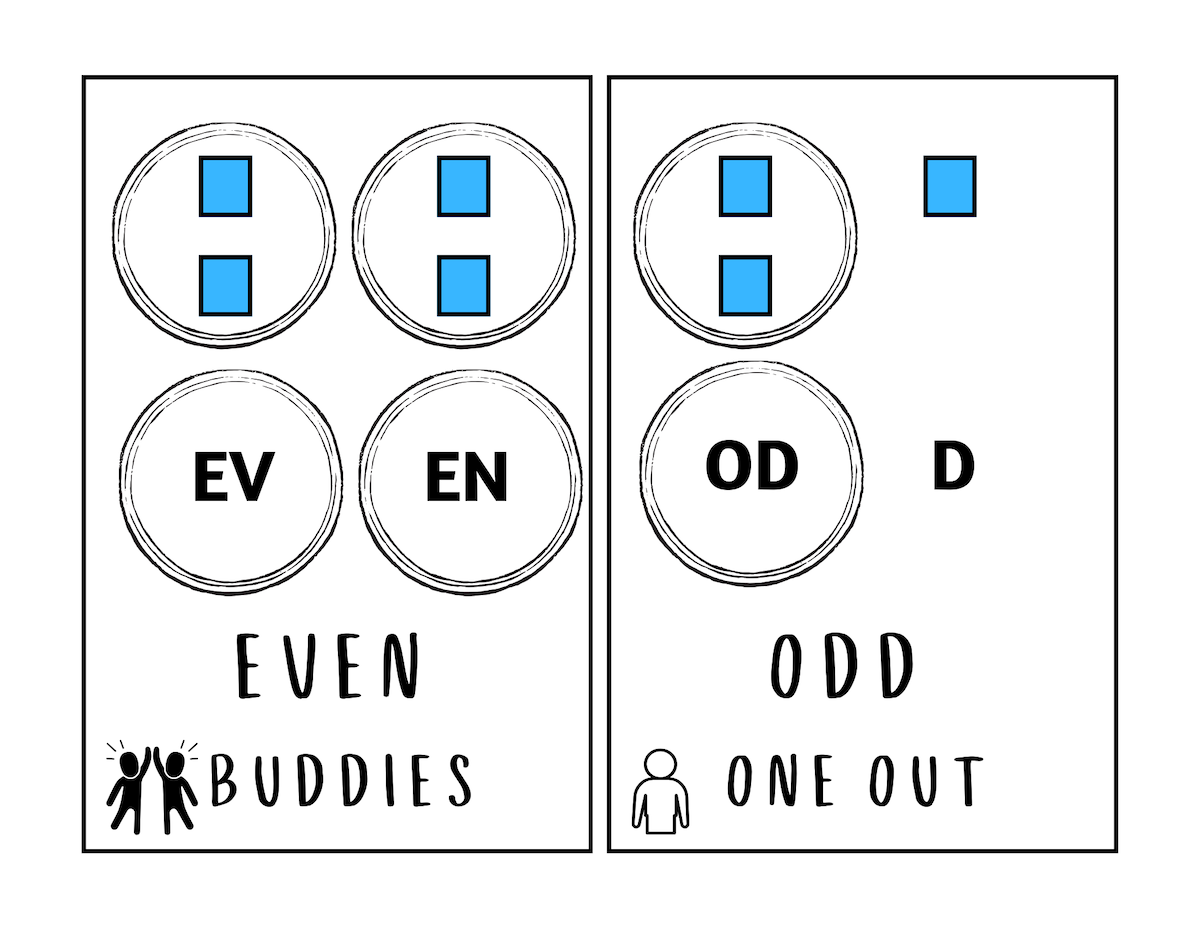
The buddy system is my favorite method for teaching even and odd numbers because it actively engages students and makes abstract concepts more tangible. When kids use the buddy system, they can physically see and feel the difference between even and odd numbers, which enhances their understanding.
To implement the buddy system, start by explaining to the students that every number loves to have a buddy. Even numbers are happy because they can always find a buddy to pair up with, while odd numbers feel a bit left out because there’s always one number without a buddy.
Have the children stand in a line or circle and hold up different numbers of fingers. Ask them to pair up their fingers, or even pair up with a classmate when using larger numbers. If everyone has a buddy, the number is even. If there’s one finger or person left without a pair, the number is odd.
Encourage the kids to discuss what they observe. They can say things like, “I see all fingers have buddies, so 4 is even,” or “There’s one finger without a buddy, so 5 is odd.” This interactive approach helps solidify the concept of even and odd numbers in a memorable and fun way.
Multiple Ways per Each Multiple Intelligence to Teach the Concept of Even and Odd Numbers to Make it Stick
Linguistic Intelligence (Word Smart)
- Odd and Even Characters: Create characters named “Even Eddie” and “Odd Ollie.” Share stories where Even Eddie loves things in pairs, while Odd Ollie prefers having just one of each.
- Storytelling: Create a story about two kingdoms: Evenland and Oddville. Each kingdom has rules about how many items their citizens can have. In Evenland, everything comes in pairs—two shoes, four chairs, six apples—while Oddville loves unique, uneven counts—three hats, five spoons, seven balloons. Students can illustrate scenes from each kingdom, reinforcing the concept through narrative.
- Odd and Even Word Relay: Write sentences on the board. Students take turns circling words with an even number of letters in blue and odd in red. For example, in the sentence “The cat ran fast,” “The” (3 letters) is odd, “cat” (3) is odd, “ran” (3) is odd, and “fast” (4) is even.
- “Even-Odd Story Chain”: Sit students in a circle. Start a story with a sentence containing an even number (e.g., “There were 4 cats on the roof…”). The next student continues the story with a sentence containing an odd number. Alternate even and odd numbers as the story grows.
Books:
- Missing Mittens – Stuart J. Murphy
- Even Steven and Odd Todd – Kathryn Cristaldi
- Splitting the Herd – Trudy Harris
- If You Were an Even Number – Marcie Aboff
- If You Were an Odd Number – Marcie Aboff
- One Odd Day – Doris Fisher
- My Even Day – Doris Fisher
Logical-Mathematical Intelligence (Number/Reasoning Smart)
- Pattern Recognition: Students sort the cards into even and odd piles, explaining that even numbers can be divided into two equal groups without leftovers. Reinforce with concrete examples like 8 apples split evenly versus 9 apples leaving one leftover.
- Game: Even-Odd Bingo – Create bingo cards with random numbers. Call out numbers, and students cover them if they match the called category (even or odd). For example, call out “Odd number greater than 10,” and students mark 11, 13, 15, etc.
- “Even-Odd Sort Race”: Get a set of number cards (1-100). Divide students into two teams. Place a pile of mixed number cards in the center. On “Go,” one member from each team races to pick a card and place it in the correct “Even” or “Odd” basket. Continue until all cards are sorted. The team with the most correct placements wins.
- Odd-One-Out: Present groups of numbers with one odd or even number. Students identify the outlier.
- Number Guess and Parity Clue: Guess a hidden number using parity as a clue.
Visual-Spatial Intelligence (Picture Smart)
- Buddy System (Favorite Method): Numbers that can be paired with a “buddy” are even. If one is left without a buddy, it’s odd. Give students a set of items. Have them create pairs. If all items are paired, it’s even; if one remains unpaired, it’s odd. Identify if anyone is left out.
- Color-Coding Patterns: Use color markers or crayons. Have students color even numbers one color and odd numbers another. Patterns emerge, reinforcing recognition.
- Visual Representation: Draw arrays of dots to show even and odd numbers. For even numbers like 6, dots can pair up evenly (•• •• ••). For 7, there’s an extra dot without a pair. Students can also use colored markers to highlight pairs.
- Odd-Even Art Collage: Have students cut out shapes from colored paper. They’ll glue an even number of shapes on one side of the poster and odd numbers on the other, creating a colorful visual representation of the concept.
- “Even-Odd Art Collage”: Students cut out images of items grouped in visible quantities (e.g., 5 apples). They create a collage with two sections: “Even” and “Odd.” Glue items in the correct section and label them accurately.
- Parity Match-Up: Match cards with numbers to “even” or “odd” labeled cards.
- Color Code Numbers: Color code even numbers one color, odd another on worksheets.
- Place a handful of beads on the table. Count them and determine if the quantity is even or odd. Add another handful of beads to the table and identify if it is even or odd. Then, combine both sets and determine if their total is even or odd. Repeat this process.
- Create an Even/Odd Column on a whiteboard. Arrange various objects grouped together in their respective spots. For a twist, write numbers on tiles, place them in water, scoop out a tile, and sort it into the even/odd bowl.
- Prepare two jars or bowls that say “odd” and “even.” Create around 10 paper strips. Roll two dice to generate a two-digit number and write the number on a strip. Place the strip in the odd or even bowl or jar. Alternatively, arrange the strips by linking odd-numbered strips with even-numbered strips.
Hands On:
- Manipulatives:
- Duplo/Lego
- Base ten blocks (tangible, picture, or draw square, line, dots..)
- 100, 10’ s, 1’ s coins
- Number Line
- Monopoly money/ Fake Money / coins
- Number Bond
- Cards – playing cards or uno
- Dominoes
- Number tiles (like scrabble tiles)
- Beads (like Montessori but make your own)
- Tens Frame
- Hundreds Chart
- Ruler / Measuring Tape
- Beads/Beans … etc
Bodily-Kinesthetic Intelligence (Body Smart)
- Use beanbags to form groups. Students physically arrange themselves into pairs with beanbags. If there’s a leftover beanbag, the total is odd; if not, it’s even.
- Even & Odd Hopscotch: Even & Odd Hopscotch – Create a hopscotch grid labeled with numbers 1–20 or random numbers. Students hop on even numbers with both feet and on odd numbers with one foot. This kinesthetic activity reinforces number recognition and classification.
- “Hopscotch Even-Odd”: Draw a hopscotch board with numbers up to 20. Students take turns tossing a small object onto the board. They hop to the number, saying “even” or “odd” aloud. Correct answers earn points; incorrect answers lose a turn.
- Number Line Hop: Draw a number line on the floor. Students hop on even numbers with both feet (showing balance/paired), and hop on odd numbers with one foot (unbalanced/single).
- Number Line Jump: Jump forward on a large number line, calling out each number’s parity.
- Use a number line (create one using a ladder and chalk outdoors or use pieces of paper with numbers in a row). Step only on the even or odd numbers.
- Draw two circles on the ground, one for odd and one for even numbers. Jump into the circle that matches the number you call out.
- Hide a number and have someone locate it. Once found, determine whether the number is even or odd.
- Building with Blocks: Stack blocks in pairs. If every block has a partner, it’s even. If there’s a block without a matching buddy, it’s odd.
- “Odd or Even Toss”: Toss a handful of small objects, count them, and decide if the total is odd or even.
- Number Toss: Toss a beanbag onto a number grid and state if it’s even or odd.
- Parity Puzzle Pieces: Puzzle pieces fit together only if matched with numbers of opposite parity.
- Even-Odd Treasure Hunt: Hide numbers around the room. Students collect based on parity clues.
- Parity Relay Race: Teams run to a pile, grab a number, and sort into even or odd bins.
- Ball Toss Parity Call: Toss a ball; catcher calls out the parity of the number shouted by the thrower.
- Math Jenga: Write numbers on Jenga blocks. State parity when pulling a block.
Musical Intelligence (Music Smart)
- Rhythmic Learning: Clap or drum patterns representing even beats (steady pairs) and odd beats (a lone beat at the end).
- Odd-Even Song: Create a simple chant or rap: “2, 4, 6, 8, even numbers sure are great! 1, 3, 5, 7, 9, odd numbers are also fine!” Students perform with claps or instruments.
- “Musical Pairs”: Like musical chairs, but students must find a partner quickly. When someone is left out, it illustrates an odd number.
- “Even-Odd Clap and Stomp”: Teacher calls out numbers between 1 and 20. Students clap for even numbers and stomp for odd numbers. Increase speed for added challenge.
- Odd-Even Song and Dance: Create a song with actions for even and odd numbers.
- Musical Numbers: Dance around until the music stops, then call out a number and jump that many times from side to side (left/right). Finally, determine if the number is even or odd.
- YouTube: Numberock :Even and Odd Numbers, Jack Hartmann: Count by 2’s, Jack Hartmann: Count by 2’s from, Jack Hartmann: Count by Odd, Mr, R’s Songs Even Number, Scratch Garden: Counting Odd, Numberblocks: Odd Side Story, Smile and Learn: Even & Odd, Homeschool Pop: Even and Odd
Interpersonal Intelligence (People Smart)
- In pairs, students receive number cards. They collaboratively decide if each number is even or odd, explaining their reasoning to each other. Odd and Even Charades: Students act out scenarios representing even or odd items. For example, miming a bicycle (2 wheels, even) versus a tricycle (3 wheels, odd), while classmates guess.
- Even-Odd Sorting Race: Provide number cards. Students race to sort them into “even” and “odd” piles.
- Odd or Even Dice Roll: Roll a die, declare if the number is odd or even. Add a second die for more complexity.
- Even-Odd Bingo: Bingo cards with mixed numbers. Call out “even” or “odd”; students mark accordingly.
- Parity Flashcards: Show flashcards quickly; students shout “even” or “odd.”
- Parity Tic-Tac-Toe: Standard grid, but players can only mark even or odd numbers based on their role.
- Rummikub: Create sequences of odd or even numbers using tiles.
- Uno: Play cards that are either odd or even in sequence.
- Dominoes: Arrange the total on domino tiles into odd or even numbers.
- Go Fish: Request cards that are either even or odd.
- Alternate counting by even and odd numbers, for example: you say 1, they say 3, you say 5, and so on.
- “Race to __”: where you choose a number to count to (e.g., 20) by odd or even numbers, with each person only able to say 1-2 numbers at a time. The winner is the one who says the target number (20).
Intrapersonal Intelligence (Self Smart)
- Journaling: Students journal about how they encounter even and odd numbers in daily life—like counting steps, coins, or utensils.
- Personal Number Journal: Over a week, students track numbers they see (like house numbers, license plates), noting whether they’re even or odd, and reflecting on any patterns they observe.
- Number Puzzles Connect the Dots – Even and Odd. Take all the even or odd numbers and scatter them across the paper. Then, connect each number with a line to its consecutive even or odd counterpart.
- Parity Memory Game: Match cards with the same parity.
- APPS: IXL,Khan Academy Kids, Khan Academy, MathSeeds (on ReadingEggs), NCTM APP: Number Chart, Number Line, Number Pieces
- Online Games: Mathplayground: Math Hop, Mathplayground: Color in all the odd or even numbers on the number chart, Word Wall: Odd and Even
Naturalistic Intelligence (Nature Smart)
- Go on a nature walk. Students collect items like leaves, rocks, or sticks, then count and group them to identify if their collections are even or odd.
- Nature Number Hunt: Students pair up, find sets of natural objects, and classify them as even or odd based on how many they collected. They share findings with the class, relating them back to the concept.
- Use popsicle sticks or twigs from outdoors as tally marks. Count items like flowers, cars, etc., and determine if the quantity is even or odd.
- Count everything around you, including outdoor items and toys. Write numbers in sand or dirt, or gather the corresponding number of leaves or sticks. Determine if the total count is even or odd.
Adjustments:
- Simplify the games for younger learners by using numbers up to 10 or make it harder by using larger numbers.
- Add scoring systems to each game to encourage friendly competition.
- Modify the games for group activities or independent practice.
By embracing multiple intelligences and learning styles, educators can create engaging and effective lessons that make the concept of even and odd numbers accessible to all students. Diverse activities such as storytelling, movement games, rhythmic exercises, and nature-based explorations provide opportunities for students to connect with mathematical concepts in meaningful ways. This holistic approach not only reinforces understanding but also cultivates a positive and inclusive learning environment where every student has the chance to succeed.
Get Your Even and Odd Packet:
Even & Odd
Over 70 Pages of Games and Activities Already Made Up

@engagethestages