
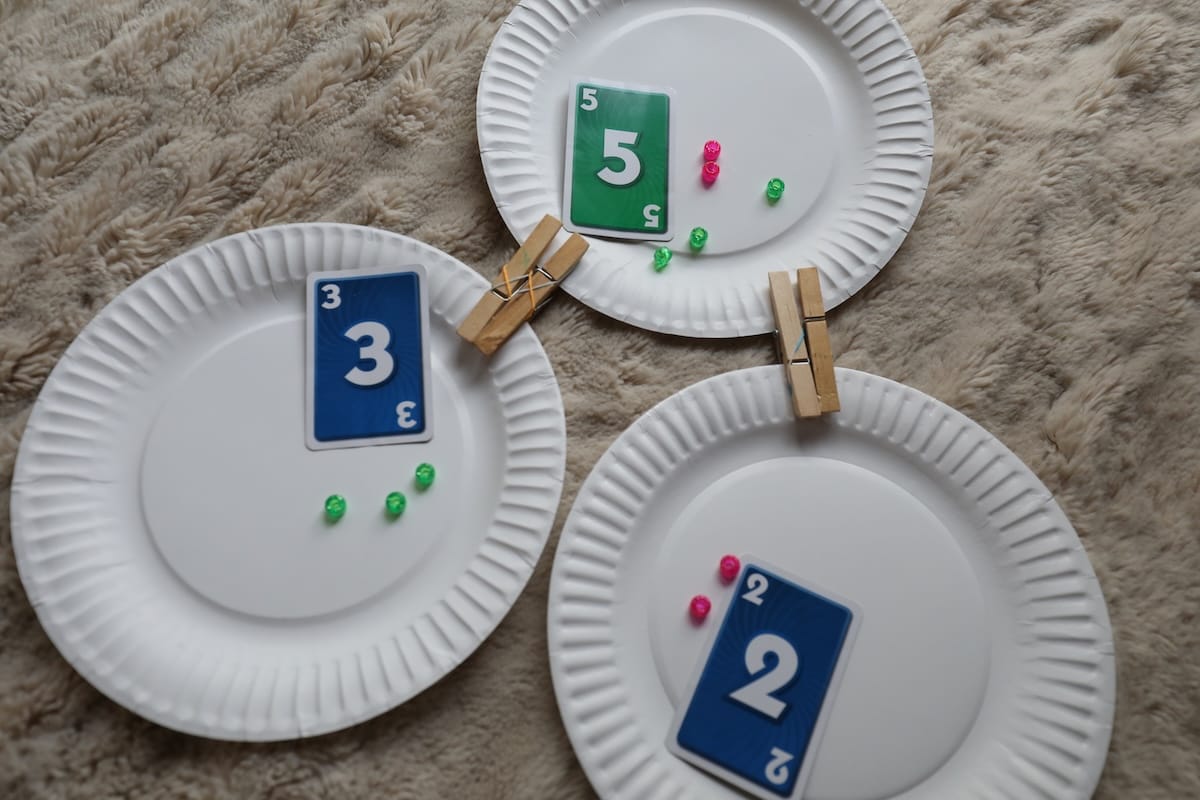

My daughters were having difficulty visually grasping the concept of number bonds, especially when the number bond was turned around. To help them, we used three paper plates and paper clips to attach two of the plates to the main one, as we didn’t have popsicle sticks to tape onto the plates.


First, we utilized beads of two different colors for a visual representation. We placed green beads on one part and pink beads on the other. Then, we combined (dumped) them into the “whole” plate to see their total. For instance, combining 3 pink and 2 green resulted in 5. We repeated this with various examples to reinforce their understanding. Next, we reversed the setup, placing 2 green and 3 pink in the whole plate while leaving one “part” plate empty and filling the other with 3 pink beads, prompting them to identify what was missing. They quickly grasped this concept, so we simplified it to just one bead color. For example, with 6 pink beads in the whole and 2 in one “part” plate, they determined there were 4 missing in the other “part” plate.
Second, we then introduced number cards alongside the beads, mixing in missing numbers. Eventually, we focused solely on using card numbers on the plates. We either placed numbers and beads in the part plates to find the whole plate number or put one number in the whole plate and another in a part plate. One of my favorite activities involved taking two cards, like 5 and 3, and placing them on the “part” plates, asking what the “whole” plate would amount to. Then, I would move the 5 to the “whole” plate and leave the 3 on a “part” plate, asking what the other “part” plate would be. This approach encouraged them to think critically and recognize the differences.
We also rotated the number bond, sometimes placing the whole number plate on top, at the bottom, or on the side. The plates allowed for easy manipulation, turning it into a fun, hands-on game for them.


Third, we transitioned to drawing circles on a whiteboard and using cards or writing our own numbers with whiteboard markers. We also created random number bonds on paper for them to solve.
GAMES: We also turned the number bonds into a fun game to see who could solve the problem correctly first, or how quickly they could determine the missing number. Players had to either find the missing part or the missing whole number. Additionally, we introduced a target number, which was written in the whole number spot. Participants would flip cards and then find the other missing number that would equal the target. For instance, if the target number is 10 and you write that in the whole number spot, and then you flip a card and reveal a 6, you must quickly respond that the missing part would be 4.
My twin daughters truly enjoyed this hands-on approach, which helped solidify their understanding of the concept.
This method proved to be a creative and engaging way to teach number bonds, turning what initially seemed like a challenging concept into an enjoyable learning experience. The tactile nature of using paper plates and beads, combined with the visual aid of number cards, allowed my daughters to interact with numbers in a playful manner. This interactive strategy not only improved their mathematical skills but also boosted their confidence in solving problems independently.
As they grew more comfortable with number bonds, we incorporated storytelling into our sessions. We would create simple stories involving characters or objects that needed to be divided or combined, using the number bonds as the underlying math problem. This narrative approach made the learning process even more relatable and fun, as they could see the practical application of number bonds in everyday scenarios.
Additionally, we explored digital resources, such as educational apps and online games, that reinforced the concept through animated exercises and interactive challenges. These digital tools offered a modern twist to our traditional methods, keeping my daughters engaged and eager to learn more.
Overall, this journey of teaching number bonds through various techniques not only enhanced their mathematical understanding but also nurtured their curiosity and love for learning. As a parent, witnessing their progress and enthusiasm was incredibly rewarding, reminding me of the importance of adapting teaching methods to suit individual learning styles and needs.
To create a number bond using plates, beads, and cards, follow these steps:
Materials Needed:
- Three plates (these will represent the two parts of the number bond)
- Two popsicle sticks to connect the plates
- A set of beads with two different colors (these will represent the quantities)
- Deck of cards
- Choose a Number: Decide on a total number you want to work with. For example, let’s say the total is 10.
- Distribute the Beads: On one plate, place a certain number of beads (for example, 4). On the second plate, place the remaining beads to make up the total (in this case, 6).
- Create the Number Bond: Show how the two plates together represent the total. You can write on the card: “4 + 6 = 10” to illustrate the number bond.
- Explore Different Combinations: Change the number of beads on each plate to discover different combinations that still add up to 10. For example, you could try 3 beads on one plate and 7 on the other, writing “3 + 7 = 10” on the card.
- Visual Representation: Use the plates to visually demonstrate how the parts (beads) combine to make the whole (total), reinforcing the concept of number bonds.
Number Bond Games:
- Exploring Basic Number Bonds: Start with small numbers, such as 1 to 10. Ask students to create all possible pairs that add up to a specific number. For example, for the number 7, the pairs would be (0,7), (1,6), (2,5), (3,4), and (4,3).
- Number Bond Charts: Create a number bond chart that visually represents the relationships between numbers. Students can fill in the bonds for numbers up to 20, allowing them to see patterns in addition and subtraction.
- Story Problems: Encourage students to create their own story problems based on number bonds. For example, “If I have 5 apples and give away 2, how many do I have left?” This helps them connect the concept to real-life situations.
- Number Bond Bingo: Create bingo cards with sums and call out numbers. Students must find the corresponding number bonds that make up the sums on their cards. (Create bingo cards with different number bonds (e.g., 2 and 3 for 5). Call out a total (e.g., 5) and players cover the corresponding number bonds on their cards.)
- Number Bond Match-Up: Create cards with number bonds on one set and their corresponding totals on another. Players must match the number bonds to their totals within a time limit.
- Number Bond Race: Set up a relay race where teams must solve number bonds before passing the baton. Each teammate must correctly answer a number bond before moving on.
- Memory Game: Create pairs of cards with number bonds and their totals. Players take turns flipping cards to find matching pairs.