

Spark Joy with Every Page: Reading Fun for Little Ones!
While some children naturally enjoy reading, others may not share the same enthusiasm. By exploring various books and reading methods, you can ignite their curiosity and foster a lifelong love for reading. Start incorporating reading into your daily routine from the beginning, especially focusing on books about animals, as they are a favorite at this age.
8 Ways to Engage Babies During Reading Sessions:
Initially, engage by pointing, talking, or singing. As they grow older and can point, encourage them to interact by pointing to objects, verbalizing words, singing along, or matching objects on the page with their toys for a more interactive experience.
1. SINGING

Singing to Make Reading Enjoyable
Some books at this stage may be limited to just pictures with a few words. It’s a picture and maybe some words. To enhance engagement, we enjoy incorporating songs that relate to the objects or themes in the book. For instance, if a page features stars, we might point to them and sing “Twinkle, Twinkle Little Star.” Many babies enjoy singing, so it becomes singing time with visuals. When a book showcases various animals, we sing “Old McDonald” and continue singing as we turn the pages, matching the lyrics to the pictures. For example. you turn the page and there’s a cow – “Old McDonald had a farm A, E, I, O, U and on that farm he had a COW – with a MOO, MOO here and a MOO, MOO there… everywhere a MOO MOO, Old McDonald had a farm…” turn the page and there’s a pig, “and on that farm he had a PIG… with an OINK, OINK, here…” (Oh yeah, I changed E-I-E-I-O to the vowels so maybe hearing the vowels will stick later on in life. And would shorten the song in parts to keep the book flowing. Change the lyrics of songs to match the pictures in the book. This practice not only broadens their vocabulary but also reinforces the connection between words, images, and songs.
While exploring ABC books, we sing the phonics song, associating each letter with an object on the page. For example, “A is for Apple (or whatever object is on the page) Ah-Ah-AAAAple, Ah Ah AAAAPPLE A apple” and repeat for each letter and picture in the book. Afterward, we go through the book, pointing to the letters while singing the ABC song, “A, B, C, D… Z now we know our ABC’s next time won’t you sing with me.” Or I point to the letter and have them tell me the name and sound. Children eventually enjoy singing the book themselves while pointing at the letters.
For color books, we incorporate the color song: “Red, Orange, Yellow, Green, Blue, Purple…”
Additionally, there are interactive books with buttons that play songs, lullabies, nursery rhymes, or sounds of objects. If introducing a second language, there are books with songs in the target language accompanied by corresponding pictures. They can play the song and nursery rhyme. For instance, in “BAO BAO Learns Chinese,” nursery rhymes are sung with matching images and words provided for pronunciation.
2. SOUNDS

Making Sounds the Animal Makes to Make Reading More Enjoyable
Replicate the sounds the objects make in the book. For instance, the dog says, “Woof.” Children enjoy imitating sounds and identifying the source of each sound. Ask them to point to the animal or thing that makes that sound.This activity aids in teaching them the sounds associated with different animals or objects. Some books include sounds, and children delight in hearing the actual noise made by a penguin.
3. COUNTING

Counting Objects to Make Reading More Enjoyable
When reading a book, we enjoy counting various objects like balls, birds, or any other items depicted on the page. We would carefully count everything we could find on each page and ask which items have more or less. For example, if there are stars, we would count how many stars there are by pointing to each one. Then, we would compare, noticing that there are 5 stars and only 1 moon, concluding that there are more stars. We would also count all the bears, hearts, bikes, and other objects.
When reading their 1-2-3 books, we would point to the number, say its name, and count the objects on the page.
Here are some activities we would do:
- 123: Say the number, trace it, and count all the objects on the page. Ask them to identify the number and count along with them by having them say the number first and then mimicking them after. Encourage them to count and say each number. When there are two different numbers on the page, ask which number is larger or which set of pictures has more. Prompt them to identify the largest and smallest numbers.
- Maisy’s bus: Ask them to identify the number, say it out loud, and then read the page.
- Prompt them to predict which number comes next on the following page.
- Utilize side-by-side pages and count all the pictures together. For instance, if there are 3 and 4 displayed side by side, count all the objects on the page with 3 and then on the page with 4. Then, ask how many objects are there in total. Encourage them to add the numbers together, such as 3 + 4 = what, and count all the objects as a sum.
4. Comparing

Comparing Objects to Make Reading More Enjoyable
Compare the sizes of things. Discuss what is larger, what is longer, and so on. Explore different elements in your reading material and compare the images on each page. Identify the largest and smallest stars. Encourage discussions on which item is the biggest, smallest, longest, shortest, and so forth.
5. Shapes

Identifying Shapes to Make Reading More Enjoyable
Identify out all the shapes you can find in the photo. Name the shapes, count their sides, and describe their characteristics.
6. Colors

Pointing Out the Colors to Make Reading More Enjoyable
I point out all the colors and say the name. Ask what color shirt the person has on, or if they can find a color on the page, or if they can find a toy that is the same color. When introducing a COLOR BOOK, accompany it with the COLOR SONG, singing “Red, Orange, Yellow, Green, Blue, Purple… That’s the color of the rainbow” while pointing to the colors in the book. Point to the colors as you’re singing the song.
7. Matching

Matching Objects to Their Toys to Make Reading More Enjoyable
Match the objects in their book to toys in the room by engaging in interactive activities. Here are some ideas to make learning fun:
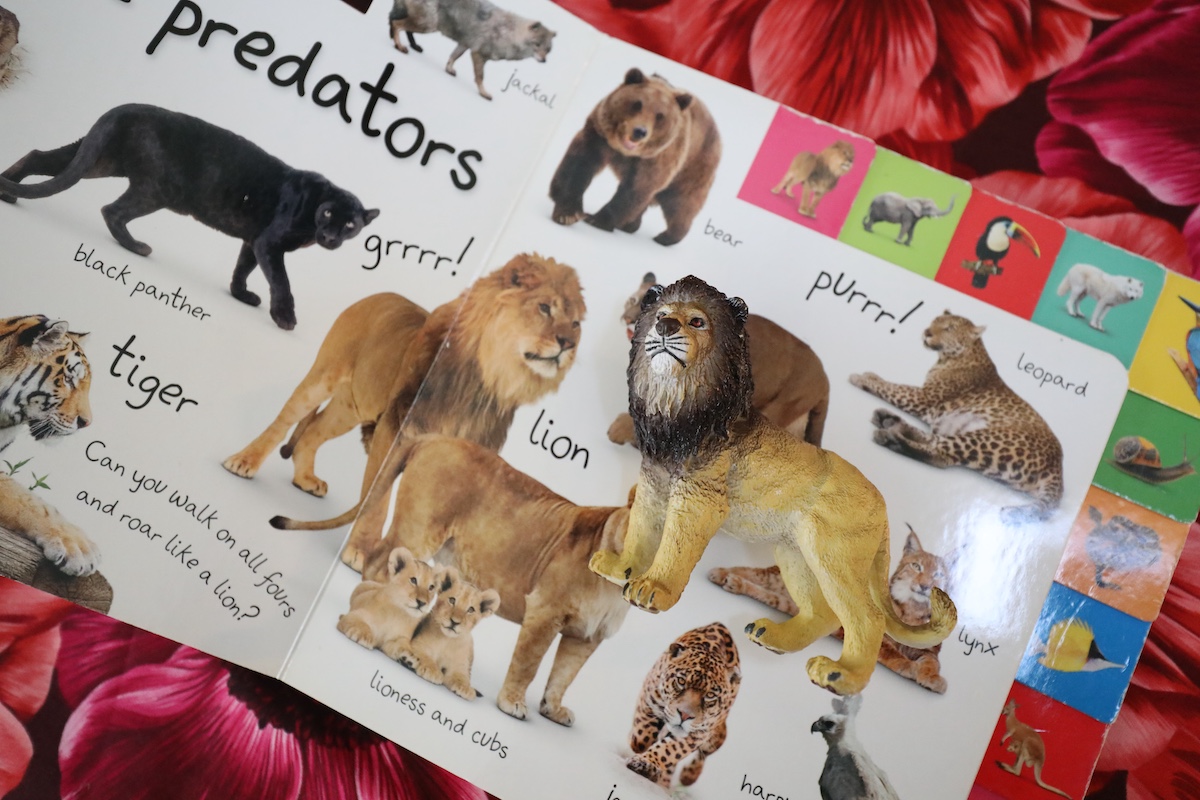
- Place a pile of animals next to the book and ask where the giraffe is. Have them find the toy and match it to the book.
- Hold up the giraffe toy and ask them to locate it in the book.
- Encourage them to search their animal bin for a giraffe or pick out the giraffe when named.
- Prompt them to match the toy to the animal depicted in the book.
- This interactive approach often leads to them locating and pairing the correct items. Many times they will see an animal in a book and run to their animals and get it and match it.
8. Real World Examples

Connect to Real World Examples to Make Reading More Enjoyable
If we are reading a book about cows, consider visiting a farm afterward to observe real cows and see how big they are in real life. You could even bring the book along for a side-by-side comparison.
For a more immersive experience, when they’re older, search YouTube for videos related to what they’re reading. For example, if the book is about whales, watching a whale clip on YouTube can bring the topic to life. Similarly, if the reading is about the glowworm caves in New Zealand, watching a YouTube video about them can enhance their understanding. Utilize YouTube for an engaging experience, especially when it comes to songs; let YouTube play the song for them.


Book to Show Different Words for a Letter, Trace the Letter, and Sing While Reading:
This book is a great way to introduce children to different words for a letter. . While reading the book, I sing it to my child phonetically. We also sing the Alphabet song and flip and point to each letter while singing it. This book is available in colored (for a more realistic visual of the word) as well as black and white (so the child can color in the pictures).
Achievement-Focused ABC BOOK
ABC Book in Color and Black & White
A-Z with 6 pictures on each page

@Engagethestages
ABC BOOK IN BLACK AND WHITE:

@Engagethestages
Achievement-Focused ABC BOOK
ABC Book in Black & White
A-Z with 6 pictures on each page