
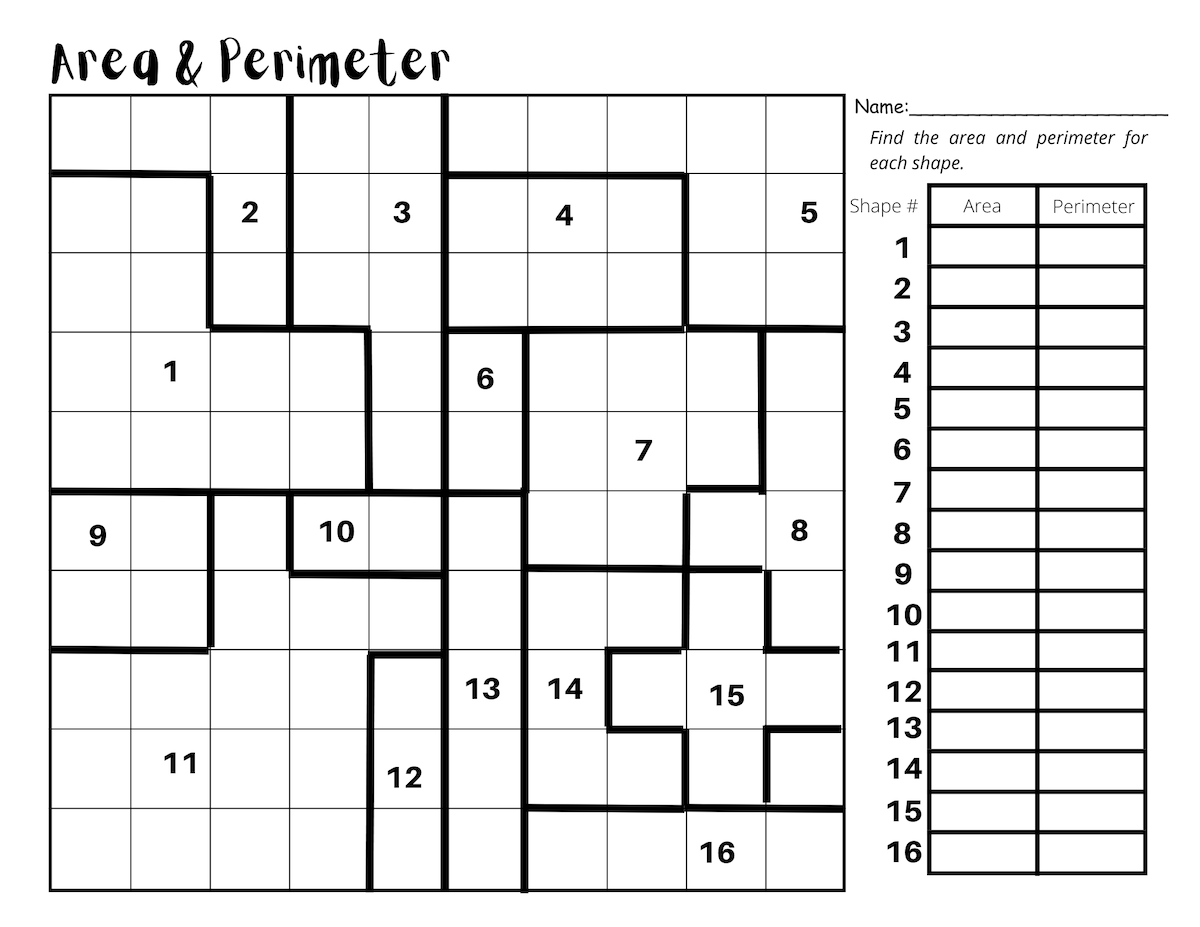
Learning area and perimeter doesn’t have to be a routine of formulas and worksheets. By tapping into multiple intelligences, students can explore math in ways that feel natural and fun for them—from hopping along chalk-drawn shapes to composing perimeter poems. This blog post brings together step-by-step games and activities that cater to linguistic, logical-mathematical, visual-spatial, bodily-kinesthetic, musical, interpersonal, intrapersonal, and naturalistic learners. Whether your students thrive through storytelling, building, moving, or music, there’s a creative approach here to make area and perimeter come alive.
Games and Activities for Learning Area by Multiple Intelligences
Linguistic Intelligence
- Area/Perimeter Story Problems: Write short story problems that involve calculating area (e.g., carpet for a room). Students solve individually or in pairs. Discuss solutions and reasoning. Write about the perimeter.
- Perimeter/ Area Poetry Provide students with shapes drawn on graph paper. Have them calculate the perimeter of each shape. Students write a short poem or rhyme that includes the perimeter number and a descriptive phrase about the shape. Share poems in small groups. Find the area.
Books:
- Spaghetti and Meatballs For All! – Marilyn Burns
- Sir Cumference and the Isle of Immeter
- Sir Cumference and the Dragon of Pi
- Sir Cumference and The Sword in the Cone
- Perimeter, Area, and Volume Monster Book -David A. Adler
- Racing Around- Stuart Murphy
- Bigger, Better, Best! – Stuart Murphy
- Sir Cumference and the First Round Table (Circle) – Cindy Neuschwander
- What’s Your Angle, Pythagoras? – Julie Ellis
Logical-Mathematical Intelligence
- Estimate and Check Area/Perimeter: Have students pick an object and estimate its area in square units. Record the estimate. Measure or cover the object to find the actual area. Compare estimates to actual measurements. Reflect on strategies to improve estimation. Find the perimeter.
- Perimeter/Area Puzzle Challenge: Prepare a set of shapes with missing side lengths. Give students the total perimeter. Students must use logic to determine the missing sides and verify their calculations. Share solutions and explain reasoning. Find the area.
- Match area or perimeter shapes to the matching area and perimeter numbers.
Visual – Spatial Intelligence
- Cover the Desk: Provide tiles, paper squares, or sticky notes. Students cover their desks completely. Count the squares/tiles to calculate the area. Find the perimeter.
- Cover the Shape with Tiles: Give students a simple shape drawn on paper (square, rectangle, or irregular polygon). Ask them to cover the shape completely with tiles or paper squares without gaps or overlaps. Count the total tiles used to find the area. Compare shapes with the same or different areas. Discuss how area relates to the number of square units. Find the perimeter.
- Grid Paper Area Challenge Draw several rectangles on grid paper. Count the number of squares inside each rectangle to determine the area. Compare with calculating area using the formula (length × width). Repeat with larger rectangles or irregular shapes. Discuss efficiency and why formulas are helpful. Find the perimeter.
- Area with Everyday Objects: Have students choose an object like a notebook or small box top. Estimate how many sticky notes or paper squares cover its surface. Place the objects on top of the square units to check. Record and compare results. Discuss which objects have the largest and smallest areas. Find the perimeter.
- Shape Transformation for Area: Draw and cut out a rectangle or square from grid paper. Cut along a diagonal or straight line to create two pieces. Rearrange the pieces into a new shape and tape them together. Count the squares to verify that the area stays the same. Discuss why area is conserved even when the shape changes. Find the perimeter.
- Area Puzzle Challenge: Give students an area target (e.g., 20 square units). Ask them to draw as many different rectangles and L-shapes with that area. Record length and width for each design. Compare and display the variety of shapes with the same area. Repeat with a new area goal. Find the perimeter.
- Design Your Own Floor Plan: Ask students to design a simple room, park, or garden on graph paper. Set an area goal (e.g., 30 square units total). Draw and label spaces, calculating the area of each. Adjust the design to meet a new area requirement. Share projects and discuss how area impacts design choices. Find the perimeter.
- Mystery Area Challenge: Give students a target area (e.g., 24 square units). Challenge them to create as many unique shapes as possible with that area. Record and label each shape’s dimensions or square-unit count. Share and compare designs with classmates. Discuss patterns and strategies for creating shapes with the same area. Find the perimeter.
- Tessellation Art: Teach students simple tessellation patterns. Have them create a tessellation on grid paper. Calculate the total area and the area of repeating units. Find the perimeter.
- Shape Design Studio Provide students with grid paper or digital design tools. Ask students to create a figure with a specific perimeter (e.g., 24 units). Students color and decorate their designs. Display the designs on a classroom wall. Find the area.
- Perimeter with Everyday Objects: (Paper clips, string, LEGO bricks (blocks, pentominoes, magnatiles, crackers), popsicle sticks, rulers.) Give each student or group a set of small objects. Ask them to create a shape (square, rectangle, triangle) using those objects. Measure the perimeter by either counting objects (if all are same size) or using a ruler. Have students create a different shape using the same number of objects. Compare perimeters and discuss how shape affects perimeter. Find the area.
- Build and Measure with Blocks (Unifix cubes or small blocks.): Ask students to build a simple rectangle with blocks. Count the blocks along the edge to determine the perimeter. Rebuild the blocks into an L-shape, T-shape, or irregular figure. Measure the new perimeter. Compare which shapes have the longest and shortest perimeters. Find the area.
- Perimeter Puzzles: Provide puzzles where students need to arrange shapes to match a given perimeter. Measure sides and check totals. Discuss which shapes can share the same perimeter. Find the area.
- Build with Blocks: Have students create shapes with building blocks. Count the outer edges to determine the perimeter. Compare perimeters of different shapes. Find the area.
- Perimeter Art Project: Students create a picture using only geometric shapes. Measure and calculate the perimeter of each shape. Label the perimeters on the artwork. Find the area.
- Shape Transformations (Grid paper, scissors, pencils.): Give students cut-out squares or rectangles (or let them draw shapes on grid paper). Ask them to tape or arrange the shapes to form a larger rectangle. Measure the perimeter. Rearrange the same pieces into a new shape. Measure and compare perimeters, noting how the area may stay the same. Find the area.
- String Measurement Challenge (String, scissors, rulers.): Give each student a string of the same length. Have them form the string into a square and measure the perimeter with a ruler. Reshape the string into a rectangle, triangle, or other polygon. Measure again and record results. Discuss how the perimeter changes despite using the same string. Find the area.
- Perimeter Puzzles (Grid paper, pencils, rulers.): Give students a perimeter number (e.g., 12 units). Ask them to draw all possible rectangles with that perimeter. Record the length and width of each option. Compare shapes and discuss which perimeters allow the most variations. Repeat with a different perimeter number. Find the area.
- Utilize various colored post-it notes to design a picture and determine the area of the different colored notes.
- Utilize Magnatiles, Duplo, or Legos to create houses (with various rooms), towns, zoos, or farms. Calculate the area and perimeter of your structures. Replicate the dimensions on grid paper. Use fences or tiles to represent the perimeter.
- Highlight the line that is unknown and you need to find. Use little tick marks to tick off the lines you have counted already.
- Print a photo or cut out an image from a magazine. Use the edges to create a frame for it. Then, document the area and perimeter calculations.
- Organize the magnatiles by color. Use one color for area and another color for the perimeter. Build a flat building and record their area and perimeter.
- Write your name on grid paper then find the area and perimeter.
- Blokus / Tetris / Pentiminoes – Create a shape or picture and calculate its area and perimeter.
Manipulatives:
- Magnatiles
- Duplo/Legos
- Math Cubes
- Cheez-it crackers/saltine crackers / starbursts
- Geoboard
- Post-it Notes
- Colored square/cubed blocks
- Tape on floor tiles
- Pattern Blocks
- Color the unknown side with a crayon to highlight to find that number first.
- Cards – playing cards, Uno, or Skipbo
- Qwirkle, Ubongo! Lokus, Tetris, Pentominoes,
Bodily-Kinesthetic Intelligence
- Shape Hunt: Give students a list of shapes (squares, rectangles, triangles, circles). Have them find real objects matching these shapes. Measure dimensions and calculate the area of each shape. Find the perimeter.
- Floor Grid Walk: Create a large grid on the floor with tape, each square representing 1 unit². Call out shapes or areas. Students walk and mark the shapes, then count the squares to find the area. Find the perimeter.
- Outdoor Chalk Shapes: Use chalk to draw large shapes on the playground. Students measure dimensions with tape measures. Calculate the area of each shape. Find the perimeter.
- Area Scavenger Hunt: Assign students to pairs or small groups. Provide a list of classroom items with flat surfaces (tabletop, whiteboard, rug, folder). Have them measure length and width and calculate the area. Compare which objects have the largest and smallest areas. Discuss how area relates to shape and size. Find the perimeter.
- Outdoor Chalk Area Exploration: Take students outside in groups with chalk. Instruct them to draw a large rectangle or square on the ground. Measure the sides and calculate the area (length × width). Try drawing irregular shapes and estimate the area using squares or by subdividing shapes. Compare which group created the largest area. Find the perimeter.
- Human Perimeter Walk: Mark large shapes on the playground with chalk or tape. Assign students to walk the perimeter while counting steps. Compare step counts with the actual measured perimeter. Repeat with different shapes and sizes. Find the area.
- String Shapes: Give students pieces of string and a set of shape cards. They must form the shape and then measure the string around it. Record the perimeter on a worksheet. Find the area.
- Shape Sorting Relay: Place cards with shapes and side lengths at a distance. Students run, measure, and calculate the perimeter. They sort the shapes into “same perimeter” groups. Find the area.
- Perimeter Scavenger Hunt (Rulers, measuring tapes, recording sheet.): Assign students to pairs or small groups. Provide a list of classroom objects to measure (desk, whiteboard, rug, book). Students measure the length of each side and calculate the perimeter. Compare which objects have the largest and smallest perimeters. Discuss findings and any shapes with similar perimeters. Find the area.
- Calculate random objects area and perimeter.
- Measure the distance around objects in the room or the size of things. Record it and write the perimeter. Draw a picture of the room, objects and their perimeter & area.
- Use big arms to go around for perimeter and big arms wiping the whole middle for area.
- Head outdoors and either draw with chalk on the ground or use tape to outline designated areas. You can place pictures of what would occupy these spots, such as cows, a garden, or a swing set. Encourage participants to measure the area and perimeter of each section.
- Creating irregular shapes will increase the challenge!
- Tape floor tiles onto the room’s surface and calculate the area and perimeter. Alternatively, use large sheets of paper to draw shapes and have participants fill them in with blocks or measure them. Incorporate irregular shapes for added challenge.
- Create an irregular shape or an L shape using magnatiles, blocks, or Legos. This will serve as your animal enclosure, complete with food inside. Calculate both the area and perimeter, and label the numbers along the outer fence lines.
- Outdoor Chalk Shapes (Sidewalk chalk, tape measures, or use footsteps as units.): Take students outside and divide them into small groups. Instruct them to draw a large shape (square, rectangle, triangle) with chalk. Measure each side using tape measures or pacing out steps. Add the sides together to calculate the perimeter. Redraw the shape in a different configuration and compare perimeters. Find the area.
- Footstep Perimeter Walk (Open space, chalk or cones.): Have students outline a large shape on the ground with chalk or cones. Walk around the shape, counting footsteps as units. Record the footstep perimeter. Compare with a measured perimeter using a tape measure. Discuss accuracy and estimation. Find the area.
- Perimeter Hopscotch: Draw shapes (squares, rectangles, triangles) on the playground with chalk. Number the sides. Students hop along each side while adding lengths to find the perimeter. Find the area.
- Walk the Perimeter: Take students outside to a court or field. Walk around the edges while measuring with a measuring wheel or tape. Add the lengths for the total perimeter. Find the area.
- Use a whiteboard marker to label the lengths of the shape on the sides of the desk or whiteboard.
Musical Intelligence
- Create a simple, catchy song about calculating the perimeter of different shapes.
- Have students sing the formula for rectangle and square perimeters while tracing the edges of shapes.
- YouTube: toto.australis – perimeter song, Bazillions – Perimeter Around the Area, The Singing History Teachers – Area and Perimeter Song, Star Toaster – area for kids, Numberock – Area and Perimeter Song, Flocabulary How to Area and Perimeter
Interpersonal Intelligence
- Area Bingo: Create bingo cards with different area values. Call out dimensions of shapes (e.g., rectangle 3×4). Students calculate the area and mark the corresponding value if it appears on their card. Find the perimeter.
- Geoboard Creations: Provide each student with a geoboard and rubber bands. Ask them to create a shape and calculate its area. Share and compare different shapes and areas. Find the perimeter.
- Area Relay Race: Divide students into teams. Place area problem cards at one end of the room. One student runs to get a card, solves it, and tags the next teammate. Fastest team with correct answers wins. Find the perimeter.
- Team Perimeter Hunt: Divide students into small groups. Hide shape cards around the classroom. Teams find a card, measure each side, and calculate the perimeter together. First team to collect and solve all cards wins. Find the area.
- Interactive Board Race: Draw multiple polygons on the board with labeled or unlabeled sides. Students race to calculate the perimeter correctly. Award points for accuracy and speed. Find the area.
- Perimeter Bingo: Create bingo cards with different perimeter values. Call out shapes and their side lengths. Students calculate the perimeter and mark the correct value. Find the area.
- CHEEZ-IT AREA & PERIMETER ACTIVITY – Roll two dice or flip two cards. Use one number to create that many rows of Cheez-Its and the other number for the columns. Calculate the area and perimeter. Clear the board and roll two more dice or flip two more cards to repeat the process. If necessary, record your answers on a separate sheet of paper. Variation: Add the two numbers rolled or flipped together to create an area and then find its perimeter. Variation: Make a shape first out of the cheez-its, magnatiles or blocks then find the area and perimeter.
- Play Simon Says. Draw a large square/picture frame. When you say “area” everyoe has to run in the middle. When you say “perimeter” have to run to the outside.
- BUMP! Area & Perimeter Game: Each participant starts with 10 tiles or markers (or designate one as X and the other as O). Roll two dice or flip two cards, then add the results. Calculate the area and perimeter of the specified shape. If your answer is correct, place your marker or cross off that answer. If your opponent has a marker in that spot, you can bump it off and claim the square. The winner is the first player to use all their cubes. On the other hand, if the board becomes completely filled, the player with the highest number of markers on the board is declared the winner.
- ARRAY / MAGNATILES: Begin by flipping two cards or rolling two dice. Then, create an array using the magna-tiles based on the numbers from the cards or dice. Document your equation for the area of the array or rectangle on this paper. For instance, if you flip or roll a 3 and a 4, arrange the magna-tiles with 3 tiles placed horizontally and 4 tiles vertically. Record the area as 12. You can play solo or with a partner, and the player with the highest total area wins. Variation: In this version, one partner constructs an array or rectangle, and the other must determine the area. For example, if they create an array with an area of 24, the other player counts the sides and states the area.
Intrapersonal Intelligence
- Area Puzzle Match: Prepare cards with shapes and separate cards with their areas. Students match the shape card to the correct area card. Check answers as a group. Find the perimeter.
- Perimeter Reflection Journal: Ask students to independently measure objects around their desk area. Calculate the perimeters and record them in a journal. Reflect on which shapes were easiest or hardest to calculate. Set a personal goal for improving perimeter skills. Find the area.
- Mystery Shape Challenge (Grid paper, pencils, rulers.): Give students a mystery perimeter (e.g., 16 units). Ask them to create as many different shapes as possible with that perimeter. Record and label each shape’s sides. Compare designs with classmates. Reflect on how perimeter can be constant across various shapes. Find the area.
- Create as many rectangles as possible with a perimeter of 32. Record the area of each one. On a separate sheet of paper, list the areas in descending order from largest to smallest at the top. What patterns do you observe? You can also calculate the area for a rectangle with a area of 32 and then note the corresponding perimeters. Organize these perimeters from largest to smallest, starting from the top of the page. What do you notice in this case?
- Games: MathPlayground – Perimeter Snatch Jr, MathPlayground Area Snatch, MathPlayground Area Blocks, ToyTheater – Area Climber Game, ToyTheater Area and Perimeter, ToyTheater Perimeter, WordWall Area, WordWall – Perimeter
- IXL, Khan Academy Kids, Khan Academy, NCTM
- APPS: Geoboard, Number Pieces, Partial Product Finder
Naturalistic Intelligence
- Outdoor Perimeter Explorer: Take students outside to identify natural or man-made shapes. Measure perimeters of things like garden beds, sidewalks, or playground areas. Record findings and compare which shapes have the largest or smallest perimeters. Create a simple report or drawing of their discoveries. Find the area.
- Creative Design Project (Graph paper, pencils, rulers, markers.): Ask students to design a small park, garden, or zoo layout on graph paper. Set a perimeter goal (e.g., 24 units). Students draw their design and calculate the perimeter. Optional: Have them adjust the design to meet a new perimeter requirement. Share and compare projects, discussing how shapes impact perimeter. Find the area.
- Make a zoo, farm, house, theme park, etc on grid paper and find the area and perimeter of the space for each attraction.
- Have multiple real life examples for area and perimeter and sort into the appropriate categories.
- Garden Plot Design: Assign a small plot in a school or community garden. Students can measure and calculate the perimeter for fencing and the area to determine how many plants will fit.
- Tree Shadows Investigation: Measure the length and width of a tree’s shadow during different times of the day. Calculate the area of the shadow on the ground and discuss how it changes.
- Outdoor Chalk Grids: Draw rectangles or irregular shapes with chalk on the pavement. Students can measure sides to compute perimeters and areas, incorporating irregular shapes found in nature like leaves or stones.
- Ask students to design a small wildlife habitat or vegetable garden, planning paths and plant beds using area and perimeter calculations.
By incorporating activities that align with each type of intelligence, you transform the study of area and perimeter into an engaging, hands-on adventure. Students not only strengthen their math skills but also gain confidence as they connect conceptsto their individual strengths. Try mixing and matching these games in your classroom, and watch as learningshapes up to be both memorable and meaningful.
Area and Perimeter Concepts and Games Packet:
Area and Perimeter
Over 40 Pages of Concepts & Games Already Made Up

@engagethestages