
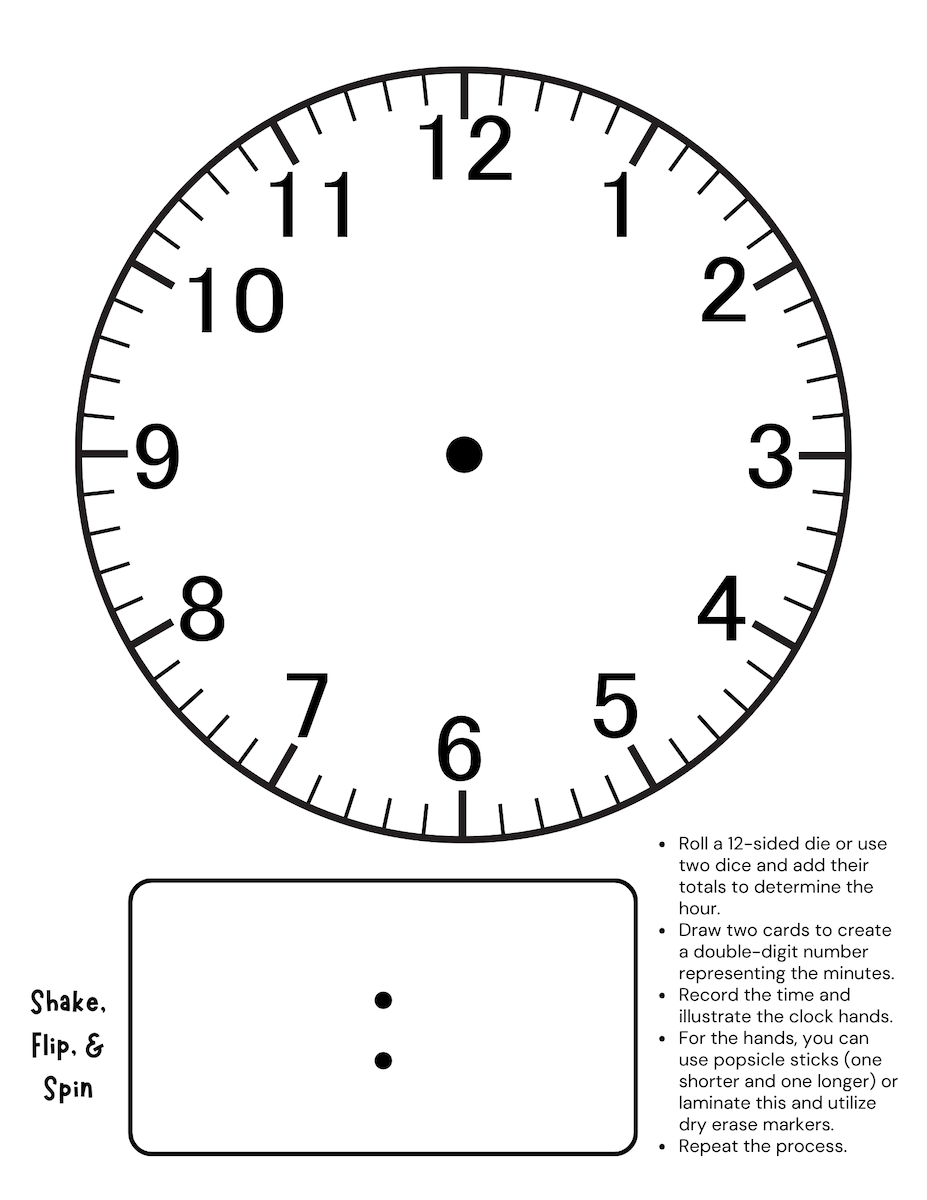
Teaching children how to tell time can be both an exciting and engaging experience when approached with creativity and variety. Time-telling is not just about reading numbers on a clock—it’s about understanding the structure of a day, connecting with daily routines, and fostering time management skills. By incorporating Howard Gardner’s theory of multiple intelligences, educators and parents can tailor their teaching strategies to suit every child’s unique learning style. Whether your learner is word-smart, number-smart, picture-smart, or even nature-smart, there’s an effective approach waiting to be explored.
Step-by-Step Teaching Directions
- Introduce the Clock Face
- Explain the short hand (hour) and long hand (minute).
- Teach Hours First
- Set the clock to each hour and say it aloud.
- Connect to daily routines.
- Introduce Half-Hours and Quarter-Hours
- Show how the minute hand points to 6 for :30 and 3 or 9 for :15 or :45.
- Teach Counting by 5s Around the Clock
- Practice skip counting to read minutes.
- Combine Hours and Minutes
- Set various times and have learners read them.
- Practice Daily in Short Intervals
- Use games, flashcards, and real clocks to reinforce.
Here are ways to teach telling time tailored to each of Howard Gardner’s Multiple Intelligences:
Linguistic Intelligence (Word Smart)
- Use simple rhymes for remembering the clocks: “The little hand shows the hour, the big hand shows the minute power.”
- Storytelling and Real-Life Practice: Incorporate time-telling into stories: “The cat eats lunch at 12:00. Where is the hour hand? Where is the minute hand?” Ask learners to check clocks throughout the day to reinforce skills.
- Have students write short stories incorporating clock times.
- Use rhymes or chants about hours and minutes.
- Create a “time diary” where they record daily activities with specific times.
Books:
- Telling Time – David A. Adler
- Time Zones – David A. Adler
- It’s About Time – Stuart J. Murphy
- Game Time! – Stuart J. Murphy
- Get up and Go – Stuart Murphy
- A Second is a Hiccup – Hazel Hutchins
- Winnie the Pooh Tells Time – A.A. Milne
- As an Oak Tree Grows G. Brian Karas
- I.Q., It’s Time – Mary Ann Fraser
- Pigs On a Blanket – Amy Axelrod
- Every Minute Counts – Shabnam Minwalla
- Clocks and More Clocks – Pat Hutchins
- Clockwise – Sara Pinto
- Game Time! – Stuart Murphy
- Rodeo Time – Stuart Murphy
- How Do You Know What Time It Is? – River E. Wells
- About Time: A First Look at Time and Clocks – Bruce Kocsielniak
- Telling the Time – Usborne
Logical-Mathematical Intelligence (Number Smart)
- Just like small numbers first, then larger numbers (or ordering in line from shortest to tallest): SHORTER HAND first for the hour then LONGER HAND second for the minutes. (For some reason this method stuck better for my kids.)
- Longer hand needs to be longer for the minutes because it’s closer to the little lines.
- Practice solving time-related math problems, like elapsed time.
- Use analog and digital clock matching activities.
- Challenge students with puzzles about schedules and time differences.
Visual-Spatial Intelligence (Picture Smart)
- Moveable Paper Clock (Paper plate, brad fastener, two paper clock hands (different lengths), markers.): Write the numbers 1–12 around the plate like a clock. Attach the hands with the brad so they can rotate. Practice moving the hands to show times called out loud.
- Provide colorful clock diagrams and visual timelines.
- Use drawing activities where students illustrate what they do at certain times.
Manipulatives:
- Cards – playing cards or Uno
- Dominoes
- Number tiles (like Scrabble tiles)
- Clock
Bodily-Kinesthetic Intelligence (Body Smart)
- “What Time Is It?” Movement Game: Call out a time (e.g., 3:00). Learners use their arms to mimic the clock hands. Students freeze in position, then check for accuracy.
- Use arms to indicate the time on a clock, with one arm being LONG and the other arm being short.
- Create a large clock using a hula hoop. Flip cards to indicate the time. Use sticks as the clock hands, and write the numbers on the hoop with chalk.
- Time Scavenger Hunt: (Small paper clocks hidden around the room.) Hide clocks showing different times. Have learners find a clock and read the time aloud. They can also match the clock to a daily routine event.
- Track the time it takes you to run a lap, make 10 successful basketball shots, and more. Can you surpass your own record? Keep track of the time and time passed the original time.
- Use hopscotch or floor games where they jump to the correct time.
Musical Intelligence (Music Smart)
- Youtube: British Council – How to Tell the Time, ToyTheater – Telling the Time, Numberock – Telling Time Song for Kids, eSpark – Tell Time to the Nearest Hour, eSpark – Skip Around the Clock, Numberock – Telling Time Song for Kids, The Telling Time Song – Scratch Garden
- Teach a song or jingle about how to read clocks.
- Clap or tap rhythms to represent seconds and minutes.
Interpersonal Intelligence (People Smart)
- Time Matching Game: (Clock flashcards (showing analog), matching digital time cards.) Lay the analog and digital cards face up. Match digital times to the correct analog clock. Start with whole hours, then increase difficulty.
- Clock Bingo: Make bingo boards with different clock faces. Call out times, and players mark the corresponding clock if they have it. First to get a row wins.
- What Time Is It, Mr. Wolf?: A classic playground game where the “wolf” shows a time (e.g., “3 o’clock”). Players call out the time then take steps based on the hour said, and if the wolf says “Dinner Time!” they chase the players. This reinforces time recognition while moving.
- Time Scavenger Hunt: Hide clock cards around the house or classroom. Kids find a card and have to read the time aloud correctly to keep it.
- Spin the Clock: Use a toy clock with movable hands. Players spin or adjust the hands to match times you call out or draw from a deck of time cards.
- Time Memory Game: Play a memory card game where one card shows an analog clock and the matching card shows the written time. Players flip and try to match pairs.
- Race to the Right Time: Call out a time, and players use mini clocks or paper plates with movable hands to set the correct time as quickly as possible.
- Facilitate group games where students quiz each other about time.
- Have pairs act out daily routines and classmates guess the time.
- Create a group storytelling activity based on a schedule.
Intrapersonal Intelligence (Self Smart)
- Time Match-Up: Create cards with analog clocks showing different times and separate cards with the digital times written out. Players match the clock face to the correct digital card.
- Encourage students to reflect on their daily schedule and write about time management.
- Online Games: Fun Kids English – Learn to Tell Time, Arcademics – Giraffe Dash, WordWall – Telling Time, MathPlayGround – Puzzle Pics Clock, Arcademics – Giraffe Pull, Khan Academy Kids, Khan Academy, IXL
- NCTM APP: Math Clock, IXL, Khan Academy Kids, Khan Academy
Nature Intelligence
- Daily Schedule Timeline: (Large sheet of paper, markers, sticky notes.) Draw a horizontal line representing the day. Mark key times and attach sticky notes with activities. Have learners place the matching clock time next to each event.
- Daily Schedule Challenge: Show a series of daily activities with times (like lunch at 12:30). Kids need to set the hands on a clock to match the event’s time, reinforcing the link between real-life schedules and clock reading.
- Create a list of tasks to accomplish that evening, such as homework, chores, reading, or playing games. Specify the times for each activity and estimate how long each will take. Afterward, review whether your time predictions were accurate.
- Create a schedule and design a poster featuring images that outline their weekly activities, including sports, school, homework, and specific times.
- Estimate the duration needed for your cleanup and keep track of the time.
- Sun Dial – How to Tell Time Begin by drawing a large circle on a sheet of paper, then create a smaller circle inside it. Place a piece of clay at the center of the circles. Insert a straw into the clay, ensuring it stands upright. Trace the shadow line that forms between the two circles. Continue to trace additional lines every hour thereafter.
- Make a timeline of a two hour party. What do you need to do before hand? How long will it take?
- Events at party.
- Clean up and times.
- Preparation Before the
- Party:
- Plan the guest list and send invitations (1 week in advance)
- Shop for supplies and food (1 day before, 2 hours)
- Set up the party space (1 hour before)
- Events During the Party:
- Guests arrive (0:00)
- Welcome drinks and mingling (0:00 – 0:30)
- Serve appetizers (0:30 – 1:00)
- Main activities or games (1:00 – 1:30)
- Dessert and cake cutting (1:30 – 1:50)
- Farewells and goodie bags (1:50 – 2:00)
- Clean-Up:
- Start cleaning as guests leave (2:00)
- Complete clean-up (30 minutes)
Incorporating diverse teaching methods not only makes learning to tell time more enjoyable but also ensures that every child finds a strategy that resonates with them. From interactive games and storytelling to hands-on crafts and real-life applications, these creative approaches help solidify the concept of time in meaningful ways. By connecting lessons to daily experiences and using activities that align with different intelligences, we’re not just teaching kids to read clocks—we’re helping them develop lifelong skills in organization, time management, and critical thinking.
Get Your Telling Time Pack!
Telling Time
9 Pages of Games

@engagethestages