
Learning to divide fractions can feel intimidating for many students, but it doesn’t have to be. By tapping into the eight intelligences—linguistic, logical-mathematical, visual-spatial, bodily-kinesthetic, musical, interpersonal, intrapersonal, and naturalistic—you can transform fraction division from a dry math lesson into an engaging, multi-sensory experience. From storytelling and skits to nature walks, songs, and hands-on activities, students learn to approach fractions in ways that resonate with their unique strengths. This dynamic approach not only makes the process of “keep, change, flip” memorable but also builds deeper understanding and lasting confidence in math.
Learning to Divide Fractions Through Multiple Intelligences
Linguistic Intelligence (Word Smart):
- Create a story where characters need to divide items, such as sharing pies, and write step-by-step how fractions are divided.
- Play “Fraction Storytelling,” where each student explains the process of dividing fractions in their own words.
- Story Problems Creation: Have students write and solve their own real-world word problems for fraction division, such as “I have 3/2 gallons of juice and want to pour it into pitchers holding 3/4 gallon. How many pitchers will I fill?”
- Story Problems: Write word problems that involve dividing fractions in real-life contexts, such as recipes or dividing a piece of land. This allows students to apply their logical reasoning skills to solve practical problems.
- Storytelling with Fractions: Have students create short stories or narratives that involve dividing fractions. For example, a story about a baker who needs to divide a recipe into smaller portions. Encourage them to use dialogue and descriptive language to explain their thought process.
- Fraction Poems: Ask students to write poems that incorporate the concept of dividing fractions. They can use metaphors or humor to make the topic more relatable. This activity allows them to express their understanding creatively.
- Fraction News Report: Students can role-play as news reporters who are covering a story about dividing fractions in real-life situations, such as cooking or sharing. They can present their reports to the class, emphasizing clarity and thorough explanations.
- Debate on Fraction Division Methods: Organize a debate where students discuss different methods for dividing fractions (e.g., using reciprocals versus visual models). This activity encourages them to articulate their reasoning and engage with their peers.
- Write Instructions for Dividing Fractions: Have students create a set of step-by-step instructions or a how-to guide for dividing fractions. This could be presented in the form of a manual, a poster, or a digital presentation, enhancing their clarity and organization skills.
- Fraction Division Skits: Students can develop and perform skits that illustrate the process of dividing fractions. They can use props or visual aids to help convey their message and make the learning experience more dynamic.
- Books: Multiplying Menace, The Multiplying Menace Divides
Logical-Mathematical Intelligence (Number Smart):
- Division is… MULTIPLICATION BY THE RECIPROCAL!
- The quotient represents the number of times the second fraction can fit into the first fraction. (You can visualize this by removing the second fraction to determine how many times it fits or by grouping/crossing it out within the first fraction.)
- Solve fraction division puzzles and math riddles.
- Begin by reviewing multiplication and division concepts. For multiplication, consider 2 x 3, which means 2 groups of 3, resulting in 6. For division, take 27 ÷ 9, which asks how many 9s fit into 27, and the answer is 3.
Visual-Spatial Intelligence (Picture Smart):
- Fraction Strips: Choose strips that represent both the dividend (the first fraction) and the divisor (the second fraction). For example, if solving ( 3/4} \div 1/2), take a strip for 3/4 and strips for 1/2. Lay out the strip that represents the first fraction. Shade or highlight the portion that represents ( 3/4). Determine Divisor Size: Look at the strip that represents the divisor fraction (1/2) to see how long each segment is. Fit Divisor Strips into Dividend: Place as many (1/2) strips end-to-end along the ( 3/4) strip to see how many times (1/2) fits into (3/4). Count the Groups: The number of (1/2) strips you can fit into ( 3/4) (including partial fits) represents the quotient.
- Fraction Circles: Select the Fraction Circles: Choose circles divided into the denominators of the fractions in your problem. Show the Dividend: Shade the part of the circle representing the first fraction. Identify the Divisor: Take a circle or wedge that represents the second fraction. Compare and Count: See how many divisor wedges fit into the shaded dividend portion. Determine the Result: Count how many whole and partial divisor pieces fit into the dividend to find the quotient.
- Fraction Number Line Jumps:Draw a number line from 0 to 2. Place a point at 3/4 and have students take jumps of size 1/4 to see how many 1/4s fit into 3/4 ( 3/4 \div \1/4). Repeat with various fractions.
- Grouping with Tiles or Counters:Give students 8 tiles to represent 8/8 (1 whole). Ask them to solve a problem like \( 1 \div 2/8) by physically grouping the tiles into groups of 2/8.
- Area Model:Ask students to draw a rectangle representing 1 whole. Shade a fraction like 3/5. Then divide the shaded section into groups of 1/10 to model ( 3/5 \div 1/10). Count the groups to find the answer. See how many times 1/10 fits into 3/5
- Pattern Blocks: Assign Pattern Block Values. Decide which block will represent 1 whole. A hexagon is often used for 1 whole. Determine the fractional value of the other blocks relative to the hexagon: Trapezoid = 1/2, Rhombus = 1/3, Triangle = 1/6. Model the Dividend (First Fraction). Use pattern blocks to showthe dividend. Model the Divisor (Second Fraction). Divide Using Pattern Blocks. Count how many divisor pieces (triangles) can fit into the shaded dividend. That count is your quotient.
- Hands-On Measurement: Utilize measuring cups and other kitchen tools to have students practice dividing fractions in a real-world context. Assign them a recipe that requires them to divide ingredients into smaller portions. For example, if a recipe calls for 3/4 cup of sugar, ask them how much sugar they would need if they wanted to make 1/2 of the recipe.
- Fraction Strip Races:Provide fraction strips and have students race to see how many strips of a smaller fraction fit into a larger one. For example, test how many 1/6 strips fit into 2/3 ( 2/3 \div 1/6).
- Fraction Tiles: Create or use pre-made fraction tiles. Have students manipulate the tiles to visually divide fractions. For instance, they can physically separate a whole into smaller fractional parts and see how many times one fraction fits into another.
- Area Model: Use grid paper, graphing software, or transparency paper to create area models. Students can draw rectangles and shade different sections to represent fractions. They can then visually divide these shaded areas to understand how dividing fractions works.
- Fraction Wheel: Design a fraction wheel that students can spin. Each section represents a different fraction. Have students figure out how many times one fraction fits into another by spinning the wheel and visually assessing the overlaps.
- Visual Story Problems: Create story problems that involve dividing fractions and ask students to illustrate the scenarios. They can draw pictures or diagrams to represent the fractions involved and visually work through the division process.
- Foldable Paper Models: Provide students with strips of paper that they can fold to represent fractions. For example, they can fold a strip in half and then fold one of those halves into thirds.
- Posters and Infographics: Have students create posters or infographics that explain the process of dividing fractions visually. They can include diagrams, colors, and illustrations to represent their understanding.
- Real-Life Scenarios: Engage students in real-life activities like cooking or sharing food, where they have to divide fractions. For example, if a recipe calls for 3/4 cup of milk and they want to divide it in half, they can visually measure the amounts.
- Pizza Party: Use paper plates to represent pizzas. Divide the plates into different fraction slices. Have students solve division problems involving fractions by physically cutting the pizzas or shading in the slices. For example, if they have 3/4 of a pizza and they want to divide it by 1/2, they can visually see how many half slices fit into the three-quarters.
- Visual Art Projects: Integrate art by having students create posters or drawings that illustrate dividing fractions. They can use pie charts or other visual representations, combining creativity with logical reasoning.
- Use drawing activities such as illustrating pizzas or grids and divide them fractionally.
- Create comic strips showing each step of dividing fractions.
- Play matching games with fraction diagrams and division problems.
- Each of the following concepts—fraction strips, number lines, grids, pattern blocks, and play-doh—can be utilized with both proper fractions and mixed number fractions for multiplication and division.
Manipulatives:
- Duplo/Lego Base ten blocks (tangible, picture, or draw square, line, dots…)
- Number Line
- Number Bond
- Cards – playing cards or Uno
- Dominoes
- Number tiles (like Scrabble tiles)
- Beads (like Montessori but make your own)
- Ruler / Measuring Tape
- Beads/Beans … etc.
- Magna-Tiles
- Pattern Blocks
- Shapes
- Grid Paper
- Pentominoes
- Geoboard
- Measuring Cups
- Fraction Strips
- Fraction Circles
- Fraction Puzzles
- Food – crackers, cookies, etc.
- Oreos and the frosting
- Playdough
- Mega-Bloks (write on them which fraction they are in proportion to each other)
Bodily-Kinesthetic Intelligence (Body Smart):
- Play “Fraction Relay,” where students physically divide objects (like paper strips or counters) according to fractional instructions.
- Use gestures to model dividing fractions (folding and segmenting paper or using arm motions to represent division).
- Number Line Activity: Create a large number line in the classroom. Have students place fractions along the line and demonstrate dividing them. This visual representation can help them understand the concept of dividing fractions more clearly.
- Fraction Pizza Creation: Provide students with paper plates or cardboard cutouts to create their own pizzas. Have them divide the pizza into different fractional parts (e.g., 1/2, 1/4, etc.). Once they have created their pizzas, challenge them to divide the pieces in various ways, such as sharing with classmates or creating a new pizza recipe that requires dividing one fraction by another.
- Fraction Relay Race: Set up a relay race where students have to solve fraction division problems at various stations. Each station will have a different task, such as cutting a rope into specific lengths representing fractions or using measuring cups to divide liquids. They must complete the task before moving to the next station.
- Fraction Hopscotch: Create a hopscotch grid with different fractions written in each square. Students will take turns hopping on the squares while solving a fraction division problem corresponding to the square they land on. For example, if a student lands on 1/2, they must state what 1/2 divided by 1/4 equals before proceeding.
- Fraction Scavenger Hunt: Organize a scavenger hunt where students search for items that can be grouped or divided into fractions. They can collect items like fruit, blocks, or any other manipulatives. Once they have their items, they can work in pairs to demonstrate how to divide these items into fractions.
- Fraction Dance: Create a dance or movement activity where each type of movement corresponds to a specific fraction operation. For example, jumping for division and clapping for fractions. As they perform the movements, call out different fraction division problems, and they must perform the corresponding movements to indicate their answer.
- Build It with Blocks/Mega-Bloks, Magna-Tiles: Use building blocks to represent fractions visually. Have students create structures that represent different fraction divisions. For instance, if they divide 3/4 by 1/2, they can use blocks to show how many 1/2 units fit into 3/4.
- Magna-Tiles in place of grid paper. Opt for LEGO or MEGA BLOKS instead of fraction strips, and implement a life-sized number line for your number line activities.
- Have fractions written all over the ground with chalk. Play some music for everyone to dance to. When the music stops, quickly rush to a fraction. Then, draw either a domino or a fraction card and either multiply or divide your fraction. If you answer correctly, you earn a point.
- Create large fractions on the ground using chalk to represent multiplication. Illustrate the groups and add shade in.
Musical Intelligence (Music Smart):
- Sing or chant fraction division steps to a simple rhythm.
- Create a fraction division rap or a call-and-response song for solving problems.
- Fraction Song Creation: Have students create a song or rap that explains how to divide fractions. They can write lyrics that detail the process (e.g., “Keep, Change, Flip”) and set it to a familiar tune. This helps reinforce the concept through rhythm and melody.
- Musical Chairs with Fractions: Adapt the classic game of musical chairs by placing fraction cards on each chair. When the music stops, students must find a chair and then solve a division problem involving the fraction on that chair. They can share their answers with the group before the music starts again.
- Karaoke Fraction Division: Create karaoke sessions where students sing songs related to math or fractions. After each song, they can solve a fraction division problem as a group.
- YouTube: Murf Math – Multiplyin’ Fractions, Murf Math – Dividin’ Fractions, Numberock – Multiplying Fractions Song, Numberock – Dividing Fractions by whole numbers, Numberock – Dividing fractions Keep Change Flip, phi – Dividing Fractions rap, Numberock – Multiplying Mixed Numbers Song, Simpson_Math – Physically Multiplying Fractions, Nlvm – multiplying fractions
Interpersonal Intelligence (People Smart):
- Work in pairs or small groups to solve division problems collaboratively.
- Play “Fraction Exchange,” where students teach each other their steps and methods.
- Fraction War: Use a deck of cards (or create fraction cards). Each player draws two cards to create a fraction (e.g., a 2 and a 5 for 2/5). Players then divide their fractions and the one with the highest result wins the round. Continue until someone reaches a set number of points.
- Fraction Bingo: Create bingo cards with different fractions in each square. Call out division problems (e.g., “What is 1/2 ÷ 1/4?”) and players mark their answers on their cards. The first to complete a row or column shouts “Bingo!” and wins.
- Fraction Relay Race: Set up a relay race where students solve a series of division problems involving fractions at different stations. Once they solve a problem, they can move to the next station. This can be done individually or in teams to promote collaboration.
- Fraction Jeopardy: Create a Jeopardy-style game with categories related to dividing fractions. Teams can select questions of varying difficulty and earn points for correct answers. This encourages teamwork and problem-solving.
- Interactive Games: Utilize online math games or create card games where students must solve fraction division problems to advance in the game.
- Group Projects: Assign students to work in groups to create a presentation on dividing fractions. They can use visual aids, examples, and even skits to explain the concept, catering to both logical and interpersonal intelligences.
- Peer Teaching: Pair students and have them teach each other how to divide fractions. Teaching a concept reinforces their own understanding and allows them to engage with the material logically.
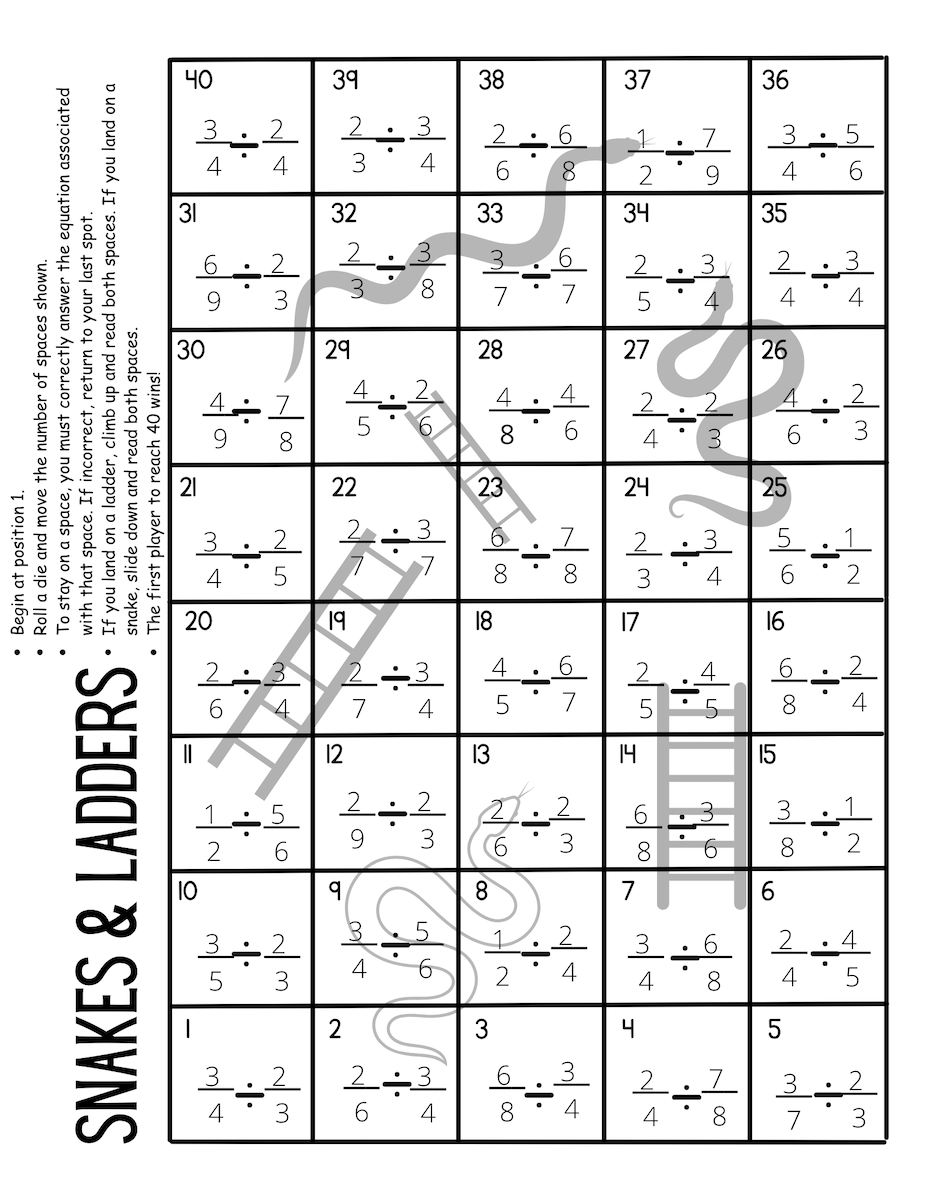
- Games like: Snakes & Ladders, 5 in a Row, BUMP, pyramid of fractions, spinners, battleship, I spy, Dominoes, Boggle
- Use dominoes, cards, or dice. Perform addition, subtraction, multiplication, and division as quickly as possible.
- Set up cups or bowls, each labeled with a fraction either on the outside or placed inside. Use a ball marked with a value or draw a random fraction card. Toss the ball into a cup or bowl and multiply the two fractions. If the answer is correct, earn a point. Variation: throw a ball into two cups or bowls and multiply the fractions from both.
- Paste equations around the room and then walk around to solve them.
- Play Connect 4. Before making your move, draw a domino or fraction card to either multiply or divide. If you arrive at the correct answer, you can place your piece; if not, you’ll need to skip your turn.
Intrapersonal Intelligence (Self Smart):
- Have students reflect in a math journal about which strategies help them understand dividing fractions.
- Interactive Matching Game: Create cards with division problems and cards with visual representations or answers. Students match the problem to the correct visual or solution.
- Digital Simulations: Use software or apps that allow students to manipulate fractions digitally. They can experiment with dividing fractions and see immediate results, enhancing their logical problem-solving skills.
- Self-Paced Learning Modules: Create a series of online or paper-based modules that allow students to learn dividing fractions at their own pace. Include interactive elements like quizzes and challenges that they can complete independently, allowing them to take ownership of their learning.
- Concept Mapping: Ask students to create a concept map that illustrates the steps involved in dividing fractions. They can use visual elements to express their understanding and relationships between concepts. This activity allows for personal interpretation and internalization of the process.
- Personalized Problem Sets: Have students create their own division fraction problems based on interests or hobbies. They can challenge themselves or peers with these problems, making the learning experience more relevant and meaningful.
- Artistic Representations: Allow students to express their understanding of dividing fractions through art. They could create visual representations, such as drawings or paintings, that depict the concept of fractions and division in a way that resonates with them personally.
- Online Games: Wordwall – dividing fractions, iknowit – muliplying fractions by whole numbers, Arcademics – Snow Sprint – Multiplying, Arcademics – Puppy Chase (Fraction to Decimal), IXL, Khan Academy, NCTM APPS: Pattern Shapes, Partial Product Finder, Number Pieces, Fractions, Number Line nlvm.usu.edu National Library of Virtual Manipulatives
Naturalistic Intelligence (Nature Smart):
- Use real-world division examples involving nature, like dividing a garden into fractional plots.
- Practice with real-world word problems that require dividing fractions.
- Practice with fraction problems based on recipes, sharing fruit, or splitting natural items.
- Role-Play “Fraction Shop”:Set up a pretend shop where items are sold in fractional amounts (like 1/4 of a cake). Ask students to figure out how many of these fractional items can be made from a larger fraction quantity (e.g., 5/4div 1/4)).
- Real-Life Scenarios: Present students with real-life situations that involve dividing fractions, such as recipes or construction projects. Have them work in pairs or small groups to solve these problems and present their solutions.
- Fraction Recipe Book: Have students create a recipe book that involves adjusting ingredient amounts by dividing fractions. This practical application helps them understand the concept while engaging their logical thinking.
- Garden Division: Have students plant a small garden where they can use fractions to determine the spacing between plants. For instance, if they have a row of 12 plants and want to divide them into groups, they can use fractions to figure out how many plants would go in each section if they divide them into 1/4 or 1/3 of the row.
- Cooking with Fractions: Organize a cooking activity where students have to follow a recipe that requires dividing fractions. For example, if a recipe calls for 3/4 cup of sugar and they want to make half of the recipe, they must calculate how much sugar they need by dividing the fraction.
- Nature Walk Measurements: Take students on a nature walk and have them measure the distances between different trees or plants. They can use fractions for division when discussing how many trees are within a certain distance or how to divide the total number of trees evenly into groups.
- Building a Birdhouse: Have students work on a project to build a birdhouse. They can use measurements that involve fractions and divide the lengths of wood into various parts. For instance, if a piece of wood is 4 feet long and they need to divide it into segments of 1/2 foot, they can calculate and then physically measure the divisions.
- Animal Habitat Analysis: Have students research different animal habitats and create a presentation. They can use fractions to divide the area of the habitat into sections to represent how much space certain animals use. For example, if a habitat is 60 acres and a particular species occupies 1/3 of it, they can calculate the area occupied.
- Triple a food recipe and cook it. (Variation: half the recipe/ divide it in half.) Copy your favorite recipe and then triple it. Show the measurements and then make it.
By approaching fraction division through multiple intelligences, you give every student the chance to connect with math in a meaningful and enjoyable way. Whether they are word smart, number smart, or body smart, each learner can find a path to success through stories, visuals, movement, music, and real-world applications. Incorporating these strategies fosters an inclusive classroom environment where fraction division becomes more than a skill—it becomes an adventure in discovery and problem-solving.
Get Your Dividing Fractions Packet!
Dividing Fractions
Over 100 Pages!

@engagethestages