
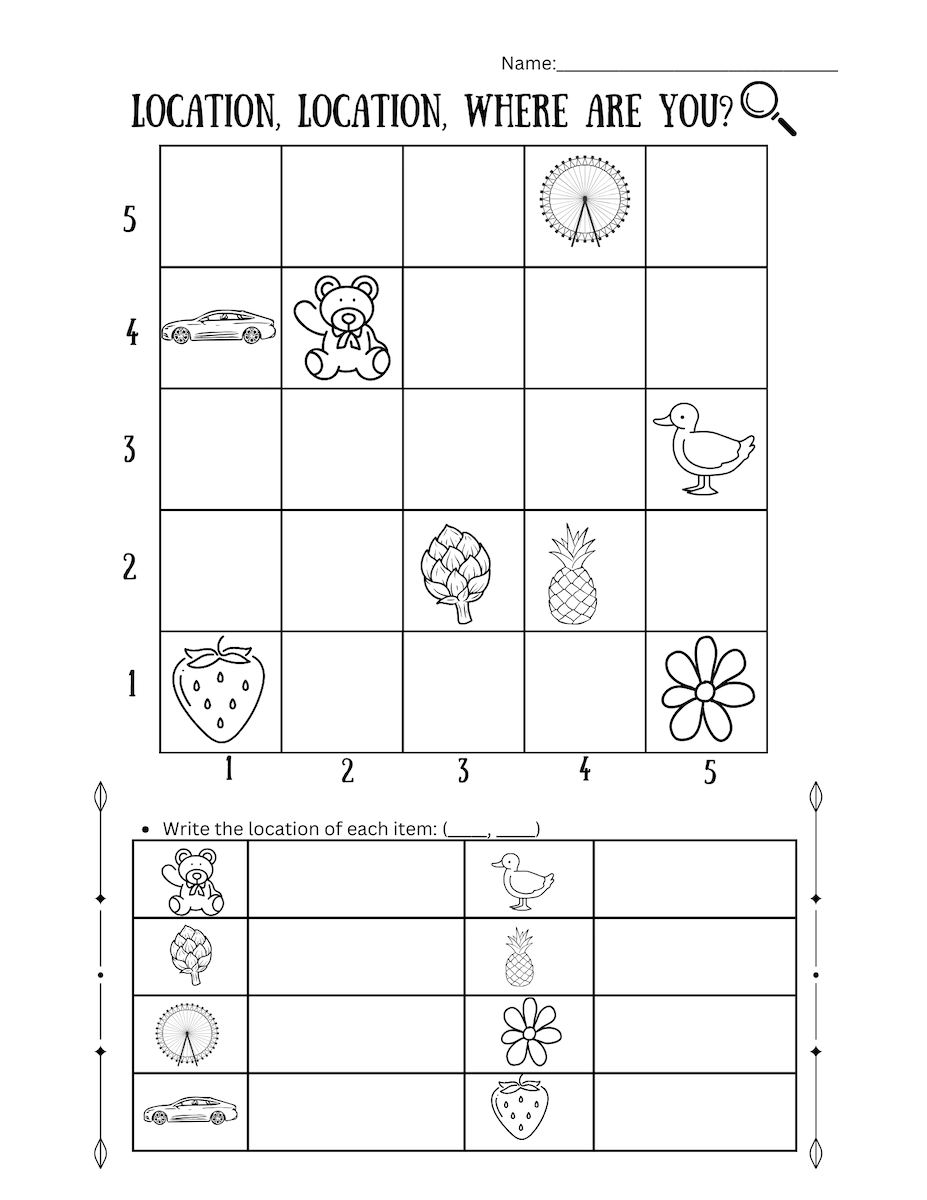
Learning X-Y coordinate graphing doesn’t have to be limited to plotting points on paper. By engaging multiple intelligences, students can explore the concept in innovative and meaningful ways that connect with their strengths. Here are games, activities, and math investigations for each type of intelligence to make graphing an interactive adventure.
Linguistic Intelligence
- Short Story: Write a short story where characters move across a coordinate grid. Students plot key events as points.
- Graphing Story Problems: (Graph paper, story prompts.) Provide students with story problems that involve plotting points on a graph. For example, a story about a character moving through a city where each location corresponds to a coordinate point. Students can plot the path taken by the character on the graph.
- “Coordinate Grid Story Relay” – students give written directions for moving from one point to another, and classmates follow to reveal a hidden shape. They can plot on a piece of paper or do this on a life size chart and they connect the dots between each person with string.
Books:
- Lemonade For Sale – Stuart Murphy
- Tally O’Malley – Stuart J. Murphy
- Sir Cumference and the Off- the-Charts Dessert
Logical-Mathematical Intelligence
- Solve coordinate-based logic puzzles, such as identifying mystery points using clues.
- Coordinate Battleship: (Graph paper, markers, rulers.) Adapt the game of Battleship to include coordinates. Each player creates a grid and places their ships at specific coordinates. Players take turns guessing coordinates to “hit” their opponent’s ships.
Visual-Spatial Intelligence
- Coordinate Art: (Graph paper, colored pencils or markers.) Students create artwork by plotting points on a coordinate grid and connecting them to form shapes or designs. They can use specific coordinates to create geometric figures, letters, or even pixel art.
- “Shape Builder” – students receive sets of coordinates to connect and discover hidden geometric figures.
- A packet of M&M’s or Skittles. Create a graph displaying the quantity of each color. Distribute a bowl of Halloween candy to each group or individual. Their task will be to sort the candy and create a graph based on their findings.
Bodily-Kinesthetic Intelligence
- Tape a giant coordinate plane on the floor and have students walk to specific (x, y) points.
- “Coordinate Tag” – students become points, and the teacher calls out coordinates to move or tag others.
- Coordinate Plane Creation: Large graph paper or a blank wall space, tape, strings or yarn. Have students create a giant coordinate plane by taping strings or yarn to form the x and y axes. Mark the axes with numbers. Students can then plot points by placing colored dots or stickers at specific coordinate locations.
- Treasure Map: (Grid paper, markers, small treasures (like candies or toys)) Students create a treasure map using a coordinate grid. They can mark the location of the treasure using coordinates (e.g., (3, 5)) and then swap maps with a partner to find the hidden treasures using the coordinates provided.
- Function Machine: (Function machine template (box with an input and output).) Create a “function machine” where students input an x-coordinate, and the machine outputs a corresponding y-coordinate based on a given function. Students can graph the pairs they generate.
- Create a large graph on the sidewalk or floor using tape or chalk. Call out coordinates, and participants must sprint to the designated spot in under five seconds.
- Create a large graph on the sidewalk or floor using tape or chalk. Toss a beanbag onto it, and announce the coordinates of the nearest point where it lands.
Musical Intelligence
- Assign musical notes to the x-axis and y-axis. Students plot points to create short melodies.
- “Coordinate Orchestra” – each plotted point triggers a sound pattern that forms a musical sequence.
- Graphing Songs: Create songs or raps that explain how to plot points on a graph. Students can use musical rhythms to remember the steps involved in graphing coordinates, making it easier and more enjoyable to learn.
- Graphing Dance Moves: Assign coordinates to dance positions and graph sequences for choreography.
- YouTube: InstrucaBeats – Coordinate Plane Song, MathAntics – Algebra Basics: Graphing, Eric Crouch – X and Y Coordinate Plane, Andrew Austin – This plane is Fly, Numberock – 1st Quadrant, Numberock – 4 Quadrants, Mathodman – Math Rap Plotting Points, eSpark – Coordinate Plane Song, The Singing HIstory Teachers – Coordinate Plane
Interpersonal Intelligence
- Pair students to solve coordinate word problems collaboratively.
- “Graphing Team Quest” – groups complete a scavenger hunt where clues lead to coordinates on a class map.
- Coordinate Battleship – Players try to “sink” ships by calling out coordinates.
- Treasure Hunt – Hide treasures at specific coordinates for students to find.
- Graphing Twister – Like regular twister but put coordinates on the game.
- Mystery Picture – Plot points to reveal a hidden image.
- Coordinate Bingo – Call out coordinates; players mark them on their boards.
- Capture the Quadrant – Compete to plot the most points in a chosen quadrant. Each player selects a quadrant of the coordinate plane to focus on (I, II, III, or IV). Players take turns plotting their points within their chosen quadrant. Points are earned for each correct placement. Bonus points may be awarded for creating patterns, filling rows/columns, or other strategic placements. The player with the most points in their quadrant at the end of the game wins. Plan ahead to maximize the number of points in your quadrant while blocking potential moves from other players.
- Math Races – Solve equations to determine coordinates and race to plot points.
- Connect the Dots – Plot points and connect them to form shapes.
- Connect 4 but in order to mark your colored dot marker, must say the correct coordinates first. First four in a row wins.
- Coordinate Mazes – Follow a path on the graph using ordered pairs as directions.
- Guess My Point – Give hints about the location of a point for others to guess.
- Graphing Battles – Teams compete to complete graphing challenges first.
- Coordinate Hopscotch – Jump to the correct coordinates on a floor grid.
- Four Quadrant Scavenger Hunt – Find items assigned to each quadrant.
- Story Graphing – Turn a story or scenario into a graphing activity.
- Equation Sorting Game – Match equations to their graphed coordinates.
- Coordinate Plane Puzzles – Solve puzzles by placing points correctly.
- Plotting Relay Races – Teams race to correctly plot a series of coordinates.
- Graphing Art Projects – Create pixel art designs through plotted points.
- Coordinate Simon Says – Follow commands to move to specific coordinates.
- Human Coordinate Plane: Tape a large grid on the floor. Students become points and stand at assigned coordinates.
- Coordinate Toss: Toss beanbags onto a floor grid. Record the (x, y) where they land.
- Graphing with Legos: Place Lego bricks at coordinates on a printed grid. Build small towers to visualize points.
- Giant Outdoor Grid: Use chalk to draw a 10×10 grid on pavement. Walk to coordinates called out.
- Sticky Note Points: Label sticky notes with coordinates. Place them on wall grids to create a scatter plot.
- String Graphs: Place pins at coordinates on a corkboard. Connect points with string to form shapes.
- Mystery Coordinate Art: Follow a list of coordinates to draw a hidden picture.
- Graphing Toss and Record: Toss coins onto a grid and plot the landing points.
- Drone or Toy Car Mapping: Drive a small car to certain coordinates. Record the path on a graph.
- Paper Plane Landings: Fly planes onto a floor grid. Mark their landing coordinates.
- Graphing a Story: Listen to a short story of movements. Plot each move as coordinates.
- Laser Pointer Coordinates: Shine a laser dot at a projected grid. Students call out the coordinates.
- Dot-to-Dot Coordinates: Connect a list of coordinates to form an image.
- Balloon Pop Coordinates: Pop balloons taped to a wall grid in coordinate order.
- Coordinate Relay Race: Teams race to stand on correct coordinates in sequence.
- Graphing with Colored Tiles: Fill a blank grid with tiles at certain points. Make color-coded patterns.
- Mapping the Classroom: Have students measure and plot the positions of desks and furniture on a coordinate grid.
- Weather Graphing: Track daily temperatures or rainfall and plot them using x-y coordinates.
- Sports Stats Graphing: Plot statistics like basketball shots made versus attempted on a coordinate plane.
- Maze Navigation: Students design mazes on a grid and provide coordinate paths to solve them.
- Coordinate Relay: Teams race to correctly plot and label a list of coordinates on a large poster grid.
- Outdoor Landmark Mapping: Plot schoolyard landmarks on an outdoor chalk-drawn coordinate grid.
- Graphing Jumps: Measure and plot the length of jumps or throws as x-y points.
- Mystery Shape Creation: Students receive coordinates that will form polygons and must guess the shape.
- Data Collection Walk: Walk around school to collect simple data (like number of windows) and plot results.
- Alien Landing Points: Pretend aliens have landed at certain coordinates, and students identify or draw them.
- Coordinate Foldables: Create foldable paper activities where students flip to find or match coordinates.
- Escape Room Coordinates: Students solve puzzles that reveal coordinates to unlock the next clue.
- Coordinate Pictionary: In this version of Pictionary, players draw a shape or object on the coordinate plane, while their teammates guess what it is based on the coordinates called out.
- Coordinate Grid Tic-Tac-Toe: Play tic-tac-toe on a coordinate grid. Players must announce the coordinates of their chosen squares, reinforcing their understanding of the x and y axes.
- Maze Navigation: Create a maze on a coordinate grid where players must navigate from a starting point to an endpoint by calling out the correct coordinates to move.
- Flip two cards, assign one value to be x and the other to be y. Graph this pair.
- Tic-Tac-Toe: use a grid and call out values. If correct mark it on the graph. Try to get 3 points in a row.
Intrapersonal Intelligence
- “My Coordinates” – students create personal designs or patterns on the grid that reflect their interests.
- Graphing: Take a crayon and draw 10 scattered dots on the board. Flip two cards (black represents positive, red signifies negative) or roll two dice, using a coin to determine the outcome: heads = positive and tails = negative for the dice. Aim to cross out as many pairs as possible. Mark each coordinate with an “X.”
- Online Games: Math Playground – Rescue Mission Jr, Math Playground – Space Graph Jr, Math Playground – Space Graph, Math Playground – Rescue Mission, WordWall – Graphing
Naturalistic Intelligence
- Plot real-life environmental data, like tree locations in the schoolyard, as points on a grid.
- “Coordinate Nature Hunt” – students record plant or rock positions as coordinates to create a site map.
- Real-Life Coordinate Hunt: (Printed coordinate grid maps of the school or community.) Take students outside with coordinate maps of the area. Assign them coordinates to find specific locations, landmarks, or objects. This will give them a practical understanding of how coordinates work in real life.
- Coordinate Mapping: Take students outside to map natural features in the schoolyard on a graph. They can plot the locations of trees, benches, or other landmarks using an x, y coordinate system, integrating real-world exploration with mathematical concepts.
- Track the number of cars parked on the street each day of the week. Create a bar graph.
- City Maps and Navigation: Streets can represent the X and Y axes, and locations (like stores or landmarks) are points on the plane.
- Video Game Maps: Characters move horizontally (X-axis) and vertically (Y-axis) on 2D maps.
- Sports Fields: Football or soccer fields can be plotted with coordinates to track player positions.
- Seating Charts: Theater or classroom seating can be labeled with coordinates, making it easy to find specific seats.
- Mapping Your Classroom: Draw an XY grid on paper. Label the X-axis (horizontal) and Y-axis (vertical). Assign (0,0) to a corner of the room. Record the coordinates of desks, teacher’s desk, and door.
- Graphing Your Daily Routine: Use time of day on the X-axis and activity importance on the Y-axis. Plot points for activities like school, homework, meals, and screen time.
- Park Layout Design: Draw a park outline on graph paper. Place benches, trees, and fountains at different coordinates. Compare designs with classmates and discuss which is most efficient.
- Bar of coins: Grab a bag of coins (quarters, dimes, nickels, pennies, etc.). Start by sorting the coins and counting how many of each type you have. Write the name of each coin along with the corresponding quantity to the right. At the bottom, create a bar graph representing each coin type. Be sure to label the numbers on the side and the names along the bottom.
By incorporating games and investigations that cater to multiple intelligences, X-Y coordinate graphing transforms into an engaging, hands-on learning experience. Students discover that math connects with language, art, movement, music, teamwork, self-reflection, and the natural world—and that plotting points can be an adventure far beyond the page.
Get Your Graphing Coordinates Packet!
Graphing Coordinates

@engagethestages