
Teaching students how to add and subtract positive and negative integers can be a challenging yet rewarding experience. By incorporating multiple intelligences into your lesson planning, you can reach a diverse range of learners and make math both fun and meaningful. Below, we explore games, activities, and math investigations tailored for each type of intelligence.
Logical-Mathematical Intelligence
- Integer card games where students must quickly solve sums or differences to win points. Black cards = positive numbers, red cards = negative numbers.
- Integer Card Game: Prepare cards with positive and negative integers. Players draw two cards and either add or subtract as directed. Correct answers earn points.
- Number line battles where students place integers and move counters to demonstrate calculations.
- Explore patterns in integer addition and subtraction using a table of sums and differences.
Linguistic Intelligence
- Integer Story Problems: Create short stories that involve gains and losses (e.g., temperatures rising and falling or bank account deposits and withdrawals).Have students identify whether they are adding or subtracting integers and solve.
- Integer storytelling, where sums and differences create the next plot twist.
- Write a math comic or narrative describing positive and negative integer adventures.
- Create and present a word problem investigation using integer operations.
- Integer Story Problems: Have students create real-life scenarios involving integers, such as temperature changes or bank transactions. They can then act out their stories and solve the resulting integer problems collaboratively.
- Integer Storytelling: Have students create a story that incorporates adding and subtracting integers. For example, they might write about a character who gains and loses items, representing these changes with integer operations.
- Math Poetry: Students can write poems that focus on integer operations, using metaphors and similes to describe adding and subtracting integers. They can perform their poems in front of the class.
- Integer Role-Play: (Props such as play money, calculators, and signs for different roles.) Set up a role-playing scenario where students act out situations involving adding and subtracting integers. For example, they could pretend to be bank tellers managing deposits (positive integers) and withdrawals (negative integers).
- Integer Charades: (Cards with integer operations written on them.) In this game, students will act out different integer operations without speaking, while their peers guess the operation being demonstrated. For example, they might mime adding two items and then subtracting one.
- Writing Prompt: Reflect on a time when you received money and describe how much positive balance you had. Now, write about an incident when you broke something and found yourself in the negative by that item’s value.
- Books: Less than Zero – Stuart J. Murphy: Keep track of the answers on a number line., Positive & Negative Numbers, Oh My! – Lisa Arias
Visual-Spatial Intelligence
- “Subtraction is dead. Add and change sign.”
- “BIG NUMBER takes the sign”
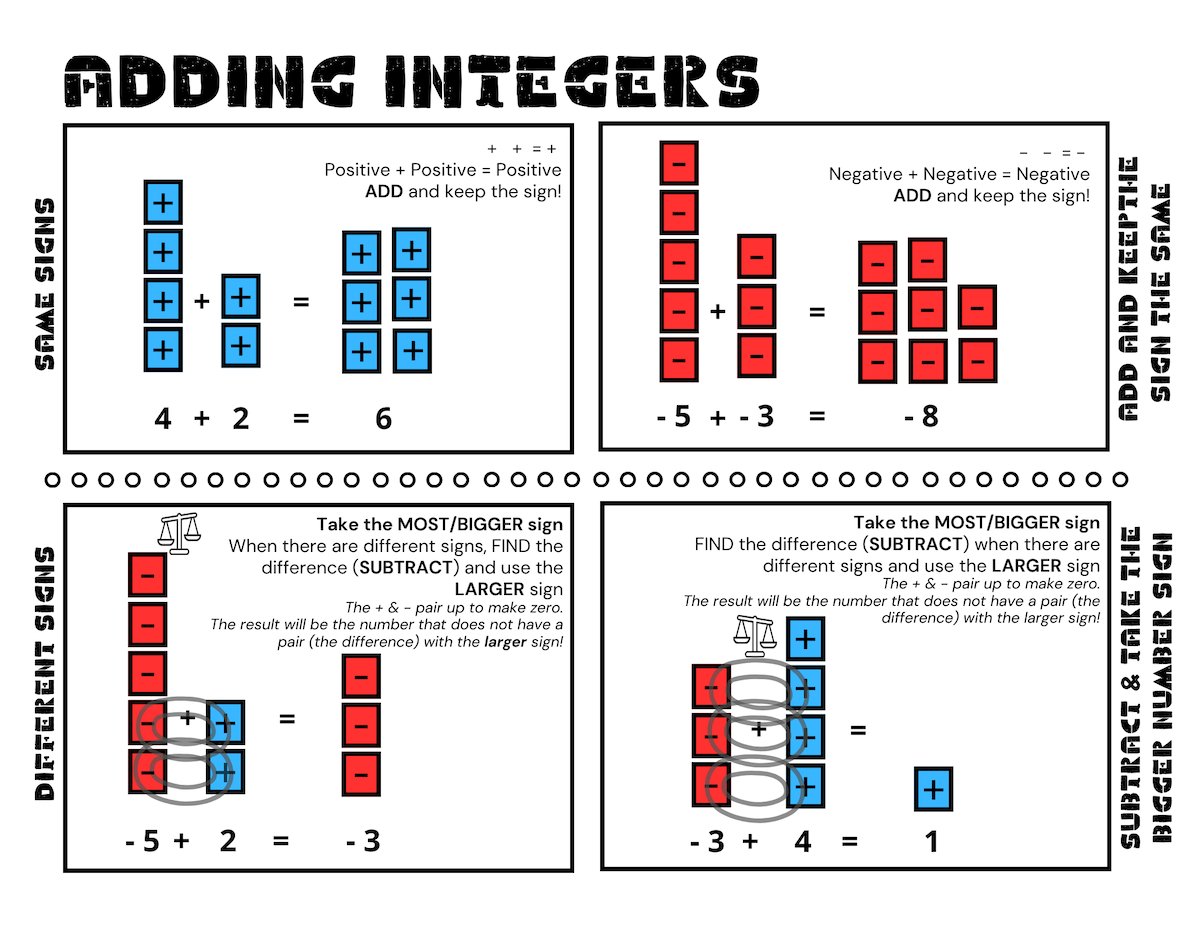
- Use Duplo to add integers. Use Duplo blocks: one color for positive numbers and another for negative numbers. Perform addition and subtraction with the Duplo/integers. For example, if you have -7 + 5, you’ll need 7 red Duplo and 5 yellow Duplo. Stack the Duplo on top or next to each other; the opposite colors will cancel out, leaving you with 2 red Duplo, resulting in an answer of -2. In the case of 2 – (-3), you’ll use 2 yellow Duplo and 3 red Duplo. Since it’s negative, you need to add the opposite, resulting in three yellow Duplo.
- Utilize the + and – paper method to solve equations. Instead of using numbers, represent them with the corresponding number of signs. Remember, every + and – pair cancels out to zero. + and – pair to zero. Print the positive signs (+) on a different colored paper (red vs yellow) than the negative signs (-). Start by using these symbols to solve equations. When you encounter a pair of a + and a -, they cancel each other out, resulting in zero. For instance, consider -3 + 2. You will have three negative signs (—) and two positive signs (++). Pair the + and – together, and you’ll be left with one negative sign. Therefore, your answer is -1.
- Use a number line to solve the equation. Move to the right for addition or positive values, and move to the left for subtraction or negative values.
- Integer Number Line Creation: (Long strip of paper or string, markers, and tape. Large floor number line from -10 to 10.) Have students create a large number line on the floor using a long strip of paper or string. They can mark integers from -10 to 10. Students can use this number line to practice adding and subtracting integers by physically moving to the correct position on the line as they solve problems. Step forward or hop for positive numbers and backward for negative numbers.
- Integer board games using color-coded positive and negative spaces.
- Create visual diagrams of integer operations with arrows and color coding.
- Design a poster or infographic showing how integer addition and subtraction work.
- Integer Chips Activity: (Connect 4 Chips: Red chips for negatives, yellow chips for positives.) Combine chips to model addition; remove zero pairs to simplify. Students combine chips to solve addition or subtraction problems, pairing one red with one yellow to make zero. For example, to add -3 and +5, they would place three red chips and five yellow chips and then remove the red chips to see the remaining quantity.
- Integer Investigation: (Various objects like blocks, counters, or colored tiles (red for negative, green for positive)). Have students represent integers using the objects. For example, use red tiles for negative integers and green tiles for positive integers. Challenge them to physically combine these tiles to solve problems like -4 + 3 or 5 – 7. They can visually see the process of combining positive and negative integers.
- Temperature Changes: (Thermometer graphic with temperatures from -20°F to 20°F.): Apply temperature changes (up for positive, down for negative) to simulate integer operations.
- Elevator Movement: (Elevator diagram showing floors above and below ground -5 to 5.)
- Students simulate elevator trips, counting positive moves upward and negative moves downward. alculate the integer operation.
- Mountain and Submarine Model: (A mountain above sea level and a submarine below.) Students place figures at coordinates to show positive altitude and negative depth.
- Hot Air Balloon Model: (Balloon with clouds above (positive) and below (negative) ground level.) Move the balloon up and down to represent adding and subtracting integers.
- Bank Account Simulation: (A balance sheet with credits (+) and debits (-).) Students add or subtract money based on transactions, showing how balances can go negative.
- Bank Account Transactions: (Play money, transaction cards.) Start with a balance. Draw cards adding deposits (positive) or withdrawals (negative). Compute new balances.
- Sports Scoreboard: (Scoreboard with positive points and negative penalties.): Apply scoring changes to calculate total points, modeling integer operations.
- Weather Gain and Loss Game: (A temperature chart with arrows indicating rise or drop.) Start with a temperature (e.g., 5°F). Draw a card showing a change (e.g., –7°F). Add or subtract.
- Frog Jump on a Number Line: (A laminated number line with a frog cutout.) Students make the frog jump forward for positive and backward for negative values, narrating integer operations.
- Integer Balance Scales: Set up balance scales and use weights to represent positive and negative integers. Students can add or remove weights to see how the balance changes, visually demonstrating the concept of adding and subtracting integers.
- Integer Balance Scale: (Balance scale, weights labeled with integers, and a set of integer problems.) Use a balance scale to represent adding and subtracting integers visually. For example, if a student has +3 and subtracts -2, they can place the corresponding weights on each side of the scale. After working through several problems, students can write a reflection on how the visual representation helped them understand the concepts better.
Manipulatives:
- Duplo/Lego
- Base ten blocks (tangible, picture, or draw square, line, dots..)
- 100, 10’s, 1’s coins
- Number Line
- Number Bond
- Cards – playing cards
- Dominoes
- Number tiles (like scrabble tiles)
- + and – coins. Use coins where heads signify positive or addition, while tails indicate negative or subtraction.
- Monkey Math Scale
- Ruler / Measuring Tape
- Beads/Beans … etc
- Part-Part-Whole
- Colored number blocks to represent different values: use yellow for positive and red for negative.
- Connect 4 game pieces for positive (yellow) and negative (red).
Bodily-Kinesthetic Intelligence
- Integer Board Game: (Game board, dice, game pieces, and integer cards.) Create a game board with spaces labeled with integers. Students roll the dice and move their pieces accordingly. When they land on a space, they draw an integer card that presents an addition or subtraction problem (e.g., “You landed on -4. Solve -4 + 7!”). The first player to reach a certain endpoint on the board wins, reinforcing their skills through play.
- Integer Race: (A large board with a racing track drawn on it, dice, and game pieces.) Set up a racing game where players advance by solving integer problems. The track can have spaces that require students to add or subtract integers based on where they land.
- Integer Number Line Relay: Create a large number line on the floor using tape. Mark integers from -10 to 10. Divide students into teams. Call out an integer addition or subtraction problem (e.g., -3 + 5). One student from each team runs to the number line to find the answer and places a marker there. The next student can only go once the previous one returns. The first team to finish wins.
- Integer Hopscotch: Draw a hopscotch grid with integers ranging from -10 to 10. Students take turns tossing a beanbag onto a number. They must then jump to that number and add or subtract a specified integer (e.g., “Jump to -2, now add 4. Where do you land?”).
- Integer Card Toss: Create cards with different integers (both positive and negative). Set up a target area a few feet away. Students take turns tossing the cards into the target while calling out the integer on the card. Then they must add or subtract that integer from a given number (e.g., starting at 0). Keep score for correct answers!
- Integer Scavenger Hunt: Hide cards with integers around a designated area. Provide students with a starting integer and a series of addition and subtraction problems they must solve by finding the hidden integers. Each found integer can be used to solve the next step in their math problem.
- Integer Balloon Pop: Write different integer problems on balloons filled with air. Students take turns popping the balloons and solving the problem inside. They can physically pop balloons using a safe method (like sitting on them). After solving, they can act out the solution, such as jumping up or down to represent positive and negative changes.
- Integer Tug-of-War: Create two teams and assign positive integers to one team and negative integers to the other. When a problem is called (e.g., 4 – 3), students must pull the rope in the direction of their assigned integers, demonstrating the concept of adding and subtracting through physical movement.
- Human Integer Walk: Assign a starting number to one student. Other students with integer cards join in, physically moving forward (positive) or backward (negative) as each operation is introduced.
- Hot Air Balloon Simulation: (Balloon cutouts, cloud cutouts, string number line.): Move the balloon up for positives and down for negatives. Practice adding and subtracting movements.
- Stacking Cups Challenge: (Red cups (negative), blue cups (positive).): Stack cups based on addition or subtraction problems. The net height represents the result.
- Integer Tug-of-War: (Rope with number line on the ground.) Teams pull toward positive or negative based on solving integer equations. Correct answers move the marker.
- Twister: Place equations on the various circles. Give it a spin! If a player lands on yellow, they must choose a yellow circle and solve the equation before they can place their hand or foot on it.
- Create a life-sized number line. When practicing addition, face the positive direction and move forward the corresponding number of spaces. For subtraction, face the negative direction and move forward that way that many spaces.
Musical-Rhythmic Intelligence
- Integer rhythm claps—students clap or stomp to represent positive and negative changes.
- Integer Song Challenge: Have students create a short song or rap about rules for adding and subtracting integers. Bonus if they include real-life examples.
- Musical Chairs with a Twist: Set up chairs in a circle, each labeled with an integer. Play music while students walk around the chairs. When the music stops, students sit in a chair and must add or subtract the integer on their chair with the integer on the chair next to them. They then share their answer with the group, reinforcing their understanding of integer operations.
- Math and Movement: Have students create a dance that represents adding and subtracting integers. Each movement can correspond to a specific integer (for example, jumping forward for positive integers and stepping back for negative integers). Students can perform their dances, reinforcing the concept through physical activity and music.
- YouTube: Add & Subtract Integers – Brain Pop, PBS Math Club- What is an Integer?, Numberock – Integers song: Absolute Value, McSantiMath – Integer Addition&Subtraction, Ellaine Limosinero – Integers Song, Math Antics – Adding & Subtracting Integer, PBS Math Club – trick for adding & subtracting, PBS Math Club-Adding & Subtracting Signed #’s, PBS Math Club- Subtracting Pos & Neg
Interpersonal Intelligence
- Integer Team Relay: Divide students into teams. Each team solves an integer problem on a whiteboard. The next team member can start only after the first solution is correct.
- Partner role-plays to explain integer addition and subtraction to each other.
- Integer War (Card Game): (Deck of cards with red = negative, black = positive.) Each player draws two cards. Add or subtract to see who has the higher total.
- Number Line Hopscotch: Create a giant number line on the floor. Students jump forward for positive numbers and backward for negative numbers.
- Integer Dice Roll: Use two dice: one for positive integers and one for negative integers. Students roll the dice to create integer addition and subtraction problems. For instance, if they roll a 3 (positive) and a 4 (negative), they can create the expression 3 + (-4) and solve it.
- Hot and Cold Temperature Game: Simulate daily temperature changes using positive and negative integers. Students add and subtract changes to find the current temperature.
- Integer Tug of War: Use a number line with a marker starting at zero. Teams move the marker forward or backward as they solve integer problems.
- Integer Puzzles: Create jigsaw puzzles where each piece has an integer problem and another piece has the matching answer.
- Integer Memory Match: Match cards with integer problems to their solutions.
- Sum It Up Relay: Teams race to solve a series of integer problems; each correct solution allows the next teammate to go.
- Integer Story Problems: Students write and share short word problems involving gains and losses to illustrate integer operations.
- Interactive Number Line Race: Online or physical number line where players race to the correct sum or difference.
- Integer Spinner Game: Spin for a number and a sign, then add or subtract as the rules dictate.
- Temperature Tracker Challenge: Keep a week-long temperature log with daily changes to practice cumulative addition and subtraction.
- Integer Escape Room: Solve integer puzzles to unlock codes for a classroom escape challenge.
- Positive or Negative Ball Toss: Toss a ball with integer problems written on it; the catcher solves the problem on their thumb.
- Integer Jenga: (Jenga blocks labeled with positive and negative numbers.): Pull a block and add/subtract it to a running total.
- Integer Jump Rope: Jump in place for positive and squat for negative; perform sequences to represent sums and differences.
- Integer Dominoes: Use domino-like tiles where one side is an integer problem and the other is the solution to match correctly.
- Integer Quiz Show: Host a classroom game show with rounds of integer addition and subtraction problems.
- Integer Temperature Race: (Game board with a number line, spinner with +/–.) Spin to move up or down the board. First to reach a target integer wins.
- Integer Scavenger Hunt: Organize a scavenger hunt where students find items around the classroom or school labeled with positive and negative integers. They can then create addition and subtraction problems based on the integers they find and solve them as a group.
- Integer Number Line Relay: Create a large number line on the floor using tape. Divide students into teams. Call out an integer addition or subtraction problem (e.g., -3 + 5). One student from each team must race to the correct position on the number line to show the answer.
- The first team to have all their members correctly place their answers wins.
- Integer Bingo: Create bingo cards with results of integer addition and subtraction problems. Call out different integer problems, and students must solve them and mark the correct answer on their bingo cards. The first student to complete a row or column shouts “Bingo!” and explains the problems they solved.
- Integer Scavenger Hunt: Set up a scavenger hunt where students need to solve integer problems to find the next clue. Each clue leads them to a location where they will find a new problem to solve that involves adding or subtracting integers. The final clue could lead to a small prize for the group.
- Role-Playing Integer Stories: Have students work in pairs to create short skits or stories that involve adding or subtracting integers. For example, they could act out a scenario where they are managing money (gains and losses) or tracking temperature changes. After performing their skit, they explain the integer operations involved.
- Integer Board Game Creation: In groups, students can design their own board games where players move around the board by solving integer addition and subtraction problems. They can include challenges or “chance” cards that require players to add or subtract integers to advance.
- Integer Art Project: Have students create a collaborative mural or poster that visually represents integer operations. Each student can contribute by illustrating a problem and its solution, using colors or symbols to indicate positive and negative integers.
- Integer War: Utilize cards (red for negative and black for positive). Aim to add, subtract, multiply, and divide as quickly as possible. In pairs, students draw two cards and create an integer addition or subtraction problem. The student with the highest total wins the round. Keep track of scores to see who wins the most rounds. This game promotes quick thinking and reinforces integer operations.
- Same Number / Same Shape: Each player starts with 7 cards (or you can play solo). Flip over a card. Players take turns, and they can match either the shape or the color. Remember, Red = Negative and Black = Positive. Add or subtract the value of their card from the card it’s placed on. If they get it right, they can leave their card there; if they’re incorrect, they skip their turn and keep the card. Toss a coin: heads = add, tails = subtract. If a player can’t make a move, they must draw another card. The first player to discard all their cards is the winner!
- I spy… Red cards represent negative values, while black cards signify positive ones. Arrange 8 (or even 40) cards face up on the board. Players will take turns. One player starts by saying, “I spy two cards that ADD, SUBTRACT, MULTIPLY, or DIVIDE to ______.” For example, they might say, “I spy two cards that add up to 14.” The other player must then guess which cards are being referred to. If the cards on the board include a 7 and another 7, they can guess one of those numbers to see if they are correct. If they successfully identify the two cards, they get to keep them. After that, add two more cards from the unused pile to the board. Continue taking turns. The player with the most cards at the end wins. (If playing with 40 cards on the floor, players can also collect any cards that match the total you called out.) The player with the highest card count at the conclusion of the game is the winner!
- Pyramid of Cards: Draw from a deck of cards, designating Black as positive and Red as negative. Select two to three numbers and create equations to eliminate the numbers. Start from the bottom of the pyramid and work your way up to the top. Document the equations on separate sheet of paper. Alternatively, you can choose a number or flip a card that the numbers must equal. Ensure that each equation includes one addition and one subtraction.
- Bring it On Up: Begin with a score of zero and draw a random card from the deck to serve as your addend. If the card is black, it counts as a positive value; if it’s red, it represents a negative value. The resulting sum will be your addend for the next round. Continue selecting new cards to determine your next addend. After nine rounds, the player with the highest total wins! As an alternative, you can choose to subtract instead. You can also flip a coin: if it lands on heads, add; if it lands on tails, subtract.
- War Order: Organizing Integers (or equations) from smallest to largest.
- Go Fish: In this game, RED cards represent NEGATIVE values, while BLACK cards signify POSITIVE values. Start by dealing five cards to each player (or yourself). Place the deck of cards in the center of the group or above this document. Choose a target number that everyone will use to adjust their hand. Players will then ask each other for numbers that can be combined to match the target number. When you find a pair that equals the target, lay them down on your paper. Variation: Flip over a card from the deck that everyone must match. After someone forms a pair, flip again to reveal a new number for addition or subtraction.
- War Add: RED cards indicate NEGATIVE values, while BLACK cards represent POSITIVE values. Distribute six cards to each player (or to yourself). Place the deck of cards in the center of the group or above this paper. Flip over a card and try to match that number using the numbers on this paper or in your hand. You can use two cards from your hand or the paper to either add or subtract to reach that number.
- Use Math Fact games for addition, subtraction, and multiplication for adding, subtracting, and multiplying positive and negative integers.
- Integer War Card Game: (Deck with positive and negative numbers. Or a deck of cards with black numbers as positive and red numbers as negative) Students flip cards and add or subtract values to determine net totals. Flip two cards and add or subtract the integers to win the round. To change whether you’re adding or subtracting, flip a coin (heads for addition, tails for subtraction).
- Battleship, Around & Around, Hunt Around the Room
Intrapersonal Intelligence
- Integer Scavenger Hunt: (Clue cards with integer problems (e.g., “What is -3 + 5?”)). Create a scavenger hunt where students solve integer problems to find the next clue. Each solved problem leads them to the next location. After completing the hunt, students can journal about the strategies they used and how they felt during the activity.
- Personal Integer Story: (Paper and colored pencils or markers.) Ask students to create a story that involves adding and subtracting integers in a real-life context (e.g., budgeting money, tracking temperature changes). They can illustrate their stories and present them to the class. This encourages personal connection to the material and allows for creative expression.
- APPS: IXL, KhanAcademy NCTM APP:Number Line
- Online Games: MathPlayground – ordering negative and positive numbers, MathPlayground – galaxy pals integers, MathPlayground -orbit integers, MathPlayground – SpiderMatch – FAST target sum, FunBrain – Line Jumper, MathPlayground Math Lines Integers, WordWall Subtracting Integers
Naturalistic Intelligence
- Weather Tracker Investigation: Track daily high and low temperatures for a week. Have students calculate changes using positive and negative integers, showing both additions and subtractions.
- Use weather temperatures (positive and negative) in a real-world integer game.
- Investigate seasonal trends and chart integer changes over time.
- Integer Relay Race: (Index cards with integers, cones or markers.) Set up a relay race where students must solve addition and subtraction problems using integers written on cards placed around a nature trail. They must run to a card, solve the problem, and return to their team.
- Provide your students or child with a fake money “allowance.” Each day, hand out “!” cards that indicate different scenarios: they may have made a purchase, owe someone money, lost some funds, or received a gift. Maintain a log to track their “money” activity.
Incorporating multiple intelligences into lessons on positive and negative integers allows all learners to connect with the material in meaningful ways. Through games, activities, and math investigations, students can develop both conceptual understanding and a genuine enthusiasm for math.
Get Your Adding and Subtracting Positive and Negative Integers Packet!
Adding and Subtracting Positive and Negative Integers

@engagethestages