
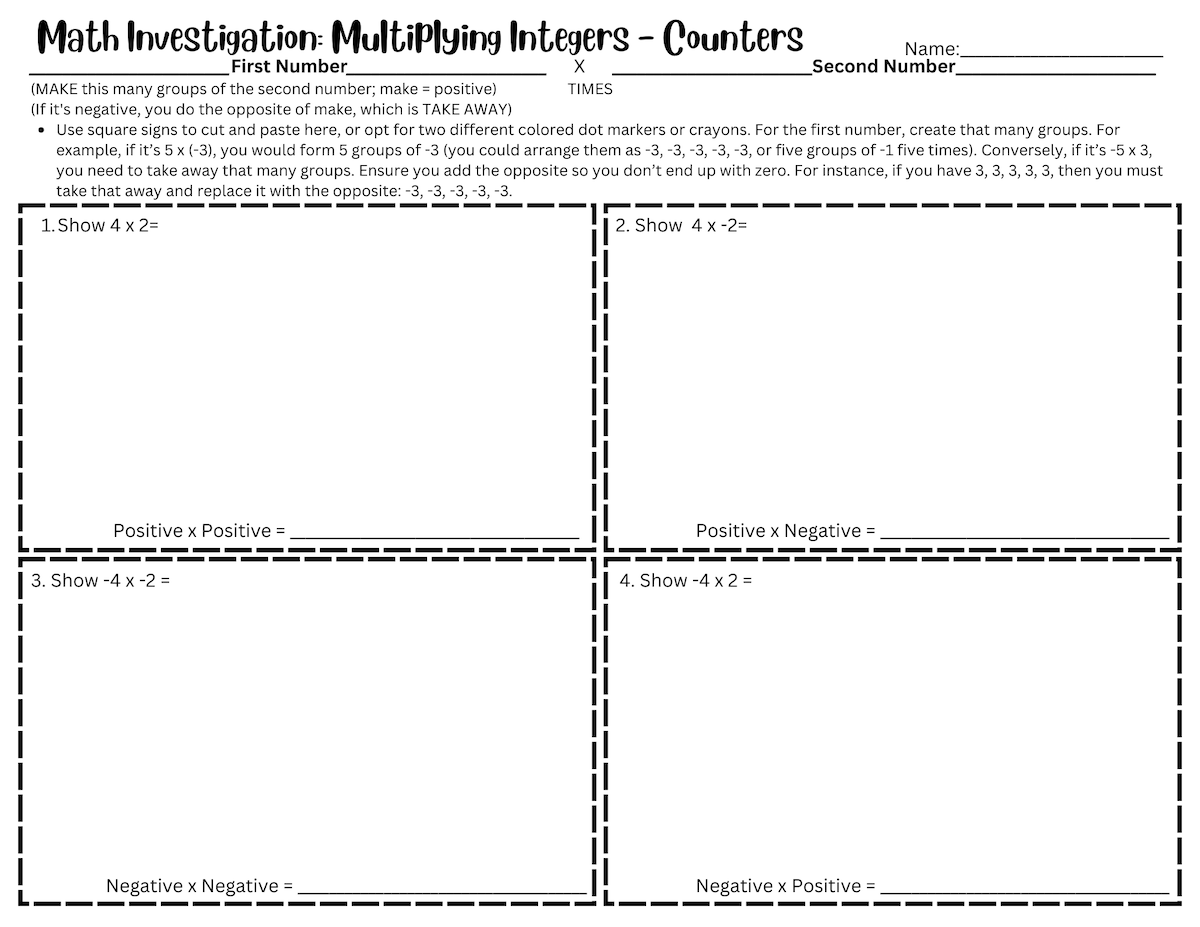
Teaching students how to multiply and divide positive and negative integers can be challenging. By incorporating activities that appeal to multiple intelligences, you can make learning interactive, meaningful, and memorable. Here’s a collection of games, math investigations, and hands-on strategies that engage every type of learner.
Linguistic
- Integer Story Problems: Students write stories that involve multiplying or dividing integers—like temperature drops or money owed.
- Integer Story Mapping: (Paper, markers.) Students create visual number stories for integer operations (e.g., “A diver dives 3 meters every 2 minutes”). Draw arrows up and down to show the movement, then calculate the product or quotient.
- Math Poetry: Encourage students to write poems or rhymes that incorporate the concepts of multiplication and division of integers. This could include using metaphors or similes related to numbers, helping them to verbalize their mathematical
- Every day, you buy a $5 smoothie. How much will her wallet be impacted after a week?
Logical-Mathematical
- Integer Number Line Game: Create a number line on the floor. Students draw integer cards and multiply or divide, then stand on or mark the result. Move in the direction to show how to get the answer.
- Integer Dice Roll: Roll two dice (positive and negative). Multiply or divide and record results to uncover sign patterns.
- Integer Puzzles (Puzzle pieces with integer problems and solutions) Create a set of puzzles where one piece has a multiplication or division problem and the other has the solution. Students must find matching pieces to complete the puzzle, reinforcing their understanding of integer operations.
Visual-Spatial
Start by multiplying 3×3, 3×2, 3×1, 3×0, 3x(-1) etc. Write the difference between each product as you solve. Based on the pattern, what do they think 3x(-1) would be.
- Integer Color Arrays: Draw arrays on graph paper using different colors for positive and negative products.
- Number Line Hopscotch: Jump to answers on a large chalk or tape number line.
- Integer Art Collage: Make collages illustrating different multiplication and division results using colors and shapes.
- Number Line Walk: (Masking tape, floor space, integer cards.) Create a large number line on the floor. Call out problems (e.g., -3 × 2). They physically move along the number line. Begin at the first number, then move according to the second number’s value. For instance, with 5×3, you go to five three times: 5, 10, 15. For -5×3, move to the left to -5 three times: -5, -10, -15. In the case of 5x-3, start at positive five three times: 5, 10, 15, and since it’s -3, flip the signs, resulting in -15. Lastly, for -5x-3, start at -5 and move left three times: -5, -10, -15, and because it’s multiplied by -3, flip the signs to get 15.
- Integer Color Arrays: (Graph paper, two colors of markers.) Students draw rectangles to represent multiplication (rows × columns). Positive areas are one color; negative areas are the other. Compare areas to visualize positive and negative products. For both positive, color in all yellow. For first positive and second negative color all red. For first negative then positive change yellow to red. For both negative change red to yellow.
- Integer Tile Multiplication: (Two-color math tiles (red = negative, yellow = positive).) Lay out rows and columns with tiles to represent factors. Flip tiles for negative rows/columns. Count the total to see the product. For division, group tiles into appropriate sets.
Manipulatives:
- Duplo/Lego
- Base ten blocks (tangible, picture, or draw square, line, dots..)
- 100, 10’s, 1’s coins
- Number Line
- Number Bond
- Cards – playing cards
- Number tiles (like scrabble tiles)
- + and – coins
- Number Line
- Beads/Beans … etc
- Part-Part-Whole
- Colored number blocks to represent different values: use yellow for positive and red for negative.
- Connect 4 game pieces for positive (yellow) and negative (red).
- Use coins where heads signify positive oraddition, while tails indicate negative or subtraction.
Bodily-Kinesthetic
- Human Number Line Hop: Students hop along a floor number line to show solutions.
- Integer Relay Race: Set up a relay course with different stations. At each station, students must solve an integer multiplication or division problem before moving on to the next.vUse cones or markers to designate each station, and have a timer to track how fast teams can complete the race.
- Multiplication & Division Card Toss: Create cards with various integer multiplication and division problems. Set up a target area (like a hula hoop or a box) at a distance. Students take turns tossing their cards into the target while calling out the answer to the problem on the card. If they make it they get points.
Interpersonal
- Group Role-Play Scenarios: Work in teams to solve real-world problems like budgeting or elevation changes.
- Integer Bingo – Fill bingo cards with integer answers from multiplication and division problems.
- Wheel of Integers – Spin a wheel to get two integers, multiply or divide, and score points for the correct answer.
- Integer Jeopardy – Solve integer problems in a quiz show format.
- Integer War – Card game where each card is an integer; players flip two cards and multiply or divide to compare results. Highest value wins.
- Integer Dominoes – Match problems to correct answers like traditional dominoes.
- Integer Tic-Tac-Toe – Solve a problem before placing a mark on the grid.
- Solve & Score Basketball – Shoot a mini basketball if you solve the integer problem correctly.
- Memory Match Integers – Match integer problems with correct answers.
- Dice Integer Game – Roll dice to generate integers, then multiply or divide for points.
- Integer Hopscotch – Hop to the next square after answering correctly.
- Flip & Solve – Flip cards to reveal integer operations, solve to collect points.
- Integer Puzzle Challenge – Complete a puzzle by solving problems for each piece.
- Math Jenga – Pull a block and solve the integer problem written on it.
- Integer Fishing – “Fish” for integer cards and solve to keep the catch.
- Integer Capture the Flag – Solve integer problems to capture flags on a digital or board game.
- Integer Rummy – Form sets based on correct integer answers to problems.
- Online Integer Battle – Compete against others in an online game solving integer problems quickly.
- Integer Card Flip Game: (Deck of playing cards (red = positive, black = negative).) Students flip two cards and either multiply or divide the values. Use a whiteboard to write the problem and show the sign rule visually with arrows.
- Integer Board Game: Design a board game where players move spaces by correctly answering multiplication and division questions involving integers. Include special spaces that allow for additional challenges or bonuses.
- Integer Board Game: Create a board game where students move around the board by rolling a die and performing operations based on the space they land on. For example, landing on a “multiply” space requires them to multiply the integer they have by another integer rolled on the die. Incorporate “challenge” spaces where they must solve a word problem involving multiplication or division of integers.
- Integer Relay Races: Set up a relay where students work in teams. Each team member must solve a multiplication or division problem involving integers before tagging the next teammate.
- Integer Scavenger Hunt: Hide cards with integer problems around the classroom or playground. In pairs, students solve the problems and find the corresponding answers hidden in other locations. This encourages collaboration and movement while applying math concepts.
- Same Number or Same Shape Multiply: Each player starts with 7 cards (or you can play solo). Flip over a card. Players take turns, and they can match either the shape or the color. Remember, Red = Negative and Black = Positive. Multiply the value of their card from the card it’s placed on. If they get it right, they can leave their card there; if they’re incorrect, they skip their turn and keep the card. If a player can’t make a move, they must draw another card. The first player to discard all their cards is the winner!
- Money: Draw two cards from a deck. Designate one color as positive and the other as negative (black = positive, red = negative). For example, if you draw a red 3 and a black 2, the calculation would be -3 x 2 = -6. In this case, you would owe the bank 6 cents. If the result is positive, you receive that many cents from the bank. Start with an initial amount of 30 cents and continue playing until the deck is exhausted. Whoever has the most money in the end is the winner!
- GO FISH: In this game, RED cards represent NEGATIVE values, while BLACK cards signify POSITIVE values. Start by dealing five cards to each player (or yourself). Place the deck of cards in the center of the group or above this document. Choose a target number that everyone will use to adjust their hand. Players will then ask each other for numbers that can be combined to match the target number. When you find a pair that equals the target, lay them down on your paper. Variation: Flip over a card from the deck that everyone must match. After someone forms a pair, flip again to reveal a new number for multiplication or division.
- Bring it on WHERE? Begin by selecting the number 1, then randomly draw a card from the deck for multiplication. RED cards represent NEGATIVE values, while BLACK cards signify POSITIVE values. The product you generate will be used as the factor for the next round. Continue drawing new cards to multiply by the new product. After 9 rounds, the player with the largest number wins!
- I spy… Red cards represent negative values, while black cards signify positive ones. Arrange 8 (or even 40) cards face up on the board. Players will take turns. One player starts by saying, “I spy two cards that ADD, SUBTRACT, MULTIPLY, or DIVIDE to ______.” For example, they might say, “I spy two cards that add up to 14.” The other player must then guess which cards are being referred to. If the cards on the board include a 7 and another 7, they can guess one of those numbers to see if they are correct. If they successfully identify the two cards, they get to keep them. After that, add two more cards from the unused pile to the board. Continue taking turns. The player with the most cards at the end wins. (If playing with 40 cards on the floor, players can also collect any cards that match the total you called out.) The player with the highest card count at the conclusion of the game is the winner!
- Spiral: Lay out a circle or game board of cards. Start at one end and first person to get to the end wins, or just keep going around the circle for 5 minutes. Roll a die. Go that many spaces. Flip a card and them multiply the number you land on to the card you flipped. Red cards = negative, black cards = positive.
- Pyramid: Set up cards randomly in a pyramid shape. Red cards = negative, black cards = positive. Start at the bottom. Pick any two cards next other or diagonal. Multiply. If correct remove from the pyramid and keep the cards. Move up the pyramid. Can’t pull from top or middle until you get there. Person with the most cards, when all the cards are picked up, wins.
- Battleship and twister
Intrapersonal
- Solo Puzzle Challenges: Work independently to match problems with solutions.
- Multiplication and Division Stories: (Story templates and art supplies.) Have students create their own stories involving scenarios that require multiplying or dividing integers. Encourage them to illustrate their stories and share them with the class.
- Integer Game Show: (Whiteboard, markers, and game show buzzers.) Set up a game show format where students can compete individually to solve integer multiplication and division problems. Include different categories with varying difficulty levels.
- Online Games: MathPlayground Math Lines Integers, MathPlayground Integer Warp, MathNook, Mathnook – Number Crunch Integer Mult, Mathnook – Number Crunch Integer Divide
Musical
- Math Songwriting: Encourage students to write songs or raps about multiplying and dividing integers. They can incorporate specific examples and rules into their lyrics.
- Musical Chairs Math: Adapt the classic game of musical chairs to include integer operations. Place chairs in a circle, each labeled with an integer. When the music stops, call out a multiplication or division problem, and students must find the chair with the answer.
- Musical Integer Line: Set up a large number line in the classroom with positive and negative integers. Play music and have students walk along the number line. When the music stops, call out a multiplication or division problem, and students must move to the correct position on the number line based on their answer.
- YouTube: Math Antics, Math with Mr. J, Math Antics – Integer Multiplication & Division, PBS Math Club, Multiplying Pos & Neg #’s, PBS Math Club Dividing Pos & Neg #’s, Colin Dods – Multiplying Negative, McSantiMath- Quotient Product Sign, Scam Squad Math Multiplying Dividing
Naturalistic
- Garden Graphing: Multiply rows and columns of plants to represent integer products.
- Nature Scavenger Hunt: Collect and group natural items to practice integer operations.
- Group Projects: Assign a project where students create a presentation on a real-world application of multiplying and dividing integers (e.g., cooking, budgeting). They will need to collaborate, divide tasks, and present their findings, enhancing both their math skills and interpersonal abilities.
By tapping into multiple intelligences, you can make learning to multiply and divide integers active, visual, musical, reflective, and fun. Every student finds an entry point to understand the rules, discover patterns, and enjoy math!
Get Your Multiplying and Dividing Positive and Negative Integers Packet!
Multiplying and Dividing Positive and Negative Integers

@engagethestages