
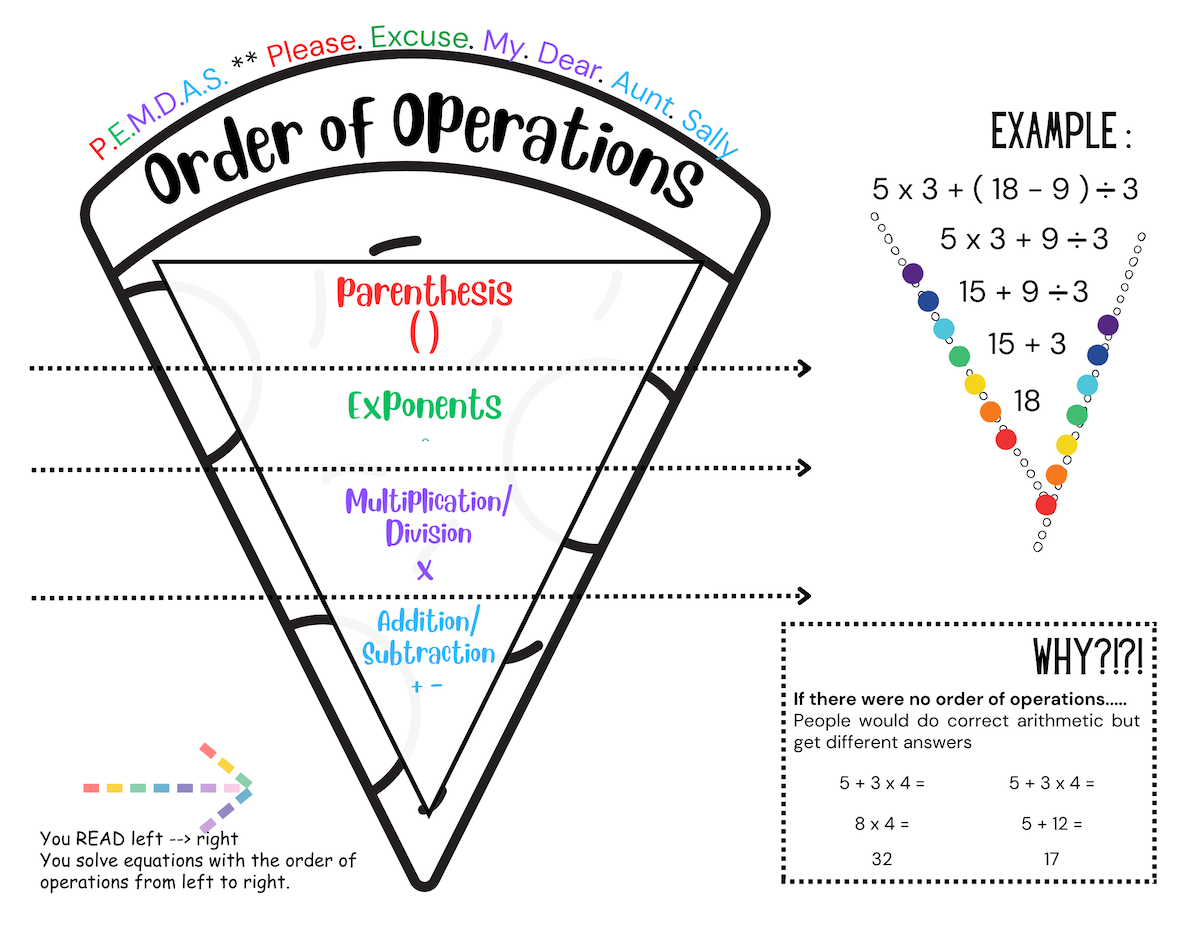
Engaging Multiple Intelligences to Master Order of Operations (PEMDAS)
Learning the order of operations, or PEMDAS, can be a fun and memorable experience when we tap into different learning styles. By designing activities around multiple intelligences, students can deepen their understanding and retain skills more effectively. Here’s how to engage various intelligences in your math classroom:
Logical-Mathematical Intelligence
- Always do the same order to get the same answer.
- Start with AS first and have a line of them A/S. Then, MDAS. Then, Parenthesis. Then, Exponents.
- WHY – Background Knowledge: To solve 2 + 3 x 4, consider this: one person calculates 5 x 4, resulting in 20, while another computes 2 + 12, which equals 14. Maintaining the same order in calculations will yield consistent answers.
- You read from left to right, and when solving problems, you follow the order of operations in the same left-to- right manner.
- Utilize number tiles (similar to Scrabble pieces, but featuring numbers) or cards to outline the next steps visually. For instance, if you have 3 + 4 x 2 = , you would arrange the tiles to show 3 + 8 = and place 11 underneath.
- Write in the missing number in the Order of Operations.
- Have all the different steps of solving one problem on different strips of paper. Mix up the order then put it in the correct order.
- Multiple choice of which operation comes first.
- Have random numbers in a line equal to a number. Students must write in the correct operations to achieve the answer.
- Give students random numbers and operations out of order. They must put the numbers and operations in the correct order to make it true.
- Have cards that say each step of PEMDAS. Mix up the cards then put the cards in the correct order of operations.
- Progressive problem sets that increase in difficulty.
- Student-created puzzles where they invent and exchange unique PEMDAS challenges.
Linguistic Intelligence
- Math storytelling or comics where characters solve problems to progress.
- Mnemonic poems and rhymes to remember the PEMDAS sequence.
- Books: P.E.M.D.A.S. The Story of the Order of Operations – Kim Huffstetler, PEMDAS Gets Lost – Rachel McNerney
Visual-Spatial Intelligence
- Highlight the parentheses in red, the exponents in green, the multiplication and division in blue, and the addition and subtraction in purple, following the colors of the rainbow. Begin with the red parentheses and proceed from left to right, addressing all the signs first. Alternatively, you can simply circle the operations that need to be prioritized.
- Create a flip book. At the top, write the equation. The flap underneath should contain the next step. Beneath this flap, indicate which part of PEMDAS they are addressing, such as Parentheses or Exponents.
- Mystery pictures or art projects where solving problems reveals an image.
- Flowcharts or colorful problem maps to illustrate step-by-step operations.
- Color-Coded Steps Chart: Create a visual chart where each PEMDAS step (Parentheses, Exponents, Multiplication/Division, Addition/Subtraction) is shown in a unique color. Solve a practice problem step-by-step, highlighting each operation in its corresponding color.
- PEMDAS Flow Diagram: Make a flowchart showing the decision path for solving problems in order. Trace each operation in a sample problem through the flowchart to ensure the correct sequence.
- Layered Equation Art: Write a complex problem and use transparent overlays for each step. Reveal and color-code steps one at a time to see how the equation simplifies.
- PEMDAS Pyramids/Pizza: Build a pyramid/pizza where the top has the initial numbers and operations, and each row shows simplified results. Solve top-down, combining operations according to PEMDAS.
- Interactive Problem Map: Create a visual map where each operation leads to a new node or box. Students follow arrows from one step to the next, checking for correct order.
- Equation to Picture Reveal: Assign different colors or patterns to problem answers on a grid. Solve PEMDAS problems and color the corresponding grid cells to slowly reveal a hidden image.
- PEMDAS Domino Chain: Each domino shows an operation or partial solution. Solve and match dominoes in correct order to complete the chain.
- Operations Sorting Cards: Prepare cards with various operations and numbers. Arrange cards visually to solve the equation in steps, grouping by PEMDAS priority.
- Equation Path Maze: Draw a maze where each junction offers a choice of next operation. Solve problems along the correct PEMDAS path to reach the maze’s exit.
- PEMDAS Staircase Poster: Students create a stair-step poster that visually shows the sequence: Parentheses → Exponents → Multiplication/Division → Addition/Subtraction. They solve sample problems by moving up or down the staircase.
- Operation Blocks Sorting: Provide wooden or foam blocks labeled with numbers and operations. Students physically stack blocks in the sequence they must solve according to PEMDAS.
- Math Wall Mural: Assign teams to create giant illustrated equations on the wall, showing each operation in a visual sequence to reinforce spatial understanding.
Manipulatives:
- Duplo/Lego
- Base ten blocks (tangible, picture, or draw square, line, dots..)
- Cards – playing cards or uno
- Number tiles (like scrabble tiles)
- Play-doh: the operations with Play- Doh and the numerical values on cards
- Mega-Bloks: Label them with parentheses, exponents, multiplication, division, addition, and subtraction. Arrange them in the correct order from top to bottom to learn how to solve equations effectively.
Bodily-Kinesthetic Intelligence
- Math obstacle courses where each station has a problem to solve.
- Relay races and Math Basketball, combining problem-solving with physical challenges.
- Equation Relay Race – Teams race to solve multi-step equations. Students physically run to different stations where each station represents parentheses, exponents, multiplication/division, or addition/subtraction.
- Operation Hopscotch – A hopscotch board is designed with PEMDAS steps. Students hop to the correct square as they solve each part of an equation.
- Math Obstacle Course – An obstacle course contains equations with steps to solve physically presented along the route. Students must complete the course in the order of operations.
- PEMDAS Floor Puzzle – Large floor cards with numbers and operations are spread out. Students physically arrange themselves and the cards to show the correct operation order.
- Operation Simon Says – A kinesthetic twist on Simon Says, where students only move when the command represents the correct next step in solving the equation.
- Giant Equation Building – Using foam numbers and operation symbols, students physically build and solve giant equations on the floor, moving through each step of PEMDAS in sequence.
Musical Intelligence
- Please Excuse My Dear Aunt Sally
- Create a PEMDAS song or chant to reinforce the order.
- Order of Operations Dance – Each operation has a unique dance move. Students perform the moves in sequence as they solve equations together.
- YouTube: Generational Genius – Intro Order Operations, Math Antics – Order of Operations, Math with Mr. J, FtBelvoirES- Math Rap by Mr. Tomai’s class, Julie Roros – PEMDAS Shuffle, Numberock – Order of Operations Song, Silly School Songs – The Order of Operations, Learningscienceisfun- PEMDAS rap, The Singing History Teachers – Please Excuse My Dear Aunt Sally, Flocabulary – PEMDAS
Interpersonal Intelligence
- Team-based escape rooms or scavenger hunts with PEMDAS chains.
- Board games or competitive team solving to encourage cooperative learning.
- PEMDAS Relay Race: Teams solve problems in sequence, passing the marker after each correct answer.
- Math Bingo: Bingo cards with answers; call out PEMDAS problems as clues.
- Escape Room Challenge: Solve chained PEMDAS problems to unlock the next clue.
- Board Game Path: Move along a path by solving problems correctly.
- Flash Card Duel: Flip a card with a problem; first to solve correctly wins the round.
- Math Jeopardy: Categories for parentheses, exponents, multiplication/division, and addition/subtraction.
- Scavenger Hunt: Solve problems to find the next location or clue.
- Digital Quiz Show: Use platforms like Kahoot or Quizizz for speed-based solving.
- PEMDAS Puzzle Pieces: Solve problems to get pieces that form an image or message.
- Math Basketball: Shoot a ball or paper wad after each correct computation.
- Roll & Solve: Roll dice to create random PEMDAS problems to solve.
- PEMDAS Ladder: Climb a ladder board with each correct problem answered.
- Escape the Labyrinth: A maze where each path is unlocked with the right solution.
- Beat the Clock: Solve as many problems as possible in a set time.
- Matching Game: Match problems with their correct answers in a card flip style.
- Mystery Picture: Color a grid based on problem answers.
- Classroom Knockout: Students solve to stay in the game; wrong answers mean sitting down.
- Problem Swap: Students create problems for peers to solve.
- Order of Operations Story: Solve problems to advance a character or story.
- Math Obstacle Course: Physical stations with problems to solve before moving on.
- CLASS – Relay Race: Group of 4. Arrange participants either in a single row or split into two groups facing each other across the room. The first person receives an equation and writes down the initial step. They then pass it to the next person (either behind them or in their group), who writes the subsequent step. Continue this process until the problem is solved and then bring it for review. If the solution is correct, the group earns a point and moves on to the next problem. If incorrect, the group must collaborate to identify the error. The first team to complete the designated number of problems is declared the winner!
- Snakes and Ladders, Spin and Solve, Roll the Die and Solve,
- Board Games: Didax PEMDice Order of Operations Game, Adsumudi
Intrapersonal Intelligence
- Math journals to record strategies and track progress.
- Self-assessment with graduated problem levels to build confidence.
- Online Games: WordWall – Order of Operations, Arcademics – Jumping Aliens, Arcademics – Martian Hoverboards, Arcademics – Skateboard Pups, MathPlayground – PEMDAS Exhibit
- IXL, Khan Academy NCTM APPS: Partial Product Finder, Number Pieces, Number Line
Naturalistic Intelligence
- Outdoor scavenger hunts with PEMDAS problems at each stop.
- Real-world scenarios about plant growth, patterns in nature, or animal groups
- Use blocks or popsicle sticks to represent equations. Write the equations in sand or dirt for a creative touch.
By incorporating activities that speak to all eight intelligences, learning PEMDAS becomes not only more effective but also more enjoyable. Try mixing and matching these approaches to keep every student engaged and invested in mastering the order of operations!
Get Your Order of Operations PEMDAS Packet!
Order of Operations
PEMDAS

@engagethestages