
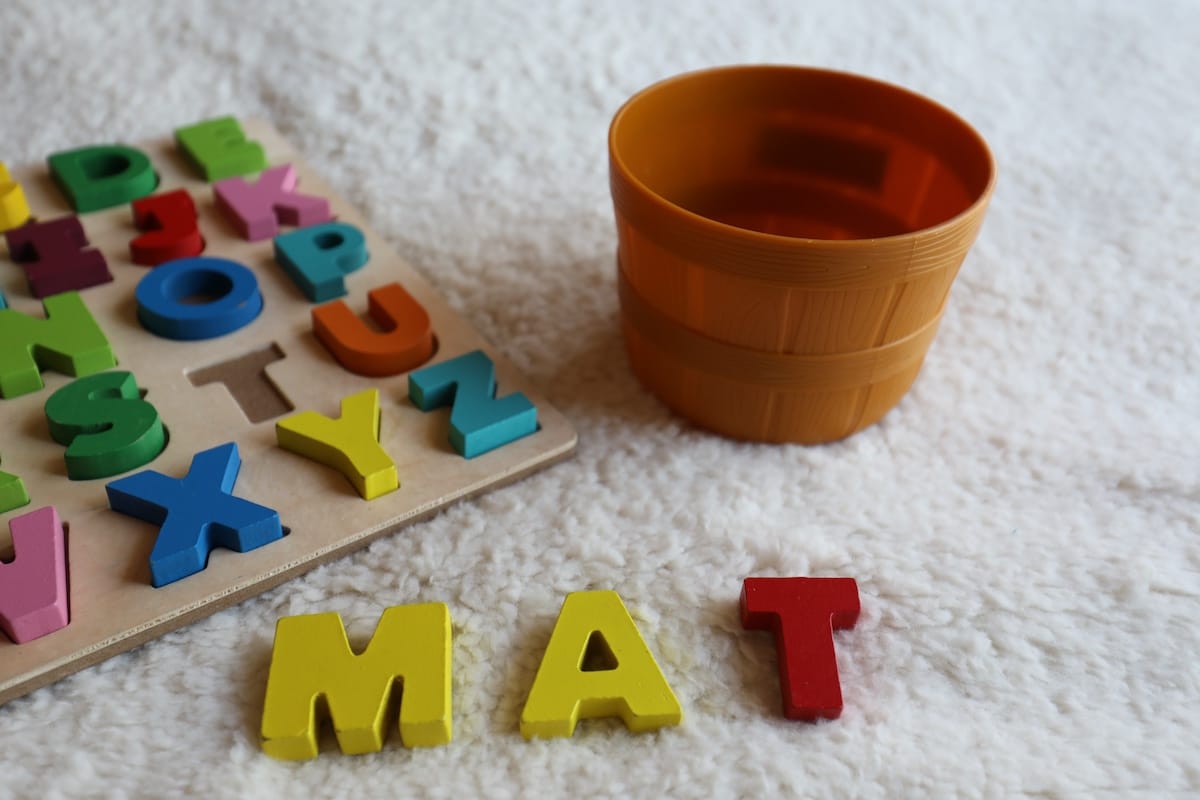
Exploring Ways to Learn the First Step in Reading Through Multiple Intelligences – a standout being Banana Gram

Visual/Kinesthetic:
- Use Banana gram tiles or chunky alphabet pieces to point to each letter and make the corresponding sound. Place the Scrabble-type pieces down individually for each letter in a word, such as “mat” by starting with “m,” placing the tile down, saying the sound, then proceeding with “a” and “t” before reading the word.
- Variation: Touch each letter as you lay them down in order, saying the sounds, then push up each letter as you sound it out. For “mat,” push up the m as you say the “mmm” sound. Push up the a as you say the “aaaa” sound then push up the letter t as you say the “ttt” sound. Then blend and point at each letter as you slide under them and say “mat.”
- Write the word on a whiteboard with circles under each letter, tap each circle while saying the sound, and then write the word again with a line under it, blending the sounds to say the full word. For example, if you have m a t, they would each have a circle under and say each sound when pressing the dots. Then under the next word, you would have mat with a line under and say mat.
- Variation: For added engagement, color-code each letter differently (e.g., green for the first letter, yellow for the middle sound, and red for the last letter) before reading the word in black to blend the sounds seamlessly.
Linguistic:
- “Crack the Code”: Display three pictures in a row. Identify the initial (first) sound of each picture and write it below. Form a new word and read it aloud.
Interpersonal:
- Present a picture or a toy. Utilize Banana Gram tiles or chunky alphabet pieces to spell out the word underneath. Spell the word, sound it out, and blend the sounds to check spelling. For a twist, write the word. Engage in a partner activity where you reveal the word you spelled. Let them read it, show them the picture after they read it to check for accuracy, then switch roles.
Bodily-Kinesthetic:
- Write letters on the ground using chalk. Jump to each sound, then run across to say the word. For example, write the word “c a t” twice with spaces between the letters to jump and sound out each letter individually, then say “cat” together while walking or running.
- Another idea is to use a ladder and place each letter (on paper) of a word in it. Jump under or on each letter on the ladder to sound out each sound, then run under the word from the beginning to the end to blend and say the word.
- Try putting play dough under each letter and squish it as you say the sound. For instance, take the word “mat.” Create small circles of play dough and place them under each letter. Press down the play dough while pronouncing the sounds. When you say “m,” press down the play dough under that letter. Repeat this for each letter and then combine them to say the complete word.
- Roll a car under each sound and say the sound (have the car stop under each letter as you say the sound). Then, as each sound is pronounced, let the car move continuously and articulate the complete word. For instance, with “mat,” position the car under the ‘m’ and say “mm,” proceed to the ‘a’ and pause to say “aa,” move on to the ‘t’ and say “t,” and finally, return to the ‘m,’ driving past all the letters while vocalizing “mat.”
- CHOP: For “cat,” use hand gestures to represent each sound. Place your palms together and make a chopping motion for each sound: “C” chop, “a” chop, “t” chop. Then, swipe your hands from left to right while saying “cat.”
- Sign each letter when segmenting the letters when reading, then make a sign for the full word and read the full word.
First, Second, Third (Logical-Mathematical):
- Explain the sequence of reading a word: the initial letter corresponds to the leftmost sound. Order 1-2-3, etc., to break it down into steps, illustrating moving from left to right and identifying the first, second, and third sounds. First, articulate the initial sound of the word, followed by the second sound, then the final sound, and finally, blend all the sounds together. As an alternative, use fingers to count each sound while vocalizing it, then blend them together.
Musical:
- YouTube songs and videos showing the child how to sound out and read the words:
- Videos on YouTube to learn how to read – Jack Hartmann – Stretchy the Word Snake Phonics Song, Kiddos World TV – Learn to Read – 3 letter words, Epic Phonics – Practice Blending Sounds for Reading – CVC words, Apple Toast Kids – Segmenting Phonemes, KIDSTV123 – Everybody’s Reading Now – CVC Phonics Song, Epic Phonics – CVC Words Phonics Blending Song, Jack Hartmann – word families, Jack Hartmann – rhyming.
Apps (Intrapersonal):
- Apps you do not have to pay for: Khan Academy Kids, Duck Duck Moose Reading, Duck Duck Moose Word Wagon, Duck Duck Moose Fish School, and Teach Your Monster to Read. Apps to pay for: Reading Eggs, OSMO Little Genius – ABC and OSMO Words Classic (Junior) – ABC Tiles.
Decodable Books & Activities:
Beginner Books:
Beginner Books
Choose which 3 letters to start learning with corresponding books to read

@engagethestages
Beginner Book Activities:
Beginner Book Activities
Activities to play and do with each corresponding books and letters being introduced

@engagethestages
Book 2: Word Families
Book 2: Word Families
25 Books with 8 pages per book for each word family

@engagethestages
Book 2: Word Families
Book 2: Word Families Activities
9 Activities to do per book and word family

@engagethestages
Book 3: Vowels
Book 3: Vowels
11 Books with 8 pages per book for each word family

@engagethestages
Book 3: Vowels
Book 3: Vowels
100 Pages of Activities to do with vowels

@engagethestages