
There are many engaging and educational ways to cater to different learning styles to learn how to add. Here are a few ideas:
Bodily-Kinesthetic:
- Scavenger Hunt: Set up a scavenger hunt or an obstacle course where children must solve addition problems to find clues or complete tasks. This way, they can learn through movement and hands-on activities.
- Create a life-size number line by adding numbers and physically moving or jumping to each point.
- Use a life-size ten frame to practice addition.
- Create a life-sized number bond using chalk on the ground, or large bowls, and using two different colored objects to place in cups or to dump.
- Create a chart that assigns each number 1-10 to 1-20 a movement. For example 1 would be jumping. Flip two cards or roll two dice and add the numbers. Look on the chart for your answer and do that assigned movement.
- Passport: Decorate rooms based on themes. Solve all challenges or equations scattered around the room accurately. Keep a record of your answers. Receive a stamp for each decorated room or space. Design new rooms or spaces with different themes to earn additional stamps.
- Twister: Place equations on the various circles. Spin the spinner. If it lands on yellow, players must select a yellow circle and solve the equation before placing their hand or foot on it.
- Tape math equations around the room. Participants can move around, solve the equations, and write them down to keep track of their answers.
- Make a base ten necklace out of fruit loops to 100. Use 10 reds then 10 yellows then etc.
Visual-Spatial:
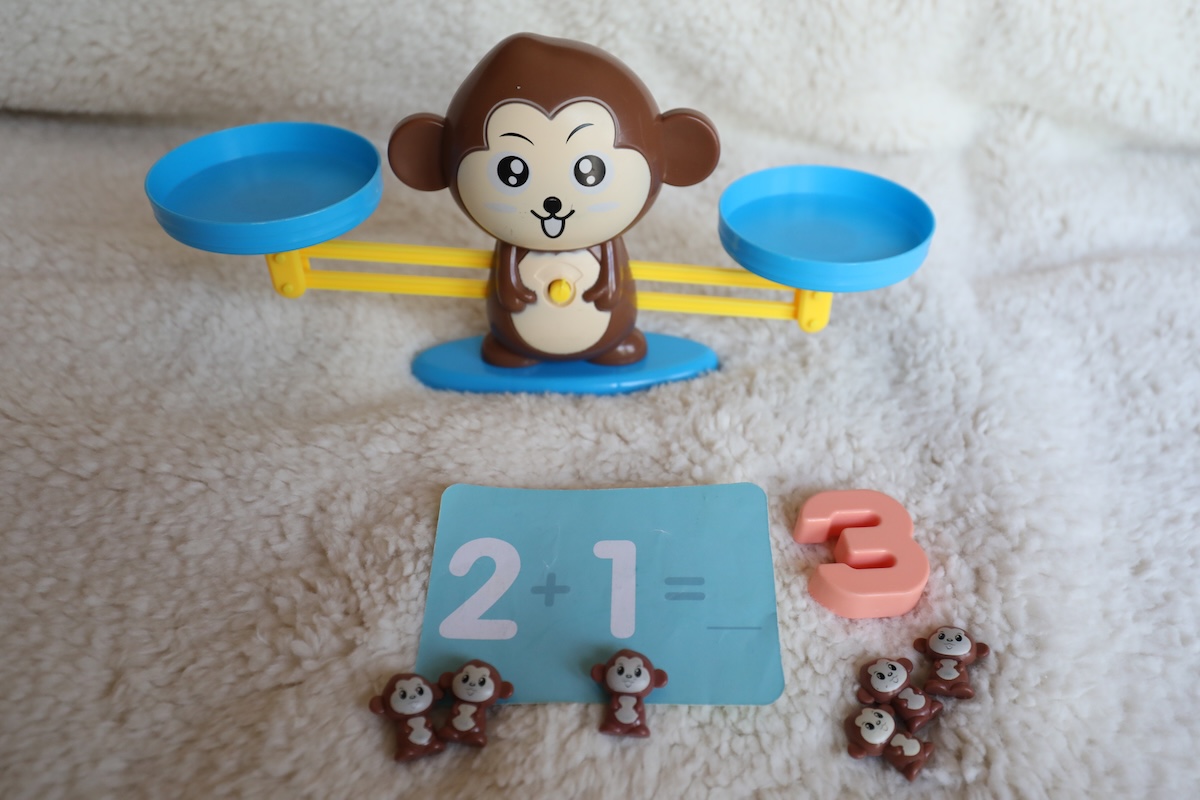
- Monkey Scale, do it yourself scale, number line, number bonds, ten frames, tangible objects, part-part-whole, and hide and seek.
- Visual Aids: Use visual aids like number lines, blocks, or interactive digital apps where children can physically manipulate objects to understand addition concepts better.
- Manipulatives: Duplo/ Lego/ Base ten blocks (tangible, picture, or draw square, line, dots…), 100, 10’s, 1’s coins, Number Line, Monopoly money/Fake Money
- Cards – playing cards or Uno, Dominoes, Number tiles (like Scrabble tiles), Beads (like Montessori but make your own), Tens Frame, Number Bond, Part-Part-Whole, Hundreds Chart, Beads, Beans, play-doh, etc., (Monkey Math) Scale.
Linguistic:
- Stories: Create a story-based math problem where children solve addition problems to progress through the narrative. Each correct answer reveals the next part of the story, keeping them motivated to continue. Create a comic. Solve and create word problems.
- Some children books to read to reinforce adding: 100 Snowmen – Jen Arena, Quack & Count – Keith Baker, Ten Apples Up on Top – Dr. Seuss, Addition Annie – David Gisler, Ten Flashing Fireflies – Philemon Sturges, 12 Ways to Get to 11 – Eve Merriam, Animals on Board – Stuart Murphy. For the book: One Is a Snail Ten Is a Crab – April Sayre, have them come up with their own equations for a number using the feet.
- While reading a book, add the side by side pages. For example if reading a numbers book, add the page 3 and 4. 3+4 = count all the objects.
Musical:
- Music: Incorporate songs or rhythms into learning addition. Create catchy tunes that involve adding numbers or use rhythm clapping games where each clap represents a number to be added.
- On YouTube Jack Hartmann has counting to 100 (go on Numberock and count in another language to 100), count by 10’s, count by 5’s, and count by 2’s. Also he has counting backwards from 100. Also Jack Hartmann has Move and Add as well as Learn Our Addition Facts. While listening, some kids can hear the pattern which helps them with the concept and retain more math facts. There is also Harry Kindergarten (Add with a pirate), KLT (The addition Math Song), Numberock (Math Facts). Also, find the counting to 100 in another language and learn it in that language.
Interpersonal:
- Group Activities: Organize group activities or games where children work together to solve addition problems. This could be in the form of board games, card games, or collaborative projects.
- Board Games to buy: Shut the Box, Adsumudi, Uno, Monopoly Jr., and Lakeshore Pop & Add to 20.
- Domino War: Each person flips a domino. The first person to add up the numbers on their domino wins.
Intrapersonal:
- Journals: Provide individual learning stations or journals where children can work on addition problems at their own pace, reflecting on their strategies and progress.
- Place cards numbered from 1 to 20 in a row. Under each card, write down or place addition facts that equal that specific number.
- Arrange cards in order from 2 to 12 or 2 to 20. Flip two cards or roll two or three dice and add the numbers. Flip over the card that matches the sum. Continue this process until all the cards are flipped over.
- Don’t Eat Pete! Create a 3×3 game board featuring math equations on each square. Place goldfish on each equation and enjoy eating them when they are answered correctly.
- Technology: OSMO: Fish (number tiles), Math Wizard (Magical Workshop), Pizza
- NCTM APPS: Number Frames, Number Line, Number Pieces, Number Chart
- APPS: IXL, Khan Academy Kids, Pet Bingo (Duck Duck Moose), Park Math, Moose Math, MathSeeds (on Reading Eggs), Frog Jumping on the number line, Kid Math Fun
- Online: Arcademics.com – Alien Addition, arcademics.com – Jet Ski Addition, arcademics.com – Kitten Match, Fun4theBrain – addition, Funbrain – Math Baseball, arcademics.com – tugboat addition, and Learning Upgrade App – Add Count
Logical-Mathematical:
- Puzzles: Design a series of puzzles or brain teasers that require solving addition problems. For example, Sudoku or magic squares can be adapted to include addition elements.
Naturalistic:
- Nature: Use nature-related themes and objects to teach addition. For example, counting and adding leaves, stones, or flowers during outdoor activities can make math more relatable and enjoyable.
- Use your fingers to count while in the car.
- Add things in nature while driving or while at the park.
- Count the number of flowers or leaves, and write down the equation in the dirt.
By incorporating these multiple intelligences into addition games, you can create a more inclusive and stimulating learning environment that caters to the diverse strengths of all students.
This and more math investigations and games are included here:
Introduction to Adding Packet:
High-Quality Introduction to Adding Packet
Introduction to Adding
Over 100 pages of games and activities to practice adding and understanding the concept of adding

@engagethestages