
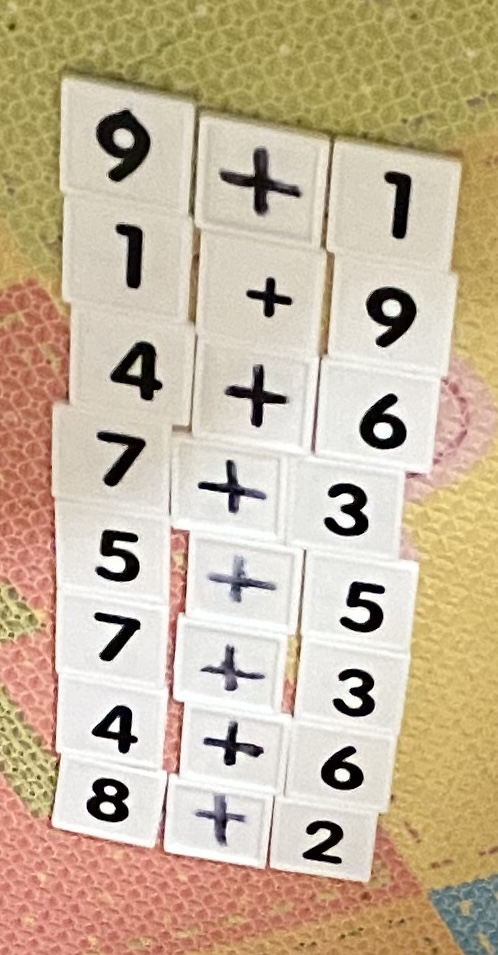
Over 60 games that can be used with addition, subtraction, multiplication, or division to master those math facts! Can also be used practicing flashcards with other types of math concepts.
Games:
- Kerplunk, CandyLand, Jenga, Monopoly, Monkey Banana, etc. Any board game can be transformed with an equation twist. Get an equation, if answered correctly then you get to move. Have to answer an equation correctly before getting to play your move.
- TOWER: Build a tower by rolling dice or flipping a card, then add that many blocks to your tower or create separate towers for each number. Keep adding on. Or separate towers with each number in the equation and add the two towers.
- MUSICAL NUMBERS: Move around number squares on the floor until the music stops, then say the equation and answer. For the answer jump that many times.
- Add/Subtract while driving. Listen to number songs (Jack Hartman & Numberock).
- COLOR: Engage in a colorful activity: Draw a flower, roll two dice or flip two cards, and draw in that many petals. One color for the first number, and another color for the second number. Write the equation and answer under the flower.
- LADDER: Transform a ladder into a learning tool by writing equations on it with chalk and calling out a number for children to find the equation that equals that number.
- CAR: Solve equations together while in the car.
- CONES: Place numbers on cones, call out an equation, and have children run to the corresponding cone that is the answer to the equation. Or reverse and put equations on cones, call out a number, and have children run to the corresponding equation that equals that number.
- MEASUREMENT: Explore concepts of greater than, less than, and equal by comparing tower sizes.
- SCAVENGER HUNT:Organize a scavenger hunt where kids find hidden equation cards to match the number on paper. Put 1-5 paper on the floor of the number (drawn on or printed off). They then have to find four equation cards hidden around the room for each number and match.
- NUMBER SPLAT: Say an equation, and children must SPLAT the correct number card on the floor. Cover the floor with a deck of cards of numbers that you’re working on. 3-5-10 different numbers. Say the equation, and with a fly swatter or hand they have to SPLAT the card then keep it if correct. Most cards, wins!
- NUMBER. Practice numbers actively by saying, writing, collecting objects, and using them in sentences.
- TWISTER: Put numbers scattered on different circles. Say an equation and they have to go stand on it.
- BOTLEY: Engage in a coding activity with BOTLEY the robot to reach specific numbers. Scatter these numbers, call out an equation, and have the child program the robot to go to the answer.
- JENGA: Write equations on JENGA tiles with post-it note or KERPLUNK sticks. Have to say the answer before they can grab the piece.
- Tic-Tac-Toe: Make a tic-tac-toe board with equations on it. Make it DON’T EAT PETE style and put chocolate chips/goldfish/M&M’s on each number and can eat it after they say the answer.
- Write: Create a challenging activity with numbers repeated on paper where children cross them off after answering equations quickly and accurately. Alternatively, put many equations all over on the a large piece of paper. Cross them off when they answer it correctly and quickly. Alternatively, find the pair of equations that are equal to the same number and cross them off.
- POM-POM-TOSS: Toss a pom-pom into a muffin tin with equations in each cup and say the answer it lands on.
- Shopping Numbers: Place or write different number on the outside of multiple bowls/bags. The child then has to put the right equations in the bowl/bag.
- PARKING LOT: Create a parking lot of numbers. Place cars on numbers when they are correctly answer the equation and fill the parking lot to completion.
- LADDER: Fill each ladder spot with equations. Start at one side of the ladder. Progress to the next spot only after correctly answering the equation.
- BALL TOSS: Toss the ball into the correct answer. Equation is 4+4= have to throw ball or put equation into the 8 bin. Alternatively, set up a bunch of tubs with points on it (1point, 2 points, 5 points, etc). Pick an equation and answer it. If correct, toss a ball into a bowl. Whichever tub the ball lands in, you get the corresponding points. Keep a running score and see how high you can get.
- POPPING: Assign equations to air bubbles from packages. Participants must correctly say the answer on each air pocket before popping it. Alternatively, put numbers on the air bubbles. Say an equation. Participants must correctly find the air pocket with the correct answer.
- TIME IT: Challenge participants to answer equations as quickly as possible.
- PAPER AIRPLANE: Scatter equations across the floor. Throw a paper airplane and read the equation it lands on; then perform that many jumps (the answer to the equation).
- HOPSCOTCH: Incorporate equations into each square of the hopscotch game. They say the answer as they hop on it.
- ORDER: Arrange 4 random equation cards in ascending order from least to greatest.
- STACKING CUPS: Write equations on the bottom of disposable stacking cups. Read the equation and solve, then stack them. Test how high they can stack before they fall and count the total number of cups.
- SHAKE SHAKE: Shake equation cards in a bowl, dump them out, and solve only the face-up equations. Repeat the process by putting the cards back in and shaking again.
- EGGS: Fill Easter eggs with equations and hide them. Upon finding an egg, solve the equation and write down the answer.
- Play Dough: Shape the play dough into the number of balls to represent each number. Solve the equation.
- COOTIE CATCHER: Design a cootie catcher with written equations to say the answer.
- TREASURE HUNT: Hide items like bottle caps or beads etc in sand. Show equation. They have to read the equation then find that many objects, and place them in their treasure chest.
- STOMP: Scatter equations on the floor. Participants must state the answer before stomping on it.
- HIDDEN OBJECT: put three bowls upside down with a hidden object under it. Put one random equation on top of each one, they have to read the equation and solve on top of a bowl they choose . If they are correct, they can look under the bowl to see if they found the missing object.
- HIDDEN OBJECT BEHIND CARD: have playing cards laid out. Hide something under one of them (like a printout of a happy face etc). Call out an equation. They have to say the answer correctly. Then find the corresponding card and can look under to see if they found the missing object behind the card.
- GO FISH: Play a fun card game like “GO FISH” with numbered cards, encouraging matching equations to answer. Make a deck with equations and answers. Shuffle cards, deal each person six cards. Place remaining cards spread out in the middle of the table. One person asks the other player “_____ do you have the number _____” (insert a name and a number they want to make a pair to an equation). If they have it, then they give it to the player, if they don’t then they say, “GO FISH!” and the person asking then takes a card from the center pile. All pairs should be placed numbers up in front of each player as they are collected.
- SCAVENGER HUNT: Hide equations around the room for players to find and solve.
- BOBBING FOR EQUATIONS: Equations hanging from the ceiling must be found and answered. Write on separate sheet of paper.
- EQUATIONS ON CONES: Kick the ball to knock down the cone and solve the equation.
- OH SNAP: Pick equations from a bucket, answer correctly to keep the card, but beware of the “Oh Snap” cards. Have to pull it out, read it, and if correct, keep the card. If wrong, put it back. There are 2 “BAM” cards in the bucket. If they pull it out, then you have to put all your cards back in the bucket.
- Battleship: Use a Battleship board. Fill it in with equations. Play like battleship, but have to answer the equation correctly before finding out if you found one of their ships.
- TREASURE HUNT: Put numbers in the sand. Call out an equation, have to search quickly to find the answer and then put it in your treasure box.
- SCATTERED: Have numbers scattered, call out an equation, and they have to go stand on the number.
- MUFFIN TIN: Have numbers in the tin. Call out an equation, put a bead in the hole of the number that is the answer.
- FOUR CORNERS: Have 4 numbers on a wall/floor/different corners. Say the equation, or if they find the equation, match the equation to the answer (or say the equation and they have to go to the correct answer). Or post-it note the equation to the answer.
- MEMORY/MATCHING: Lay multiple pairs of different number cards upside down. Flip two cards at a time to see if you can find two numbers that are the same and keep that pair. Have to say the correct number to keep the cards.
- 4 in a ROW: Two people can play on the same board. Lay out cards on the floor 6×7 or use a board that’s already made up. Take turns reading a number. Have to say the number correctly before they can cross out or put a colored paper over the number they said. (Each player gets a different color). First person to get four in a row, wins!
- FIRST ONE: Challenge players to find the answer between them and respond first to the equation. Put a couple of numbers between two people. (Variation: Have them jump up, then clap, then sit down first.) Then say the equation and have them see who is the first person to get the answer.
- FOUR CORNERS: Have four numbers displayed on a wall, floor, or in different corners. Present an equation or have participants match the equation to the correct answer. Or post-it note the equation to the answer.
- SWIRL: Scatter cards randomly in a line or swirl pattern. Begin at one end with a Lego piece or doll, then roll a dice or flip other cards to move a certain number of spaces along the cards. Add or subtract the values on the cards. Stay on the card if correct, go back to the starting point if incorrect. You can also adapt this game to a Candy Land board, rolling the die and answering equations on flipped cards.
- MUSICAL CONES: Play “Musical Cones” where equations are placed under cones or chairs. Move around the cones while music plays. When the music stops, solve the problem under the cone you are in front of. Remove the cone if you solve it correctly, and continue until all cones are gone.
- UNDER CONES: Label numbers 1-6 on the outside of six cones, with a problem under each cone. Roll the die, run to the corresponding cone, and solve the problem underneath.
- TARGET NUMBER: Number cones 0-10 and have participants flip a card or roll a die. Match the number rolled to a cone that, when combined with the rolled number, equals 10. For example, if the roll is 4, go to the cone labeled 6 (as 4 + 6 = 10).
- EXERCISE: Engage in exercises while moving towards a cone and provide the answer upon reaching it.
- Spinner: Put equations on a spinner and solve them when you land on it.
- Pyramid of Addition: Make a pyramid with playing cards. Add the cards next to each other. If correct, they can remove the pair of cards. Keep going until there is no cards left and you made it to the top. Alternatively, pick a target number to add to. Have to find cards that add to that and pick it up.
- Number Tiles: Grab some number tiles and label the backs with +, -, x, /, and = signs. Select 7 tiles and form number sentences with these 7 numbers and use the +, -, x, /, and = from the other tiles not being used at the time. Then, in a turn-based manner, connect your number sentences with a partner like you would connect words in a game of Scrabble.


