
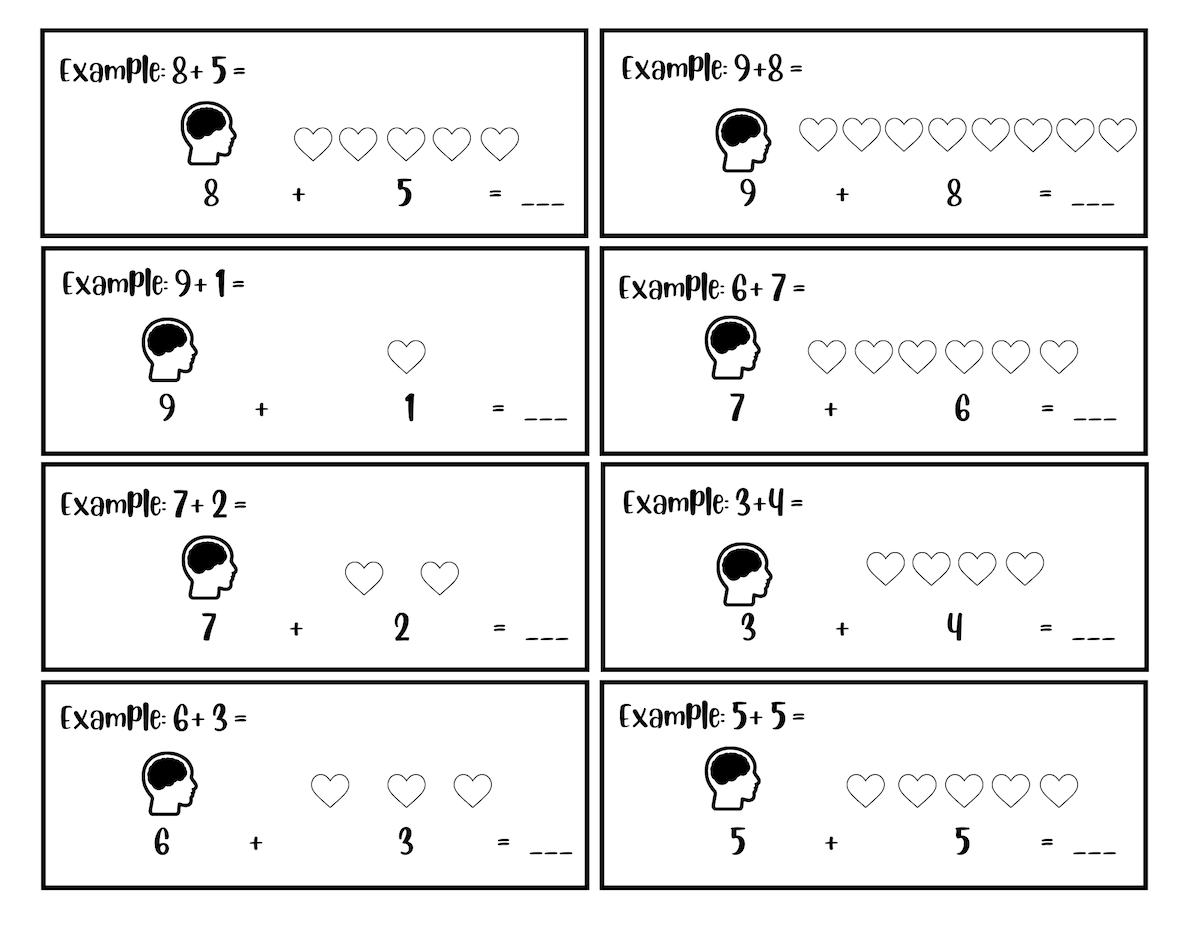
Understanding addition by counting on through the lens of multiple intelligences offers a dynamic and engaging approach to mathematical learning. By integrating strategies that cater to diverse learning styles—linguistic, mathematical, visual-spatial, bodily-kinesthetic, interpersonal, intrapersonal, musical, and naturalistic—students gain a comprehensive understanding of addition concepts. This method not only makes learning more accessible but also fosters creativity and critical thinking, enabling students to connect mathematical concepts with real-world experiences in meaningful ways.
Linguistic:
The following books are great to read and discuss while doing addition with counting on:
- One Is a Snail Ten Is a Crab – April Sayre: Have them come up with their own equations for a number using the feet.
- 100 Snowmen by: Jen Arena
- Ten Flashing Fireflies – Philemon Sturges
- Mall Mania – Stuart Murphy
- Splash – Ann Jonas
- Sixteen Runaway Pumpkins – Diane Ochiltree
- Jack the Builder – Stuart Murphy
- 12 Ways to Get to 11 – Eve Merriam
- Mission Addition – Loreen Leedy
- Get Up and Go – Stuart Murphy
- Mall Mania – Stuart Murphy
- Spunky Monkeys on Parade – Stuart Murphy
- Sheep Won’t Sleep – Judy Coxby
- Leaping Lizards -Stuart Murphy
Mathematical:
- Number Tiles: Grab some number tiles and label the backs with +, -, x, /, and = signs. Select 7 tiles and form number sentences with these 7 numbers and use the +, -, x, /, and = from the other tiles not being used at the time. Then, in a turn-based manner, connect your number sentences with a partner like you would connect words in a game of Scrabble.
Visual-Spatial:
Manipulatives:
- Duplo/ Lego/ Base ten blocks (tangible, picture, or draw square, line, dots…)
- 100, 10’s, 1’s coins
- Number Line
- Monopoly/Fake Money / Coins
- Cards – playing cards, Uno, or Skipbo
- Dominoes
- Number tiles (like Scrabble tiles)
- Beads (like Montessori but make your own)
- Tens Frame
- Number Bond
- Part-Part-Whole
- Hundreds Chart
- Beads, Beans, play-doh, etc.
- (Monkey Math) Scale
- Ruler/ Measuring Tape
Bodily-Kinesthetic:
- Create a life-size number line by adding numbers and physically moving or jumping to each point. *Use a life-size ten frame to practice addition. *Create a life-sized number bond using chalk on the ground, or large bowls, and using two different colored objects to place in cups or to dump.
- Write numbers on the ground using chalk (or on paper and taped to the ground). Call out a math fact, and participants must run to stand on the corresponding number.
- Twister: Place equations on the various circles. Spin the spinner. If it lands on yellow, players must select a yellow circle and solve the equation before placing their hand or foot on it.
- Utilize beads, beans, balls, etc., to create a group. Instruct the child to double the group size. For instance, if you display 4 items, they should increase it to 8. Then, reverse the task by presenting 10 items and asking the child to halve it, resulting in 5.
Interpersonal:
- The following board games are fun and reinforces addition while counting on:
- Shut the box board game
- Mountain Raiders
- Adsumudi
- Head to the grocery store and look for items packaged together with multiple pieces. Practice skip counting or counting on to add these items together.
- Use cards or dice. Add as fast as you can.
- Gather 30 beads, beans, cheerios, etc. Roll the dice and add that number of items to a bowl or jar. Continue rolling and adding until someone reaches 30. Keep a record of the rolls on paper. The first player to reach 30 wins.
- Use two different colors of duplo for each number. Add them together and stack them.
Intrapersonal:
- Arrange cards in order from 2 to 12 or 2 to 20. Flip two cards or roll two or three dice and add the numbers. Flip over the card that matches the sum. Continue this process until all the cards are flipped over.
- OSMO: Fish (number tiles), Math Wizard (Magical Workshop & Amazing Airships), Pizza
- NCTM APPS: Number Pieces, Number Line, Number Frames, Number Chart, Money Pieces
- APPS: IXL, Khan Academy Kids, Pet Bingo (Duck Duck Moose), Park Math, Moose Math, MathSeeds (on reading eggs), frog jumping on the number line, Kid math Fun
- ONLINE: Fun4theBrain Addition, Funbrain – Math Baseball, Arcademics – Kitten Match, Toy Theater – Math Bingo, Arcademics – Tugboat Addition, Arcademics – Alien Addition, Arcademics – Jet Ski Addition
Musical:
- Jack Hartmann – Learn our addition facts
- Numberock – Math Facts
- Learning Upgrade App – Add Count On Song
- Hopscotch – Doubles Addition Facts Song
Nature:
- Use your fingers to count while in the car. Add things in nature.
- Count the number of flowers or leaves, and write down the equation in the dirt.
- While in the car, you earn 5 points (or any skip counting number you choose) for spotting a car or a bike. The first person to reach 100 points wins, or you can multiply the points earned by 10 for the target number.
Incorporating multiple intelligences into the teaching of addition enriches the learning process by addressing the unique strengths of each student. Embracing this holistic educational framework not only enhances mathematical proficiency but also promotes a lifelong love for learning and problem-solving.
Get Your Adding By Counting On Packet With Over 140 Pages:
Adding by Counting On Games
Over 140 Pages of Games Already Made Up

@engagethestages
Get Your Adding By Counting On CONCEPTS Packet With 100 Pages:
Adding by Counting On Concepts & Investigations
100 Pages of Math Investigations and More Already Made Up

@engagethestages