

Introduction
Incorporating a scale into early math education offers an innovative and engaging approach to teaching counting on in addition. Unlike traditional objects, a scale provides a visual and tangible representation of numerical balance and quantity comparison. This tool aids young learners in conceptualizing how adding quantities affects the overall weight, reinforcing the principles of counting on and addition through real-world applications.
Why It’s Important
- Visualizing Quantity Changes: A scale vividly demonstrates how adding objects increases weight, providing a concrete representation of abstract numerical growth.
- Promotes Mathematical Reasoning: Observing how the balance shifts encourages children to predict and reason through addition problems, enhancing critical thinking.
- Engages Multiple Senses: Using a scale integrates visual, tactile, and kinesthetic learning styles, making the learning experience more comprehensive and memorable.
- Real-World Application: Scales are common in everyday life, from kitchens to grocery stores, helping students make connections between classroom learning and real-world contexts.
- Encourages Problem-Solving: Determining how to balance the scale after adding items fosters problem-solving skills and an experimental mindset.
Steps to Incorporate Using a Scale in Learning Counting On
- Introduce the Concept with Familiar Items: Start with objects of known weight, like toy blocks or small fruits. Place a few on one side of the scale and add more, asking students to observe what happens.
- Model the Counting On Process: Demonstrate placing 3 items on one side of the scale. Count them aloud, then add 2 more items, continuing the count from 3 to 5, highlighting the total count.
- Guided Hands-On Practice: Provide each student with a balance scale and objects. Give simple addition problems where they add items and observe the changes, counting on from the initial quantity.
- Introduce Challenges: Pose problems where students need to add a specific number of items to balance the scale, reinforcing the counting on strategy.
- Transition to Mental Math: As students become adept, encourage them to predict the outcome of adding items before actually placing them on the scale.
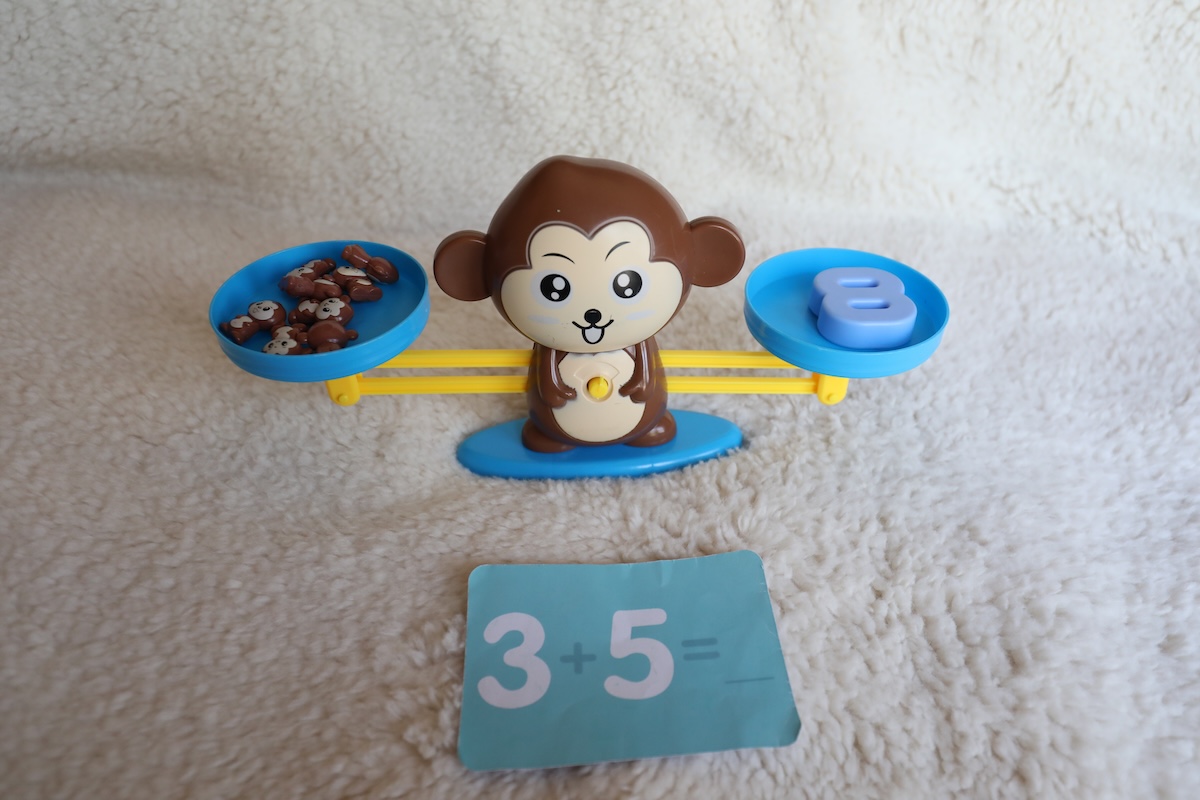
- Monkey Math Scale: If you are adding 3+2, place the number 3 on the scale. Then add two monkeys on that side. Solve the equation then put the correct answer on the other side of the scale to see that it balances it out.
Games to Play Using a Scale When Learning Counting On
- Balance the Scale Challenge: Students start with a few objects on one side. They draw a card with a number and must add that many objects to balance the scale with the other side.
- Weight Race: Teams race to reach a target weight using the fewest number of additions. They must count on as they add objects to track their total.
- Guess and Weigh: Place a hidden number of objects on one side of the scale. Students guess how many more are needed to balance the scale, then count on as they add items to check their answer.
- Mystery Addition: Add a known number of objects to one side, then secretly add more. Students must count on from the initial number to determine the total based on the scale’s balance.
- Scale Story Problems: Create stories like, “Sam has 4 apples on one side of the scale. She adds 3 more. How many apples does she have now?” Students act out the stories with the scale, counting on to find the total.
- Monkey Math Scale: If you are adding 3+2, place the number 3 on the scale. Then add two monkeys on that side. Solve the equation then put the correct answer on the other side of the scale to see that it balances it out.
Conclusion
Using a scale to teach counting on in addition bridges the gap between abstract math concepts and tangible learning experiences. It fosters a deeper understanding of numerical relationships, supports diverse learning styles, and connects mathematical skills to everyday situations. Through structured activities and interactive games, educators can create an engaging environment where students develop strong foundational skills in addition.
Get Your Adding By Counting On CONCEPTS Packet With 100 Pages:
Adding by Counting On Concepts & Investigations
100 Pages of Math Investigations and More Already Made Up

@engagethestages
Get Your Adding By Counting On Packet With Over 140 Pages:
Adding by Counting On Games
Over 140 Pages of Games Already Made Up

@engagethestages