
Introducing Beginning Blends:
1. Understanding Beginning Blends:
Explain to students that blends are two or more consonants placed together, where each sound is heard. Examples include “bl,” “cr,” “st,” and “gr.” Use simple language like, “Blends are like friends who sit next to each other, and you can hear both of their voices.”
2. Introduce with Visuals:
Display colorful charts or flashcards with blend examples alongside pictures (e.g., “bl” with “blue,” “black”; “gr” with “green,” “grapes”). Point to each letter as you pronounce the blend slowly.
3. Use Phonemic Awareness Activities:
Engage students in oral activities without text, focusing on hearing the sounds:
- Sound Isolation: Ask, “What sound do you hear at the start of ‘stop’?” (Answer: /st/)
- Sound Matching: Find words that start with the same blend, like “star,” “step,” and “store.”
4. Blending and Segmenting Practice:
Model how to blend the sounds smoothly. For example, “s-t-a-r, star.” Use hand motions to show blending, like sliding your hands together as you say the sounds.
5. Word Building Activities:
Provide letter tiles or magnetic letters. Have students build words with blends by combining consonant blends with different vowels and ending sounds (e.g., “bl” + “a” + “ck” = “black”).
6. Reading Simple Words with Blends:
Choose decodable books or word lists focusing on specific blends. Highlight blends in words, encouraging students to read them aloud.
7. Interactive Games:
- Blend Bingo: Create bingo boards with blend words.
- I Spy: “I spy with my little eye something starting with ‘cr.’” (Answer: “crayon”)
- Sorting Activities: Sort words or pictures into groups based on their beginning blends.
8. Incorporate Writing:
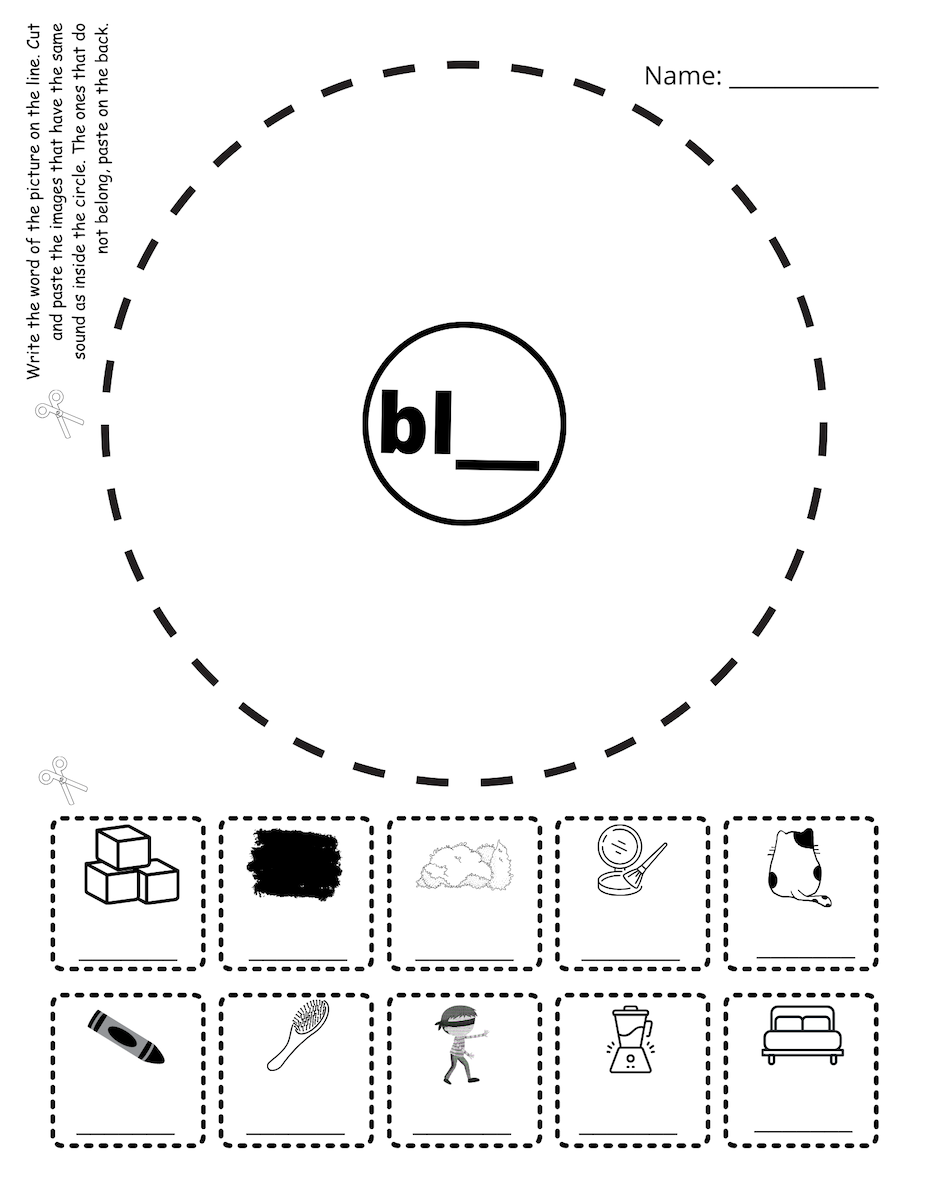
Have students write lists of words that start with the same blend. Encourage them to create simple sentences using blend words. Make circle maps.
Beginning Blends Activities for Multiple Intelligences
Linguistic Intelligence
- Blend Story Builders (Word cards with beginning blends (bl, cl, fl, etc.)): Kids pick cards and create a short story using as many blend words as possible. They can read their story aloud to the group.
- Blend Quick Time: Give students a blend (e.g., “pl”). They must come up with as many words as they can in a minute starting with that blend, like “play,” “plow,” and “plump.”
- Make book of words and pictures that start with that same blend.
- Blend Story Time: Read short stories or rhymes emphasizing specific blends. Pause to let kids identify and repeat the blend when they hear it.
- Search and Find.
- Decodable Books
Logical-Mathematical Intelligence
- Bump: set up a bump game. Roll two dice and add the together, then read the word corresponding to that number. If correct, place your marker or cross it off. If your opponent has a marker in that spot, bump it off and claim the square. Once the board is filled, the player with the most markers wins!
- Blend Bingo: Bingo cards with beginning blends and markers. Call out words, and have kids place markers on the correct blend. This requires logical thinking to decode the beginning sounds and find the correct blends. The first to complete a row wins.
- Battleship with the spaces filled in with words you have to read correctly before playing it.
Visual-Spatial Intelligence
- Blend Puzzle Match: Puzzle pieces with blends on one side and pictures on the matching pieces. Students match the blend piece with its corresponding picture to complete the puzzle.
- Blend Art Collage: Kids create a collage using magazine cutouts of objects that start with specific blends. They label each picture with the correct blend.
- Picture-Word Match: Provide worksheets where kids draw lines to match pictures with the correct beginning blend. For example, match a picture of a “flag” to “fl.”
- Make a Circle Map.
- I Spy: Find words that start with that same blend.
- Have a picture, write in the beginning blend for the word.
- Sort pictures and words into categories with the same beginning blend.
- Blend Sorting Game: Create flashcards with common beginning blends (e.g., bl, cl, fl, gl, pl, sl) and picture cards representing words that start with these blends (e.g., “bl” – blue, “cl” – clock). Spread the flashcards and picture cards on a table. Have the children match the picture cards to the correct blend flashcard. Encourage them to explain why they matched each picture with a specific blend to reinforce learning.
Bodily-Kinesthetic Intelligence
- Blend Obstacle Course: Stations with blend challenges (e.g., hopping, balancing). Set up an obstacle course where kids must stop at each station, identify the blend, and perform a related action (e.g., “cl” for “clap”).
- Blend Charades: Act out words that start with specific blends without speaking. The group guesses the blend and the word.
- Blend Hopscotch: Chalk or tape to create a hopscotch grid with different blends in each square. Call out a word (e.g., “flag”). The child must identify the starting blend (“fl”) and hop to the corresponding square. Add variations like hopping on one foot or backward to increase the challenge. Or have different words and they must read the word when jumping on that square.
- Blend Scavenger Hunt: Write blends on sticky notes and hide them around the room. Give kids a list of words. They must find the blend that matches each word.
- Blend Building with Magnetic Letters: Provide magnetic letters and a magnetic board. Call out words, and have kids build the beginning blends before completing the whole word.
- Make card with different letters on it and blending cards. Try to see if you can make real and silly words with the letter tiles.
Musical Intelligence
- Blend Song Creation: Kids create simple jingles or songs using words with the same beginning blend. They can perform their songs for the class.
- YouTube: English4abc, Rock ’N Learn, Jack Hartmann, Phonics Garden….
Interpersonal Intelligence
- Blend Relay Race: Blend cards and word lists. In teams, kids race to match blend cards with the correct words, passing the card like a baton.
- Blend Bingo: Make bingo cards filled with blends. Call out words, and kids cover the correct blend on their cards. The first to complete a line shouts “Bingo!” Or they have to read the word first before marking it off on their card. Another variation: match words to the pictures on the board.
- OH SNAP!! Put the words in a bowl and take turns picking one out to read aloud. If correct, keep it; if not, return it to the bowl. If you draw an “Oh SNAP” card, return all your cards. The player with the most cards at the end wins!
- Cut out the cards and place them in a bowl. One person picks a card and holds it on their head, while their partner must say the word. The person with the card then tries to spell it out. Keep trying at the spelling until it’s correct, taking turns back and forth. (Use a whiteboard.)
Intrapersonal Intelligence
- Blend Journal Challenge: Personal journals: Write sentences or short stories featuring different blends.
Naturalistic Intelligence
- Blend Sorting with Natural Objects: Collect natural items (like stones, flowers) and sort them based on their beginning blend names.
- Blend Scavenger Hunt: Sticky notes with blends hidden around the room.Provide a list of words that start with specific blends. Kids must search for and collect the correct blend sticky notes, matching them to the words on their list.
These activities not only help children understand beginning blends but also make learning interactive and enjoyable, ensuring the concepts stick effectively.
Book 5: Beginning Blends
Book 5: Beginning Blends
27 Books with 8 pages per book

@engagethestages
Book 5: Beginning Blends
Book 5: Beginning Blends
300 Pages of Activities

@engagethestages