
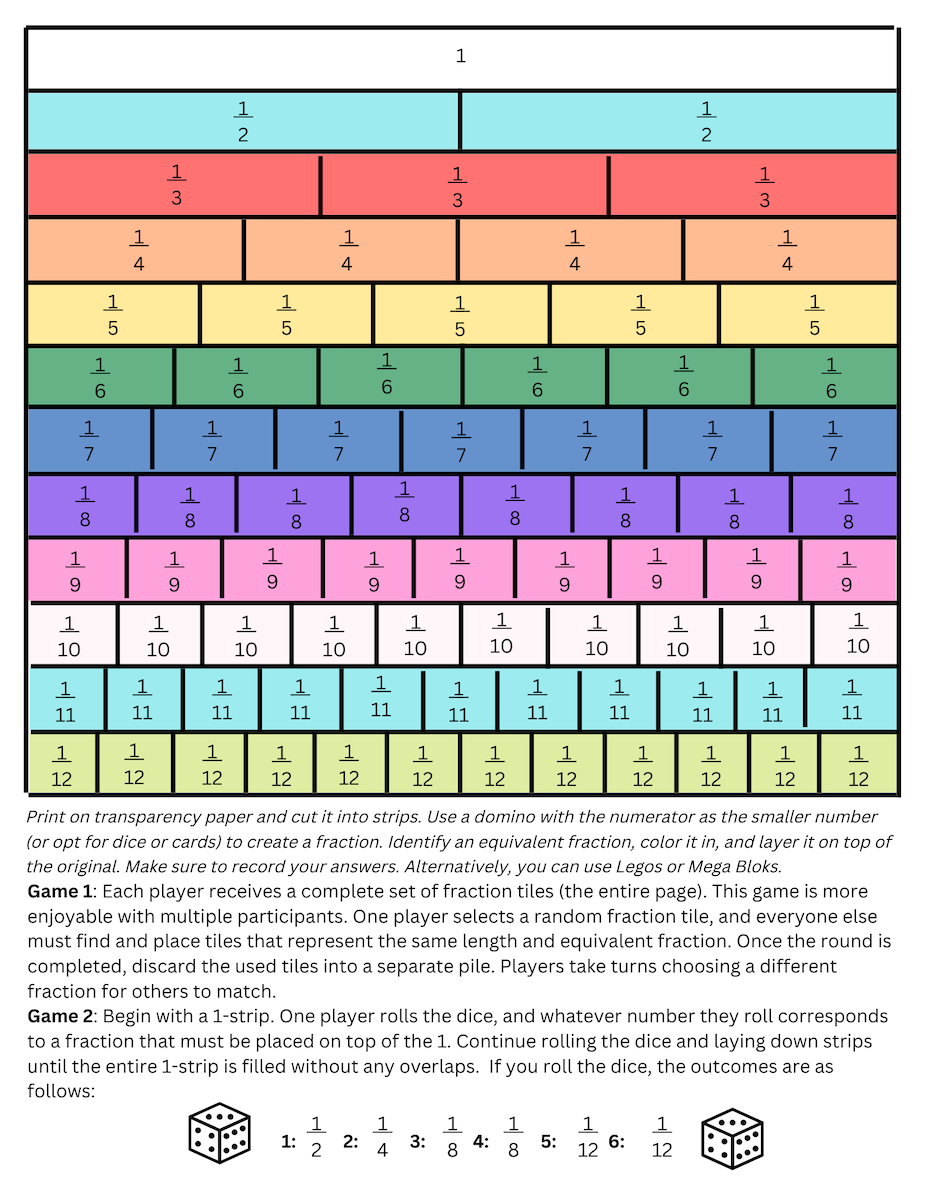
Fractions and equivalent fractions can be a tricky topic for many learners, but what if we could turn confusion into curiosity? By tapping into Howard Gardner’s theory of multiple intelligences, educators can unlock creative ways to teach fractions that resonate with every student’s unique way of learning. Whether it’s through storytelling, hands-on activities, music, or nature explorations, there’s an engaging fraction adventure waiting for every learner. Discover dynamic games and activities tailored to linguistic, logical-mathematical, spatial, bodily-kinesthetic, musical, interpersonal, intrapersonal, and naturalistic intelligences. Get ready to transform your classroom into a vibrant hub of fraction fun!
Here are engaging games and activities tailored to each multiple intelligence to help learners grasp fractions and equivalent fractions:
Linguistic Intelligence:
- Have students create a story, word problems, or a dialogue involving fractions. They can write short plays or narratives that incorporate fractions in real-life scenarios.
- Fraction Debate: Organize debates where students argue which fractions are larger and justify their reasoning using equivalent fractions.
- Develop a fraction-themed word game where players have to match fractions with their corresponding word representations or solve fraction-related riddles.
- Roll two dice or flip two cards to form a fraction. Then, craft a story inspired by that fraction.
Books:
- The Hershey’s Milk Chocolate Bar Fractions Book – Jerry Pallotta
- A Very Improbably Story The Lion’s Share – Matthew McElligott
- Give Me Half! – Stuart J. Murphy
- Jump, Kangaroo, Jump – Stuart Murphy
- Apple Fractions – Jerry Pallotta
- If You Were a Fraction – Trisha Speed Shaken
- Pythagoras and the Ratios Fraction Fun – David A.Adler
- Fractions in Disguise – Edward Einhorn
- Cut Down to Size at High Noon The Wishing Club – Donna Jo Napoli
- Piece = Part = Portion – Scott Gifford
- Full House – Dayle Ann Dodds
- Whole-y Cow! – Taryn Souders
- A Fraction’s Goal
- Parts of a Whole – BrianClearly
- Fraction Action – Loreen Leedy
- Two of Everything – Lily Toy Hong
- Fraction Fun – David A. Adler
Logical-Mathematical Intelligence:
- Fraction Sudoku: Create Sudoku puzzles using fractions in place of numbers.
- Fraction Problem-Solving Challenges: Provide complex fraction puzzles that require identifying and using equivalent fractions to solve.
- Create a fraction puzzle game where players have to solve math problems involving fractions to progress through different levels.
- Number Line Activity: Have students create a number line on the floor using tape. They can place fraction cards (e.g., 1/2, 2/4, 4/8) along the line and see how equivalent fractions align at the same point.
- Fraction Matching Game: Create a set of cards with different fractions and their equivalent fractions. Students can play a matching game to pair them correctly.
Spatial Intelligence:
- Fraction Pizza Game: Provide students with paper pizzas divided into slices. Use different toppings to represent various fractions, and ask students to create equivalent fractions by rearranging the toppings.
- Fraction Art Projects: Have students create artwork using shapes divided into fractions, coloring sections to represent equivalent fractions in creative designs.
- Design a fraction board game where players have to visualize and compare fractions in different shapes and sizes to advance in the game.
- Fraction Art with Pattern Blocks: (Materials Needed: Pattern blocks (triangles, squares, hexagons, etc.). Paper and colored pencils.) Choose a large hexagon to represent 1 whole. Use other shapes to cover the hexagon completely without gaps or overlaps. Count how many of each shape you used. Write the fraction each type of shape represents of the whole hexagon. For example, if you used 3 rhombuses, and it takes 3 to cover the hexagon, each rhombus is 1/3 of the whole. Create different designs and compare the fractions. Discuss: Can different shapes represent the same fraction?
- Equivalent Fraction Number Line: Draw a long number line from 0 to 1. Divide the number line into halves. Label 0, 1/2, and 1. On the same line, divide it into fourths. Label each mark with 1/4, 2/4, 3/4, and 4/4. Notice how 2/4 is exactly in the same spot as 1/2. These are equivalent fractions. Add more divisions for eighths and thirds to see other equivalent fractions (like 4/8 = 1/2). Discuss: Why do some fractions share the same spot on the number line?
- Fraction Pizza Party: Draw a large circle on the paper plate representing a pizza. Divide it into equal parts (e.g., halves, fourths, eighths). Color different combinations to show how 1/2 is the same as 2/4 or 4/8.
- Water Measurement Lab: (Materials: Measuring cups, water, containers.) Fill a 1-cup measuring cup halfway (1/2). Use smaller cups (1/4, 1/3) to fill the same amount. Discuss the equivalence of the measurements.
- Paper Strip Folding Steps: Fold strips into halves, thirds, fourths, etc. Compare folded sections to identify equivalence (e.g., two 1/4 sections = 1/2).
- Fraction Art Collage: Design shapes divided into equal parts. Color sections to represent fractions. Show how different sections can represent equivalent fractions.
- Color in a grid of any design. For each different color say what the fraction of the grid each color represents.
- Lego Fraction Build: Build towers with blocks. Identify fractions based on the number of colored blocks. Create towers to show equivalent fractions.
- Recipe Adjustment Activity: Provide recipes and ask students to double or halve them. Identify equivalent measurements needed.
- Begin by drawing a circle and dividing it into thirds or any desired fraction. Next, place candies or flowers evenly into each of the separated sections within the circle. Create a bouquet of flowers and label the fractions representing each color of flower.
- Bake their favorite dessert. Make sure it uses many different types of fractions.
- Create a Fraction Flip Book. At the bottom of the largest piece of paper, write “1 whole,” followed by the next layers labeled 1/2, 1/4, 1/8, and 1/16. Stack each flap on top of one another, cutting them out and labeling the fractions. When you lift each flap, provide various examples, such as a number line, fractions within a circle, fraction bars, and more.
- Create artwork using fractions. For example, divide a paper into sections (e.g., 1/2, 1/4, 3/8) and color each section with different colors. Discuss how the sections relate to fractions.
- Fraction Circles: Provide students with colored paper or pre-made fraction circles. They can cut the circles into different fractional parts (e.g., halves, thirds, quarters) and then combine them to create whole circles. This visual representation helps them see how fractions relate to each other.
- Fraction Strips: Have students create fraction strips by cutting strips of paper into different lengths. They can label each strip with fractions (1/2, 1/3, 1/4, etc.) and then compare the lengths to understand how different fractions relate to one another.
- Fraction Wall: Create a large wall chart with strips of paper representing different fractions. Students can color or tape the strips to show equivalent fractions side by side.
- Use playdough or cheese blocks alongside dominoes, dice, or cards to represent your fractions. This can complement or replace worksheets for each subcategory.
- Use Magna-Tiles to construct fractions.
- Create a life-sized number line using tape or chalk to write numbers. Print out fraction cards, mix them up, and sort them from smallest to largest or arrange them on the number line.
- Write fractions on Connect Four pieces. Players must correctly state the equivalent fraction before placing their piece; if they answer incorrectly, the next player takes their turn.
- Paint paper plates and divide them into fractions, then label each section.
- Use Legos or Mega Bloks (with the fraction written on them) to create fractions or compare equivalent fractions. You can either arrange them based on size equivalence to other blocks or build a vertical tower. Create random fractions using cards, dominoes, or dice.
- Construct a fraction strip page with Legos or Mega Bloks and label it using post-it notes or dry erase markers.
- Fraction Manipulatives: Use fraction circles, bars, or tiles for students to physically manipulate and explore different fractions.
Manipulatives:
- Fraction Bars
- Circle Fraction
- Fraction in a Set
- Fraction Number Lines
- Duplo/Lego
- Base ten blocks (tangible, picture, or draw square, line, dots…)
- Number Line
- Number Bond
- Cards – playing cards or Uno
- Dominoes
- Number tiles (like Scrabble tiles)
- Beads (like Montessori but make your own)
- Ruler / Measuring Tape
- Beads/Beans… etc.
- Magnatiles
- Pattern Blocks
- Shapes
- Grid Paper
- Pentominoes
- Geoboard
- Measuring Cups
- Fraction Strips
- Fraction Circles
- Fraction Puzzles
- Food – crackers, cookies, etc.
- Oreos and the frosting
- Playdough
- Grid to draw in fractions
- Overlapping Transparency Fractions
- Mega-Bloks (write on them which fraction they are in proportion to each other)
Materials for creating a fraction : You can use two dice to generate numbers, use two distinct cards for numerical values, or flip a domino, placing the smaller number in either the numerator or denominator.
Bodily-Kinesthetic Intelligence:
- Fraction Number Line Relay: Set up a large number line in the classroom. Give students fraction cards and have them place the fractions correctly on the number line, identifying equivalent fractions along the way.
- Fraction Hopscotch: Create a hopscotch grid with fractions; students jump to equivalent fractions when called out.
- Gather 24 beads. Flip a domino and demonstrate what fraction of 24 it represents.
- Create a fraction relay race game where players have to physically demonstrate fractions using objects or movement to complete tasks.
- Fraction Manipulatives Game: Use physical manipulatives like fraction tiles or pie charts. Students can physically manipulate these to find and create equivalent fractions, making the learning experience hands-on.
- Fraction Pizzas Use cardboard or paper plates to create pizza models. Students can cut the pizzas into different fractions and then combine pieces to visualize equivalent fractions (e.g., two 1/4 pieces make 1/2).
- Fraction Tiles: Provide students with tiles of various lengths that represent different fractions. They can physically manipulate the tiles to build equivalent fractions, such as stacking 1/2 and two 1/4 tiles together.
- Building Blocks: Use building blocks or LEGO pieces to create structures that represent different fractions. For example, a tower made of 4 blocks where 1 block is a different color could represent 1/4 of the tower.
- Number Line Jumping: Draw a large number line on the ground with chalk. Have students physically jump to different fractions on the number line, helping them understand the relative size of fractions and their placement.
- Measuring Cups: Provide measuring cups and various ingredients (like water or rice). Students can practice measuring out fractions (e.g., 1/2 cup, 1/4 cup) and combine them to make whole cups, reinforcing the concept of fractions in real-life scenarios.
- Pizza Fractions: Use paper plates to represent pizzas. Students can divide their “pizzas” into different toppings (like sections) to illustrate various fractions (e.g., 1/4 pepperoni, 1/2 cheese). This fun activity makes fractions relatable and tasty!
Musical Intelligence:
- Fraction Rhythms: Use clapping or percussion instruments to create rhythms based on fractional beats (e.g., half notes, quarter notes).
- Develop a fraction rhythm game where players have to match fractions with musical notes or beats to create harmonious sequences.
- Write and perform songs about fractions. Use familiar tunes and create lyrics that explain fractions, their uses, and examples.
- YouTube: Oort Kuiper – Equivalent Fractions, Numberock – Equivalent Fraction Song, Amanda Martin- Equivalent Fractions, Kevin Barnhart – simplifying fractions, Easy Teaching – Equivalent Fractions, Numberock – Fractions on a Number Line Song, Numberock – Fraction Song for Kids, Numberock – Simplet Form Song: Simplifying Fractions, Jack Hartmann – Fractions, Fractions!, Oort Kuiper – Comparing Fractions
Interpersonal Intelligence:
- Fraction War Card Game: Use a deck of fraction cards. Two players draw cards and compare fractions. The player with the larger fraction wins the round. Incorporate discussions on equivalent fractions to determine winners in close matches.
- Equivalent Fraction Bingo: Create Bingo cards filled with different fractions. Call out fractions or display fraction models, and students cover the corresponding equivalent fraction on their cards.
- Group Fraction Puzzles: Collaborative puzzles that require team members to match fraction models with numerical equivalents.
- Fraction Match-Up Game: Shuffle cards and place them face down. Take turns flipping two cards to find matches (e.g., 1/2 and 2/4).
- Clear the Board: matching equivalent fractions
- Domino War: which fraction is larger
- Fraction Order: Take 4 fraction cards and order from smallest to largest.
- Lay down 12 fraction cards and pari up all the equivalent fraction cards as fast as you can.
- Fraction Pizza: Create paper pizzas divided into slices to represent different fractions. Have students match fraction cards to the corresponding slice of pizza.
- Fraction Bingo: Create Bingo cards with fractions instead of numbers. Call out fraction equivalents and have students mark the corresponding fraction on their Bingo cards.
- Fraction War: Play a card game where students compare fractions to see which is greater. The student with the larger fraction wins the round.
- Fraction Scavenger Hunt: Hide fraction cards around the classroom or outdoor area. Students find the cards and match them to their equivalent fractions.
- Fraction Memory Match: Create a set of cards with fractions and their corresponding visual representations (like pie charts). Players take turns flipping cards to find matches, reinforcing their understanding of fractions.
- Fraction Matching Game: Create cards with different fractions on one set and their equivalent fractions on another. Players take turns flipping two cards to find matching pairs.
- Group Challenges: Organize students into small groups and assign them to create a poster that illustrates a set of equivalent fractions using drawings, pictures, or real-life examples (like slices of fruit or pie).
- Peer Teaching: Pair students and have them take turns teaching each other about equivalent fractions using manipulatives like blocks or beads.
Intrapersonal Intelligence:
- Independent Fraction Projects: Allow students to design their own fraction-based projects based on personal interests.
- Reflection Journals: Encourage students to keep a journal where they draw and write about their understanding of equivalent fractions. They can include personal examples and reflections on what strategies helped them grasp the concept.
- Matching Puzzles: Design puzzles where students match fraction models with numerical fractions and their equivalents. This visual activity helps solidify the concept of equivalency.
- Turn over two cards or a domino with the smaller number in the numerator (top) to create a fraction. Then, plot it on the line graph. Or create the fraction out of other materials.
- Interactive Digital Fractions: Engage with apps that allow manipulation of virtual fraction pieces. Solve puzzles to match equivalent fractions.
- Online Games: MathPlayground – Bingo Fractions, MathPlayground – Monster Stroll Fractions equivalent, MathPlayground – Find the Bus Stop, Arcademics – Dirt Bike Comparing, Arcademics – Ratio Stadium, Arcademics – Ratio Blasters, Arcademics – Dirt Bike Proportions
- Games: IXL, Khan Academy. OSMO: Math Wizard and the Fantastic Food Truck, Pizza game, Tangrams. NCTM APPS: Pattern Shapes, Partial Product Finder, Number Pieces, Fractions, Number Line
Naturalistic Intelligence:
- Fraction in Nature: Identify and discuss fractions found in nature, such as the segments of fruits or patterns in leaves.
- Gardening Fractions: Use garden plots to explore fractions, such as planting in fractional sections and comparing growth.
- Fraction Walk: Walk around the school or neighborhood. Spot objects that can be divided into parts (windows, tiles). Note fractions and discuss equivalence.
- Cooking with Fractions: Involve students in a cooking activity where they measure ingredients using different fractional measurements. For example, if a recipe requires 1/2 cup of sugar, have them measure out 2/4 cups to see that they are the same amount. Prepare simple dishes.
- Have students plant or draw a small garden with rows representing different fractions. For example, they can plant 1/4 of the garden with flowers, 1/2 with vegetables, and 1/4 with herbs. As they take care of the garden, they can visually see and calculate the fractions of each type of plant.
Mastering fractions doesn’t have to be a monotonous task filled with worksheets and drills. By embracing multiple intelligences, educators can craft meaningful, interactive experiences that make fractions relatable and fun. Whether your students are building fraction towers with Legos, composing fraction-inspired rhythms, or exploring fractions in nature, these activities ensure that every learner finds their fraction “aha” moment. So, grab your manipulatives, dust off those fraction cards, and dive into a world where fractions add up to endless possibilities!
Get Your Fractions & Equivalent Fractions Packet:
Fractions & Equivalent Fractions
Over 70 Pages of Concepts & Games Already Made Up

@engagethestages