
Learning how to convert fractions to decimals to percents (and back again) can be fun, interactive, and meaningful by tapping into different learning styles based on Howard Gardner’s Multiple Intelligences. Here are many games, activities and investigations that help different learners (using the multiple intelligences) see the relationships among these forms:
Linguistic Intelligence
- Conversion Storytelling – Create short stories where characters encounter fractions, decimals, and percents in real-life situations and must solve them.
- Fraction-Decimal-Percent Riddle Race – Write riddles on how to convert between fractions, decimals and percents.
- Math Storytelling: Write a short story where characters encounter fractional amounts (like 3/5 of a treasure). Convert these fractions to decimals and percents within the story. Share stories and identify how conversions affect the narrative understanding of quantities.
Books:
- “Smart” by Shel Silverstein. Exchange money as described in the poem. Analyze the outcome. Determine how much the child lost with each transaction and calculate the percentage.
- Fractions, Decimals, and Percents – David A. Adler
- Piece = Part = Portion – Scott Gifford
- The Power of Snow – Bob Raczka
- Percentage of the Girzzly Gazette – Stuart Murphy
Logical-Mathematical Intelligence
- Fractions to Decimals: 1. Divide the bottom number into the top number “It’s a sunny day and the wind blows the top number off into the box.” 2. Make an equivalent Fraction in TENTHS, HUNDRETHS, or THOUSANDTHS
- Fraction to Percent: 1. Convert to an equivalent fraction with a denominator of 100. 2. divide the numerator by it’s denominator, then convert the decimal to percent.
- Decimals to Fractions: 1. Multiply by powers of 10 to move the decimal. Simplify. 2. Use the Place value of the decimal to write the denominator of the fraction. Then Simplify.
- Percent to Decimal: 1. Move decimal over to the LEFT one hundredth (two spaces to the left). 2. Dividing the percent by 100
- Percent to Fraction: Take off the %, write the number as a fraction with a denominator of 100. Simplify.
- Percent means parts per 100
- “Sunny and Windy” the top number (numerator) drops down and enters the box to divide a fraction, allowing you to discover the decimal equivalent.
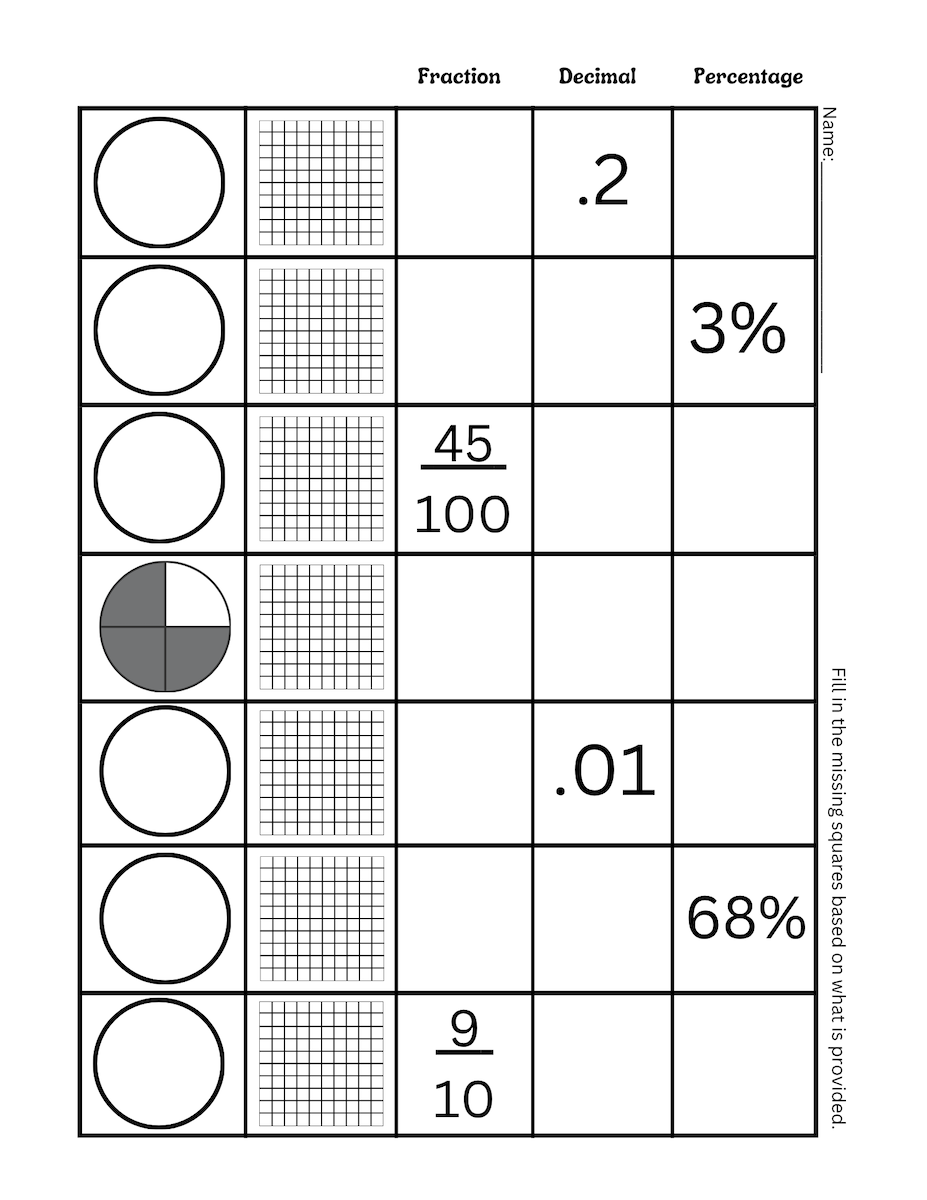
- Conversion Puzzle Grids – Fill in missing fraction-decimal-percent equivalents.
- Card Matching Game – Match fractions, decimals, and percents written on separate cards.
- Conversion Speed Challenge – Timed quiz where students convert as many numbers as possible within a minute.
- Conversion Puzzle Race: Create a deck of cards with fractions, decimals, and percents. Students match the correct equivalents as quickly as possible.
- Identify patterns in fractions that terminate vs. repeat when converted to decimals.
- Match grids colored in to decimals, fractions and percents.
- Use transparency paper to compare.
Visual-Spatial Intelligence
- Compare fraction strips converted to decimal strips and percent strips.
- Match circles cut up and colored in to 100 grids to fraction, decimal and percent written out.
- Have grid of everything written out and just a percent, decimal, fraction or picture filled in. Have to fill in missing spots based on information given.
- Fraction Circles to Percent Charts: Provide students with fraction circle manipulatives (e.g., 1/2, 1/4, 1/8). Have them arrange pieces into a full circle and color a corresponding 100-square grid. Count the shaded squares to determine the percent and write the decimal equivalent.
- Grid Shading with Tenths and Hundredths: Give students 10×10 grids. Ask them to shade in a fraction of the grid (e.g., 3/5). Convert the shaded part to a decimal and then to a percent based on 100 squares.
- Number Line Conversion: Draw a number line from 0 to 1, divided into tenths. Place fractions on the line and then label their decimal and percent equivalents. Discuss which numbers are “easy” to convert and why.
- Spin and Convert Game: Create a spinner with fractions (1/2, 1/4, 3/4, 2/5, etc.). Spin, record the fraction, and convert it to a decimal and percent on a chart. Compare results with peers to identify patterns.
- Real-Life Percents Hunt: Ask students to bring in store flyers, restaurant menus, or sports statistics. Pick an example (like “25% off”) and convert it to a decimal and fraction representation. Display findings in a class chart.
- Snap Cube Fractions: Provide students with 100 snap cubes in groups of 10. Create stacks representing fractions (e.g., 30/100). Convert each stack into a decimal and percent.
- Matching Card Flip: Make a set of cards with fractions, decimals, and percents. Place cards face down and play a matching game to pair all three forms. Record conversions for reinforcement.
- Fraction Bars and Percent Strips: Use fraction bars and percent strips side by side. Match equivalent values visually (e.g., 1/4 = 0.25 = 25%). Students create their own charts of conversions.
- Interactive Pie Chart Creation: Let students choose a data set (like favorite fruit from the class). Create a pie chart showing fractions of each choice. Convert to decimals and percents, labeling the chart with all three forms.
- Conversion Art Collage – Create a poster of fractions, decimals, and percents using images and labels.
- Pie Chart Match-Up – Match fractions and decimals to pie charts depicting the same value.
- Fraction Art Conversion: Students design a piece of art on graph paper, shading fractional portions. They then calculate the decimal and percent equivalent for each color section.
- Create five circles of equal size. Cut one circle in half, another into quarters, a third into fifths, and so on. Label each piece with its corresponding fraction, decimal, and percentage. Then, cut each piece in half again. Stack them on top of one another and paste each in the center to visually compare the different sizes.
- Create various circles representing different percentages: some at 50%, 25%, and 25%, and another at 75% and 25%. Explore these percentages by discussing them in terms of fractions and decimals. For instance, 50% represents one-half.
- Begin by cutting a piece of food in half. Next, take one of those halves and cut it in half again. Have them identify each fraction and then convert those fractions into decimals and percentages. Ask which piece represents 25% of the entire item. Finally, combine the two 1/4 pieces and ask what fraction and percentage that total represents.
- Converting different ways flip circle: Cut and paste the middle section atop the other circles, ensuring they are layered correctly. Then, work through the example problem provided below. Optional: Cut each triangle half way down to be able to lift the flap up to see the example under.
- Arrange Colors: Arrange the Skittles or beads by color around or inside the circle. Group all similar colors together and position them around the circle. (If desired, glue the beads in place.) Alternatively, you can draw your own circle. Use 25, 50, or 100 beads or candies. Draw a line from the endpoint of one color to the center of the circle. Repeat this process for both the start and finish of each color. Color the triangle representing the red beads in red. Include the percentage, decimal, and fraction within the circle. Complete a table.
- Fraction, DECIMAL, PERCENTAGE My Name Write your name evenly across the bar. Next, divide the bar equally for each letter. Each letter in your name represents its own fraction. Fill in the bar with corresponding fractions, decimals, and percentages, and then reflect this data on the line graph.
- Grid Coloring: Color in the squares in any style you choose, such as patterns or images. Be sure to use at least four different colors. Once you’ve completed this task, indicate the fractions for each color on the key at the bottom. Color the square corresponding to each color you’ve used and then write down the fraction, decimal, and percentage for that color. If you chose not to color some squares, indicate the fraction for the white or uncolored squares instead. A helpful hint: there are a total of 100 squares.
Manipulatives:
- Duplo/Lego Base ten blocks (tangible, picture, or draw square,line, dots…)
- Number Line
- Number Bond
- Number place value coins
- Cards – playing cards or Uno
- Dominoes
- Number tiles (like Scrabble tiles)
- Beads (like Montessori but make your own)
- Ruler / Measuring Tape
- Beads/Beans … etc.
- Magna-Tiles
- Pattern Blocks
- Shapes
- Grid Paper
- Measuring Cups
- Fraction Strips
- Fraction Circles
- Fraction Puzzles
- Food – crackers, cookies, etc.
- Oreos and the frosting
- Playdough
- Mega-Bloks (write on them which fraction they are in proportion to each other)
Bodily-Kinesthetic Intelligence
- Human Number Line – Students physically position themselves on a number line based on their fraction/decimal value.
- Conversion Hopscotch – Hop to fraction, decimal, or percent representations drawn in chalk.
- Relay Race Conversions – Teams run to stations where they must convert a value to the next form before moving on.
Musical Intelligence
- Math Conversion Song – Compose a short song explaining how to switch between the three forms.
- Conversion Beat Game – Tap a beat while chanting conversions (½ → 0.5 → 50%).
- Rhythm Conversions: Use simple rhythms (e.g., quarter notes as 1/4) and convert their fractional values into decimals and percents of a whole measure.
- Youtube – Math Antics, Math With Mr. J, Lets Do Math, Professor Dave Explains, Super Easy Math, Colin Dodds – Percentages, Andrew Austin – Crazy Conversions fractions, decimals, percents, Numberock – Converting Fractions to Decimals, Numberock – Relating Fractions to Decimals, Numberock – Converting Decimals to Percents, TeacherTube Math – Decimal Percent Song, Oort Kuiper – Fractions, Decimals, Percentages Rap
Interpersonal Intelligence
- Group Conversion Challenge – Small groups solve multi-step real-life scenarios requiring conversions.
- Peer Teaching – Students teach each other how to convert one form to another with examples.
- Team Quiz Show – Teams compete in a game show format answering conversion questions.
- Fraction-Decimal-Percent Bingo – Create bingo cards with numbers in one form, and call out equivalents in another.
- Matching Card Game – Have cards with fractions, decimals, and percents. Students match the three that go together.
- Conversion Relay Races – Teams race to correctly convert problems across all three forms.
- Spin and Convert – Use a spinner with fractions or decimals; students convert to the other forms.
- Real-Life Shopping Activity – Apply discounts and sales tax to practice percent conversions.
- Number Line Challenge – Place fractions, decimals, and percents on a number line.
- Memory Match – Flip cards to match equivalent fractions, decimals, and percents.
- Jeopardy-Style Quiz Game – Categories for fractions, decimals, percents, and conversions.
- Dice Conversion Game – Roll dice to create fractions, then convert them.
- Percent Scavenger Hunt – Find real-world examples of percents and convert them to other forms.
- Fraction War – A card game where higher equivalent values win, requiring conversion to compare.
- Classroom Survey Graphing – Collect data, turn it into fractions, decimals, and percents.
- Escape Room Activity – Solve conversion puzzles to unlock the next clue.
- Fraction-Decimal-Percent Hopscotch – Jump to the correct equivalent form called out by the teacher.
- Math Board Game Adaptation – Use existing games like Chutes and Ladders with conversion tasks to move.
- Conversion Puzzles – Solve jigsaw puzzles by matching equivalent numbers.
- Story Problems – Real-world scenarios requiring conversions to find solutions.
- Speed Conversion Challenges – Time-based competitions to convert mixed sets quickly.
- Fraction to Decimal Flip Cards: Create a set of flashcards with fractions on one side and their decimal equivalents on the other. Students can quiz each other and time themselves to strengthen their recall.
- Percent Scavenger Hunt: Around the classroom, place items with labels showing a fraction or decimal. Students find each one and write its percent equivalent in a notebook.
- Cooking with Fractions: Use simple recipes to measure ingredients, then convert measurements (e.g., ½ cup to 0.5 to 50%).
- Fraction-Decimal-Percents Dominoes: Make domino cards with fractions, decimals, or percents on each end. Students match equivalent values to create a chain.
- Number Line Conversion Race: Create a long number line from 0 to 1. Students place fraction, decimal, and percent cards in the correct positions as fast as possible.
- Spinner Probability Experiment: Use a spinner divided into fractions. Record the results of 20 spins and convert the outcomes into decimals and percents.
- Shopping Discount Simulation: Give students fake store ads with fractions, decimals, or percents for discounts. They calculate prices in all three forms.
- Fraction Dice Challenge: Roll dice to create fractions (e.g., 3/4). Students convert them to decimals and percents and keep score for accuracy.
- Dominoes: Flip a domino. Make into a fraction (one number over the other one). Convert into a decimal and percent.
- Cards: flip two cards. Make into a decimal. See who can convert into a fraction/percent first. Alternatively flip cards to make into a fraction or a percent and convert.
- Given a fraction, decimal and percent. Order it into smallest to largest.
- Creating a Percentages Board Game: Design a board game where players move forward by correctly answering percentage-related questions (e.g., finding the percentage of a given number). Include various levels of difficulty and incorporate scenarios where players need to apply their knowledge of percentages (e.g., shopping scenarios, sports statistics). Play the game in small groups and reflect on strategies used to calculate percentages accurately.
- Fraction-to-Percent Relay: Divide the class into teams. Call out a fraction; first team to correctly write its decimal and percent earns a point. Rotate through 10–15 fractions for practice in a game format.
- Each player starts with 5 quarters, 7 dimes, 9 nickels, and 11 pennies. Flip two cards and give the bank the corresponding amount of money. If necessary, you can exchange one of your coins for smaller denominations. Continue this process until all your money has been spent.
- Cards: Shuffle a deck of cards. Roll one die, or roll two dice and add their values. Flip that number of cards from the deck. Sort the cards by their suits: hearts, diamonds, spades, and clubs. Record the fraction, decimal, and percentage on the chart beneath each suit. Highlight or color the largest fraction. Continue this process until the entire deck is used.
- Fraction/ Decimal/ Percent Cards: Matching Game: Cut out the cards and match them.
- Tic-Tac-Toe: Create a tic-tac-toe board using cards. Put the remaining cards in a bowl, then pull one out and mark off equivalent card that match your board.
- Head Guessing Game: Cut out the cards and place them in a bowl. One person picks a card and places it on their forehead. Their partner must state the equivalent fraction, percent, and/or decimal. They will keep guessing until they get it right. Take turns.
- GO FISH: Print two copies of this page. Players must ask for the equivalent decimal, percentage, or fraction. Otherwise, they cannot lay down their matches.
- Matching Game: Cut out the cards and match them.
- Number Line Activity: Create a long number line and place the cards in their appropriate positions. Match equivalent fractions, percentages, and decimals. (Position percentages above the line, decimals in the middle, and fractions below the line.)
Intrapersonal Intelligence
- Self-Paced Mastery Sheets – Students work through increasing levels of conversion problems at their own speed.
- Personal Data Conversion: Students gather personal data such as time spent on activities per day (hours as fractions of 24). Then they convert their daily life fractions into decimals and percents. Reflect on which activities take up the largest portions of their day.
- Create a “Percentages of Me” chart by dividing a circle based on your ethnic backgrounds or your daily activities.
- Online: IXL, Khan Academy Kids, Khan Academy, ‘Websites:MathPlayground, Arcademics, FunBrain, 99 Math NCTM APP: Number Pieces, Money Pieces, Number Line
- Online Games: MathPlayground – Decention, Mathplayground – Bin, Bing, Bingo! Percentages, MathPlayground – Math Surpass percent, WordWall – Fractions, Decimals, Percentages
Naturalistic Intelligence
- Real-Life Percentages: Collect various advertisements (like sales flyers, coupons, or online promotions) that display discounted prices or percentage savings. Choose a specific advertisement and identify the original price and the discount percentage. Calculate the amount of discount and the sale price using the formula: Discount Amount = (Percent / 100) × Original Price Sale Price = Original Price – Discount Amount. Share findings with the class and discuss how understanding percentages can help in everyday decision-making.
- Percentages in Sports: Choose a sport and find a recent game’s statistics (e.g., basketball free throw percentage, soccer goal conversion percentage). Calculate the percentage of successful attempts using the formula: Percentage = (Successful Attempts / Total Attempts) × 100. Discuss how these percentages can impact team strategies and player performance.
- Percentages in Class Surveys: Create a survey with questions relevant to the class (e.g., favorite subject, preferred type of music). Collect responses from classmates and tally the results. Calculate the percentage for each response option using the formula: Percentage = (Number of Responses for an Option / Total Responses) × 100. Present the results in a class discussion and visualize the data using charts or graphs.
- Estimating Percentages: Present a list of numbers (e.g., 50, 200, 75) and ask students to estimate what 10%, 25%, and 50% of each number would be. Discuss strategies for estimating percentages, such as rounding numbers to the nearest ten or using known fractions (e.g., 25% is a quarter). Compare estimates with actual calculations and reflect on the importance of estimation in real-world situations.
- Fraction Walkabout: Place stations around the room with real-world fraction scenarios: recipe measures, sale tags, time spent online. Students rotate, convert each fraction to decimals and percents, and record comparisons.
- Analyze which contexts make fractions, decimals, or percents easiest to understand.
- Big Picture Surveys: Conduct a class survey on a meaningful topic (like favorite ways to help the environment), record responses as fractions, and convert to decimals and percents. Discuss how presenting data as percents makes trends more powerful for decision-making.
- Fraction Market Game: Set up a mock market where items are sold with fractional discounts. Students work in pairs to calculate the decimal and percent off. Decide which items give the best deal based on conversions.
- Garden Fraction Investigation: Use a garden diagram divided into fractions (e.g., 1/8 tomatoes, 1/4 cucumbers) and convert to decimals and percents. Compare which crops dominate space and how seasonal growth might change the math.
- Look through a shopping guide and calculate the final price of the item after sale.
- Class Survey: Create a survey with questions relevant to the class (e.g., favorite subject, preferred type of music). Collect responses from classmates and tally the results. Calculate the percentage for each response option using the formula: Percentage = (Number of Responses for an Option / Total Responses) × 100. Present the results in a class discussion and visualize the data using charts or graphs.
- Sports: Choose a sport and find a recent game’s statistics (e.g., basketball free throw percentage, soccer goal conversion percentage). Calculate the percentage of successful attempts using the formula: Percentage = (Successful Attempts / Total Attempts) × 100 Discuss how these percentages can impact team strategies and player performance. Variation: Engage in an activity such as shooting a basketball, serving in tennis, or kicking a ball into a goal, and complete a specific number of repetitions. Then calculate the total successful attempts versus the total attempted. Determine the percentage for each activity. You can also explore your favorite sports teams and perform similar calculations.
- Shopping: Collect various advertisements (like sales flyers, coupons, or online promotions) that display discounted prices or percentage savings. Choose a specific advertisement and identify the original price and the discount percentage. Calculate the amount of discount and the sale price using the formula: Discount Amount = (Percent / 100) × Original Price. Sale Price = Original Price – Discount Amount. Share findings with the class and discuss how understanding percentages can help in everyday decision-making.
Takeaway: By engaging multiple intelligences, students can grasp the interconnectedness of fractions, decimals, and percents with real-world meaning and hands-on practice.
Get Your Converting Fractions, Decimals, and Percentages Packet!
Converting Fractions, Decimals, and Percentages

@engagethestages