
10 of The Best Ways to Teach Numbers and Counting: Learning the Basics of Counting

Introducing numbers and counting
Numbers can be introduced at any age, and the more exposure they have, the more familiar they will become. Here are my favorite ways to introduce and teach numbers and counting to babies and young children:
1. Books


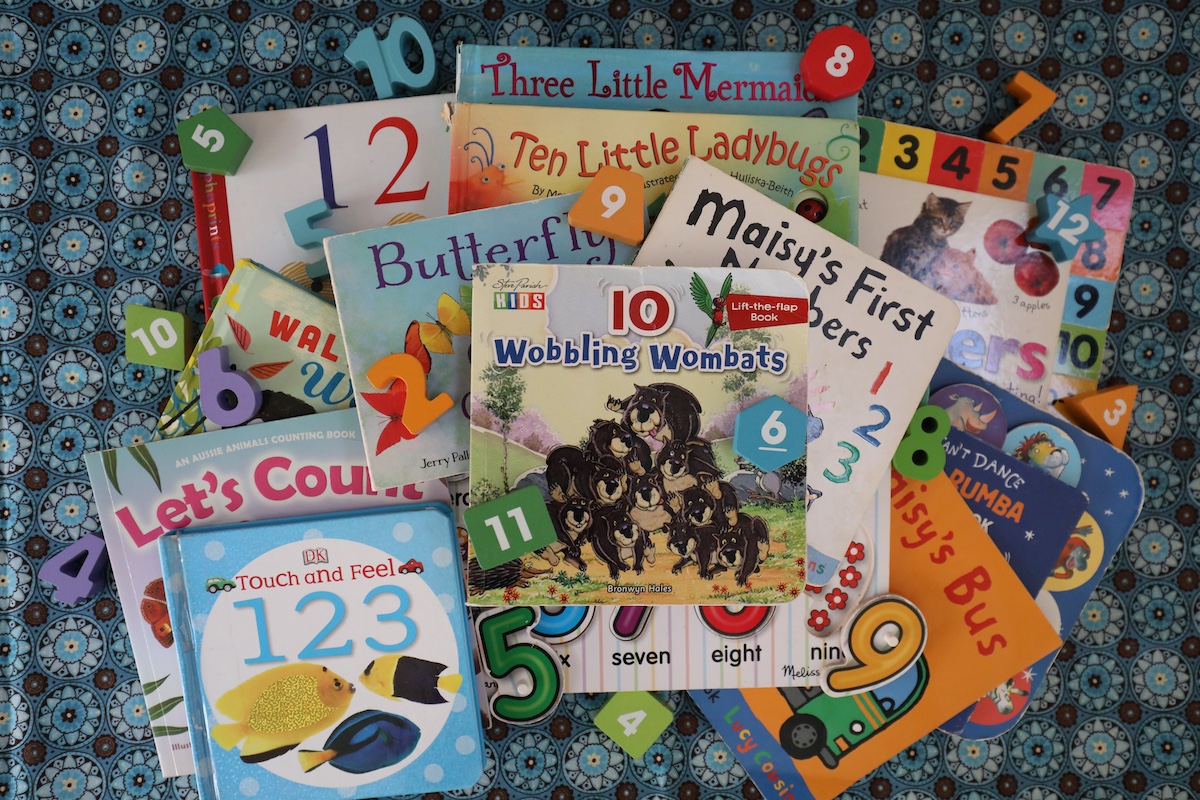
Introduce and teach numbers and counting to babies and young children through books. When reading, count objects like balls, birds, or other items in the pictures on the page, starting from a very young age.
While reading their 1-2-3 books, we point to the number, say the name of the number, trace the number with their finger, and count the objects on the page. For example, in Maisy’s Bus Book, when they would get more advanced, I would ask what number it is (quiz), then correct or repeat what they said. This helped with their number recognition, especially because this book only had the numbers 1-5 in it. Starting off learning #1-5 before learning #1-10 helped in the beginning.
As they progress, ask them to identify numbers and count objects while reading books, guiding them to say the number first and then repeating after them to ensure accuracy. Encourage them to count and say each number in the book, correcting any mistakes gently (just be a little bit slower than them counting with them, so if they make a mistake you can correct them and if they are correct, they get validation afterwards). For example, if the number is 4, they would say “1” then right after you would say “1,” then they would say “2” and you would say “2,” etc. Go through and count and say each number in the book.
2. Exploring Measurement
Introduce and teach numbers and counting to babies and young children through measurement. Introduce the concept of measurement by discussing the pictures in the books. Encourage comparisons between the largest and smallest objects, as well as the longest and shortest items depicted.
3. Playing
Introduce and teach numbers and counting to babies and young children through playing. While playing, count all their toys. Add their toys together.
4. Rhyme
Introduce and teach numbers and counting to babies and young children through rhyme. To begin, focus on the first 5 numbers. So when playing with them or talking with them, I would say the “This little piggy went to the market” song but would change it to: “1 little piggy went to the market. 2 little piggy stayed home. 3 little piggy had roast beef. 4 little piggy had none. 5 little piggy went ‘WEEEEE.’” While doing this, I would wiggle each toe, then on the fifth toe wiggle it then throw our hands in the air for the “weee.” Sometimes I would make the song shorter and just say “1 piggy, 2 piggy, 3 piggy, 4 piggy, 5 piggy, WEE!!” This method helps children grasp counting from 1 to 5 before moving on to 1 to 10.
5. Educational Music and Songs
Introduce and teach numbers and counting to babies and young children through music. Also, while driving or when playing music, I would play Jack Hartmann counting 1-20 or counting 1-100. Consider playing these songs in another language if you are teaching the baby multiple languages.
6. Number Singing
Introduce and teach numbers and counting to babies and young children through singing. Practice signing the numbers with the child while playing with them or soothing them.
7. Puzzles
Introduce and teach numbers and counting to babies and young children through puzzles. They can do number puzzles. Melissa & Doug has number puzzles where you can see the number of objects beneath the number. They also have a clock puzzle that you can practice counting the numbers.
8. Tracing
Introduce and teach numbers and counting to babies and young children through tracing. Trace numbers in the books and chunky letters with your finger.
9. Apps
Introduce and teach numbers and counting to babies and young children through apps. Some of their favorite include:
- Duck Duck Moose: Park Math
- Khan Academy Kids
- OSMO Numbers and Tiles
10. Circle Maps
Older children learning numbers can use these circle maps. They can cut out along all the dotted lines and then match the squares with the various ways to represent each number to the corresponding circle. They have the option of using it as a matching game and then reusing it or pasting it down. Additionally, there are other spaces provided for writing down their answers.

@engagethestages
Achievement-Focused Numbers
Use a Circle Map to Match Objects to Numbers
Numbers 1-10 Matching