
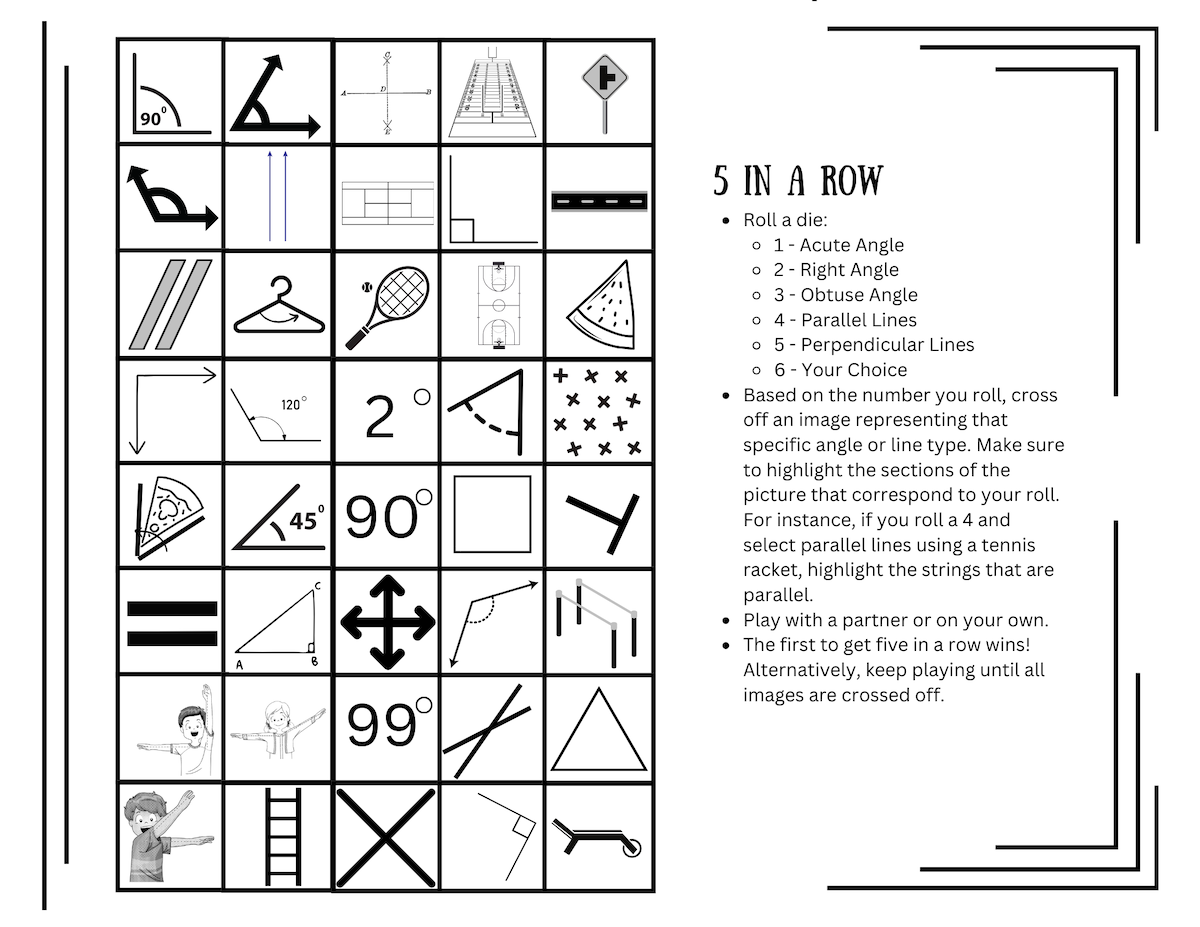
Learning about angles and lines doesn’t have to be limited to worksheets and textbooks. Students can truly grasp concepts like measuring angles, identifying obtuse, right, and acute angles, and distinguishing between perpendicular and parallel lines through interactive games and activities. By using hands-on approaches, learners can make meaningful connections between math concepts and the real world, turning a potentially dry topic into an engaging experience.
1. Measuring Angles
- Protractors: allow students to measure and construct angles accurately.
- Protractor Hunt: Give students protractors and have them measure angles found around the classroom (window corners, books, chairs, etc.).
- Angle Scavenger Hunt: Post pictures of various real-world objects with angles on the walls and have students rotate to measure them.
- Create Your Own Angle Art: Students create geometric art with different angles and label them with their measurements.
- Paper Folding: By folding paper in various ways, students can create angles and learn to measure them by unfolding and using a protractor.
- Straws or Craft Sticks: Students can create angles by connecting straws or craft sticks at different points, helping them visualize the concept of angles.
- Angle Scavenger Hunt: Create a scavenger hunt where students find and measure angles in their environment, using protractors or angle finders.
- Cardboard Cutouts: Pre-cut angles can be used to help students visually compare and measure different angles.
- Angle Relay Race: Split students into teams. Set up stations with angle measurement tasks (using protractors). Each team member must measure an angle correctly before passing the baton to the next teammate. The first team to complete all stations wins.
- Protractor Toss: Use a large protractor drawn on the ground and have students throw beanbags or balls at different angle sections. They have to identify and articulate the angle they landed on.
- Angle Construction with Straws: Provide students with straws cut into different lengths. They can create angles by connecting the straws at various points. Students can then measure the angles they created using a protractor.
- Paper Folding Angles: Give students a piece of paper and ask them to fold it to create specific angles (e.g., 45°, 90°). After folding, they can unfold the paper and measure the angles to verify their accuracy.
- Angle Art: Have students create artwork using a variety of angles. They can use rulers to measure and draw angles, then discuss how different angles can change the appearance of their artwork.
- Shadow Angles: On a sunny day, take students outside to measure the angle of their shadows at different times of the day. They can use their height and shadow length to calculate the angles formed with the ground.
- Angle Art: Have students create geometric artwork using protractors to measure and draw specific angles. They can use colored paper, scissors, and glue to construct their designs, incorporating angles into their artwork. This combines creativity with angle measurement.
- Build-a-Shape Challenge: Using straws or pipe cleaners, challenge students to construct various geometric shapes and identify the angles within them. After building, they can measure each angle with a protractor and classify them.
- Angle Relay Race: Set up a relay race where students must measure and label angles on a large poster board in a limited amount of time. Divide the class into teams and assign them different angles to find and measure. The team that completes the task correctly and fastest wins.
- Origami Angles: Introduce students to origami and have them create different shapes, focusing on the angles formed during the folding process. After creating their origami, they can measure the angles and discuss the relationships between the folds and the angles.
- Interactive Angle Walls: Use a wall or large poster board where students can stick various angle measurements. They can create a visual display that shows different angles and their classifications. This can be an ongoing project where students contribute over time.
- 3D Angle Exploration: Provide students with geometric solids (like cubes, pyramids, and spheres) and have them explore the angles formed by the edges and faces. They can measure the angles and discuss how they relate to the shapes’ properties.
- Angle Storytelling: Encourage students to create a story or comic strip that involves angles. They can illustrate scenes that include different types of angles and explain their significance in the context of the story.
- Outdoor Angle Measurement: Take students outside and have them use sticks to create various angles on the ground. They can then measure these angles and compare their findings, allowing them to connect math with the physical world.
- Angle Art Collaboration: Have students create a large mural or collage using various angles. They can use colored paper, string, or even natural materials like sticks. Each group can focus on a different angle type and present their section to the class, explaining the angles they used.
- Interactive Angle Stations: Set up different stations around the classroom, each focusing on a different aspect of angles (e.g., measuring, identifying, creating). Students rotate through the stations in pairs, completing challenges and discussing their findings with their partners.
- Angle Matching Game: Create a set of cards with different angle measures and corresponding angle names. Students can play a matching game individually, trying to match the angle cards with their correct names. This reinforces their understanding of angle types and measures.
- Musical Chairs with Angles: Play a game similar to musical chairs, but with a twist. Instead of just sitting down when the music stops, students must find a chair that represents a specific angle (e.g., if you call out “acute,” they must find a chair while forming an acute angle with their bodies).
Books:
- What’s Your Angle, Pythagoras? – Julie Ellis
- Shape Up – David A. Adler
- Sir Cumference
- Great Knight of Angleland
- Hamster Champs – Stuart J. Murphy
YouTube:
- Math Antics – Angles and Degrees
- Doodles and Digits – How to Measure using a Protractor
- Smile and Learn – Angles
- Peter Weatherall Angles Song
Online games:
- Math Playground – Alien Angles
- Math Playground – Rocket Angles
- Math Playground – Measuring Angles
- WordWall – Angles Game
- ToyTheater – Quarterback Angle
2. Determining if Angles are Acute, Right, or Obtuse
- Angle Sort Game: Provide cards with drawn angles, and students sort them into acute, right, and obtuse categories.
- Human Angles: Use string or masking tape on the floor. Students form angles with their arms or bodies, and others guess the type.
- Angle Spinner Game: Create a spinner with acute, right, and obtuse labels. Spin, then students quickly find or draw an example that matches.
- Geoboards: Using rubber bands on a geoboard, students can create various angles and shapes, allowing them to explore the properties of angles visually.
- Angle Scavenger Hunt: Create a list of different types of angles (acute, obtuse, right) and send students on a scavenger hunt around the classroom or school. They can take pictures or draw the angles they find, categorizing them accordingly.
- Angle Pictionary: Students take turns drawing angles on the board while their classmates guess the type of angle (acute, obtuse, straight).
YouTube:
- Doodles and Digits – Right, Obtuse, Acute
- Colin Dodds – Angle Properties
- Samantha Baker – Types of Angles
- Numberock – Angles Song – Acute, Obtuse..
- Numberock – Triangles Song
- Numberock – Quadrilaterals Song
3. Perpendicular vs. Parallel Lines
- Tape on the Floor: Use masking tape to create line arrangements. Students walk along lines and decide if they are parallel or perpendicular.
- Line Match Cards: Cards with pairs of lines; students match examples to “parallel” or “perpendicular.”
- Parallel/Perpendicular Relay: Teams race to identify or create examples using magnets, sticks, or whiteboard drawings.
YouTube:
- McCarthy Math Academy – Lines
- Numberock – Parallel, Perpendicular
- Numberock – Geometry – Lines & Angles
- GoNoodle – Lines and Angles
4. Combined Games
- Angle Detectives: Students get a mystery set of angles to measure and classify, earning points for correct answers.
- Geometry Simon Says: Example: “Simon says make a right angle with your arms” or “Find two parallel lines in the room.”
- Angle Bingo: Create bingo cards with different angles drawn on them. Call out angle measurements, and students must find the corresponding angle on their bingo cards. The first to complete a line (or parallel or perpendicular lines) wins!
- Angle Storytelling: Have students create a story that involves different angles. They can describe a character navigating through a world that includes acute, obtuse, and right angles. This encourages them to use descriptive language while understanding the concepts of angles.
- Angle Poetry: Students can write poems or rhymes that incorporate angle terminology. They can include definitions and examples of acute, obtuse, right, and straight angles, allowing them to express their understanding creatively.
- Create a Script for an Angle Adventure: Students can work in groups to write a script for a short play that involves characters dealing with angles. They can illustrate situations where characters encounter different angles, allowing them to think critically and creatively.
- Cover the table with painters tape. Ask students to identify the lines that are parallel and perpendicular. They can also look for acute, right, or obtuse angles. Additionally, have them measure the angles and record their findings using sticky notes or dry erase markers.
- Distribute two large sticks to each participant. Call out terms like “obtuse, “acute,” “right,” “parallel,” or “perpendicular,” and challenge them to create a representation of each term using their sticks.
- Obtain a long piece of string. Use the string to measure various angles. Variation: Select two cards and create the angle with the string.
- Create an origami figure (such as an airplane or swan). Disassemble it and identify all the angles.
- Online Games: IXL, Khan Academy
Manipulatives:
- Duplo/Lego
- Cards – playing cards or uno
- Dominoes
- Number tiles (like scrabble tiles)
- Ruler / Measuring Tape
- Magnatiles
- Pattern Blocks
- Shapes
- Grid Paper
- Pentominoes
- Geoboard
- Protractor
- Angle Finders
- Angle Meter
- Straws / Craft Sticks
- Angle Construction Kits
- Cardboard Cutouts
Exploring angles and lines through hands-on activities, games, and interactive exercises makes math both fun and memorable. Whether students are using protractors to measure angles, playing sorting games to categorize them as obtuse, right, or acute, or identifying parallel and perpendicular lines in their environment, these experiences deepen understanding. Incorporating these playful methods into lessons will not only boost comprehension but also spark a lifelong appreciation for the practical side of geometry.
Get Your Angles Packet!
Angles

@engagethestages