
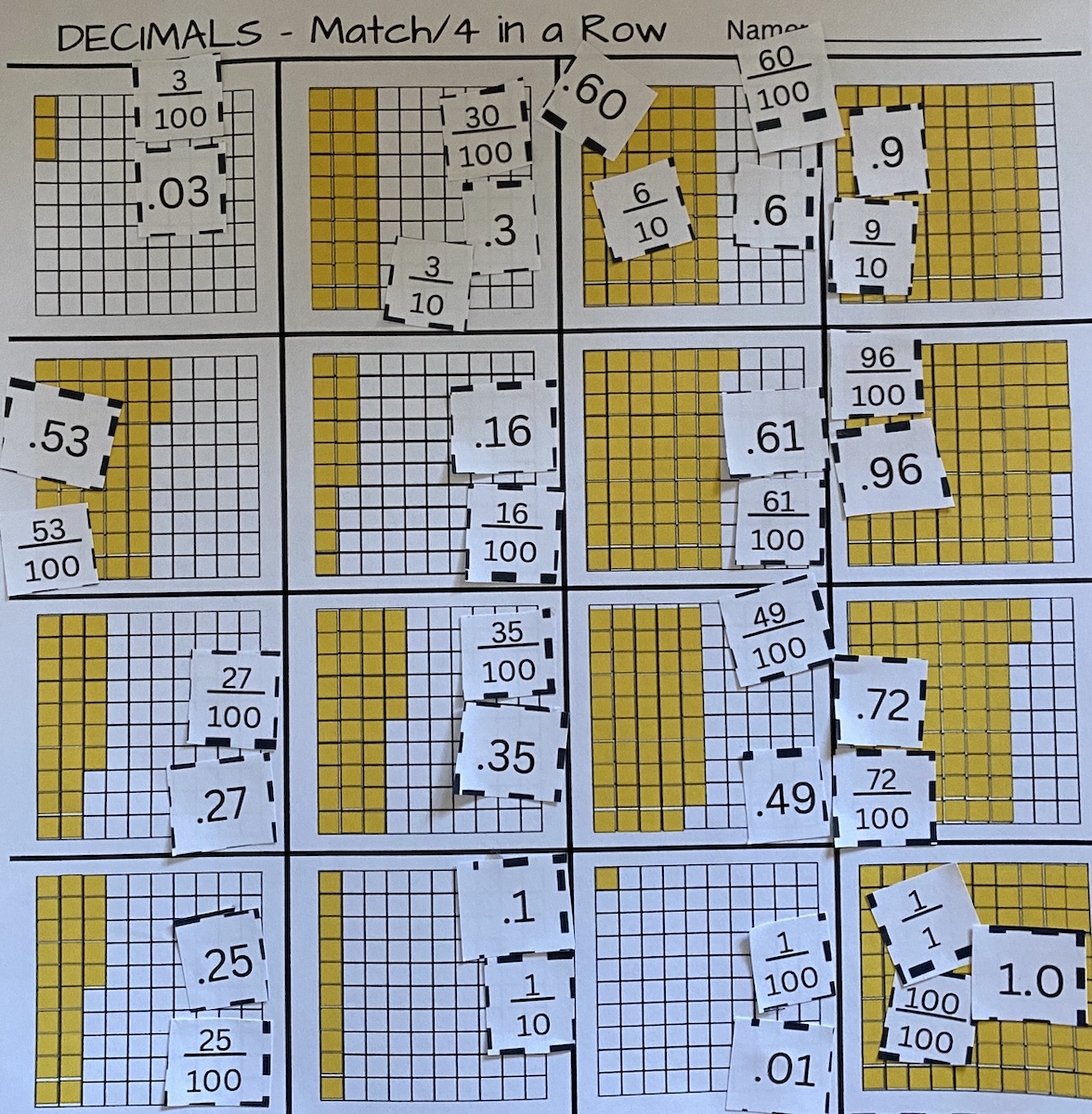
Decimals are an essential part of mathematics, appearing in money, measurements, and scientific data. Helping students master decimals builds their confidence and prepares them for more advanced math skills. To make learning decimals engaging, teachers can use activities that involve movement, creativity, and problem-solving. By incorporating activities that cater to different learning styles, teachers can help students understand and enjoy working with decimals.
Logical-Mathematical Intelligence
- Decimal Number Line Race: (Tape, floor space, decimal cards.) Create a number line from 0 to 10 in decimal increments. Hand students decimal cards (e.g., 3.4, 5.7). They must race to place their card at the correct position. Discuss which decimals are greater or less to reinforce ordering.
- Decimal War (Cards): (Card deck, decimal markers.) Players flip two cards to form a decimal (e.g., 0.47). Highest decimal wins the round. Continue until all cards are played.
- Graphing Decimals: Provide a simple data table with decimal values (for example, rainfall in inches). Students create a bar graph showing the decimals accurately on the axis.
Visual-Spatial Intelligence
- Decimal Place Value Blocks or coins: (Base-ten blocks): Use a large cube as 1, flats as 0.1, rods as 0.01, and small cubes as 0.001. Build numbers like 2.34 and have students physically count and assemble.
- Money Manipulatives: (Play money or real coins): Use dollars as 1 and dimes as 0.1. Have students represent amounts like $3.25 and combine to add or subtract decimals.
- Measuring with Rulers and Tape Measures: (Rulers, tape measures with tenths): Measure items in centimeters or inches with decimal markings. Record and compare lengths like 5.4 cm vs 5.7 cm.
- Decimal Number Line Walk: (Tape or chalk to create a large number line on the floor.): Have students stand on 0 and step to 0.1, 0.2, etc. Place cards with decimals to physically compare and order. Once all cards are placed, challenge them to add or subtract different pairs of decimals by moving the cards or finding the resulting position on the number line.
- Color in the decimal on a 100’s grid. Compare to a 10’s grid. Use transparency paper to compare which is more or less.
- Spin and Create Decimals Game: (Spinner with digits 0–9, paper.): Spin to generate digits and place them in tenths, hundredths spots. Compare decimals with classmates to see who made the largest number.
- Pouring Water for Decimal Measurement: (Graduated cylinders or measuring cups.): Pour water to measurements like 0.3 L or 1.25 L. Compare volumes and calculate combined totals.
- Cutting and Weighing Food: (Small scale, fruits or snacks.): Weigh items like 0.25 lb. Then add or subtract weights for multi-step decimal practice.
- Decimal Dice Race: (Dice labeled 0–9.): Roll dice to create decimals like 0.56. Students add, subtract, or compare decimals to win points.
- Interactive Sorting of Decimal Cards: (Pre-made cards with decimals like 0.1, 0.35, 0.75.): Students physically arrange cards from smallest to largest, then check with number lines for accuracy.
- Add and subtract decimals by hundreds grid, place value, or traditional method.
- Building with Blocks: (Unit blocks or LEGO bricks.) Use blocks to represent decimal values. For example, if a whole block represents 1, a smaller piece could represent 0.1. Students can build structures that visually represent decimal addition or subtraction.
- Decimal Scale Weighing: (A digital scale, various classroom items, and a recording sheet.) Have students weigh different items and record their weights in decimals. They can then compare weights, order them from lightest to heaviest, or even create a classroom display of their findings.
- Decimal Number Line Exploration: Draw a number line from 0 to 1. Divide it into 10 equal parts. Label each part with its decimal value (0.1, 0.2, …, 1.0). Extend the line to 2 and repeat. Have students place card numbers like 0.35 or 1.7 in the correct spot.
- Decimal Place Value Sort: Prepare cards with decimals (e.g., 0.57, 1.03, 2.6). Students grab a place value card and state which number is in that place value. Explain their reasoning to reinforce understanding.
- Decimal Place Value Mats: Create large place value mats using poster board. Divide the mats into sections for tenths, hundredths, and whole numbers. Use small items like beans, buttons, or colored paper squares to represent decimal values. Have students build different decimal numbers using the items, then practice adding and subtracting them by physically moving the items around on their mats.
- Comparing Decimals with Measurement: Provide rulers or measuring tapes. Have students measure objects to the nearest tenth or hundredth of an inch/centimeter and then compare the measurements, ordering them from least to greatest.
- Decimal Addition with Money: Give students play money or coins. Create word problems like “You bought an item costing $2.35 and one costing $1.75. How much did you spend?” Students add decimals to find totals.
- Cooking with Decimals: Use a simple recipe. Have students adjust ingredient quantities by multiplying or dividing decimals (e.g., half of 1.25 cups of sugar). Discuss real-life application.
- Decimal Art: Have students create a piece of artwork using a grid system where each square represents a decimal value (e.g., 0.1 for each square). They can use different colors to represent different values. Once the artwork is completed, students can calculate the total value of their artwork by adding up the decimals represented by the colors. For instance, a 10×10 grid can represent 1 whole, and students can color in squares to represent different decimal fractions (e.g., coloring in 25 squares to represent 0.25).
- Decimal Puzzles: (Puzzle pieces labeled with decimals and their sums.) Students match pieces to complete sums or differences. Visual problem-solving reinforces decimal operations.
- Decimal Art Projects: Have students create an artistic representation of a decimal number using colored paper or beads. Each color can represent a different decimal place (e.g., units, tenths, hundredths). After creating their art, students can work in pairs to add or subtract their decimal representations, using their art to visualize the operations.
Manipulatives:
- Duplo/Lego Base ten blocks (tangible, picture, or draw square,line, dots…)
- Number Line
- Number Bond
- Number place value coins
- Cards – playing cards or Uno
- Dominoes
- Number tiles (like Scrabble tiles)
- Beads (like Montessori but make your own)
- Ruler / Measuring Tape
- Beads/Beans … etc.
- Magna-Tiles
- Pattern Blocks
- Shapes
- Grid Paper
- Pentominoes
- Geoboard
- Measuring Cups
- Fraction Strips
- Fraction Circles
- Fraction Puzzles
- Food – crackers, cookies, etc.
- Oreos and the frosting
- Playdough
- Mega-Bloks (write on them which fraction they are in proportion to each other)
Bodily-Kinesthetic Intelligence
- Decimal Place Value Chart: Create a large place value chart using grid paper or a whiteboard. Have students use colored markers or sticky notes to represent different decimal values (e.g., tenths, hundredths).
- Large Place Value Chart: Create a large place value chart on the floor using tape. Use small objects (like counters or blocks) to represent different decimal values. For example, place 10 objects in the tenths column and 5 in the hundredths to represent 0.105.
- Money Math: Use play money to teach decimals. For example, assign values to different coins (e.g., pennies = 0.01, nickels = 0.05, dimes = 0.10, quarters = 0.25).
- Fraction to Decimal Conversion: Use measuring cups or a beaker with water to explore fractions and their decimal equivalents. For instance, show that 1/2 cup is equivalent to 0.5 and 1/4 cup is 0.25 by measuring out the water.
- Decimal Number Line: Have students create a giant number line on the floor or wall. Use paper or string to mark off increments of decimals (like 0.1, 0.2, etc.). Students can use cards to represent different decimal numbers and place them correctly on the number line, reinforcing their understanding of decimal order and spacing. Once they are in position, ask them to find and demonstrate addition and subtraction of decimals by moving along the number line.
- Decimal Scavenger Hunt: Hide decimal number cards around the classroom. Give students clues involving sums, differences, or comparisons of decimals to find the next card.
- Ordering Decimals in a Race: Give each student a decimal card. Call out instructions like “Line up smallest to largest” or “Find the person closest to 0.5.” Students move to form a human number line.
- Decimal Relay Race: (Flashcards with decimal problems.) Teams race to stations, solve decimal problems, and run to the next. Fastest team with all correct answers wins.
- Decimal Hopscotch: (Chalk or tape to create a hopscotch grid, small beanbags or markers.) Create a hopscotch grid with decimal numbers. Students take turns tossing a beanbag onto a number and then hop to that number. Once they land, they must add or subtract a decimal number (called out by a peer) from the number they landed on and say the answer out loud before moving to the next number.
- Decimal Number Line Relay: (Long strip of tape or rope to create a number line, cards with decimal numbers.) Set up a large number line on the floor. Divide students into teams and give each team a set of decimal cards. Teams must race to place their cards in the correct position on the number line. Once all cards are placed, they can work together to add or subtract decimals, physically moving to the corresponding positions on the number line to show their calculations.
- Shopping Simulation: (Play money, price tags with decimals, shopping baskets. Set up a mock store with items priced with decimal amounts. Students receive a budget in play money and must shop for items, adding and subtracting decimals to stay within their budget. They can physically pick up items, calculate totals, and make change.
- Decimal Basketball: (Small basketball or soft ball, hoops or buckets, scorecards.) Set up a basketball shooting area. Each basket made corresponds to a decimal value (e.g., 0.5 for a close shot, 1.0 for a far shot). Students keep track of their scores and must add or subtract their total points from previous rounds, discussing their calculations as they go.
- Decimal Scavenger Hunt: (Clue cards with decimal problems, various locations.) Create a scavenger hunt with clues that involve adding or subtracting decimals. Each clue leads to the next location, and students must solve a decimal problem to find the next clue. This encourages movement and problem-solving in a fun way.
- One Meter Activity – Provide each participant with a meter stick. They will need to list three items they believe are each one meter long. Next, they must locate these objects, measure them, and calculate how far off they were.
- Each player starts with 5 quarters, 7 dimes, 9 nickels, and 11 pennies. Flip two cards to determine the amount of money to give to the bank. If necessary, exchange one of your coins for smaller denominations. Continue this process until you have no money left.
- Decimal Place Value Chart: Create a large place value chart on the floor using tape. Use small objects (like counters or blocks) to represent different decimal values. For example, place 10 objects in the tenths column and 5 in the hundredths to represent 0.105. This visual and tactile approach helps students grasp place value.
- Decimal Jenga: Write decimal numbers on Jenga blocks. As students pull blocks from the tower, they must read and discuss the decimal value, compare it with others, or perform operations like addition and subtraction with the values.
Musical Intelligence
- Decimal Rhythm Patterns: (Drums or claps.) Assign a beat to each decimal (0.25 = quarter beat, 0.5 = half beat). Students create rhythmic sequences to “perform” decimals.
- Fraction-to-Decimal Jingle: Students compose jingles explaining how to convert fractions to decimals
- Decimal Dance Party: (Music, a list of decimal problems. )Play music and have students dance. When the music stops, call out a decimal addition or subtraction problem, and students must quickly find a partner to discuss the answer.
- Decimal Songwriting: Encourage students to write a song that includes lyrics about decimals. They can write verses that explain how to add, subtract, multiply, or divide decimals, using catchy tunes to reinforce learning. Performances can be recorded for review and sharing.
- Decimal Musical Chairs: Adapt the classic game of musical chairs by placing decimal cards on each chair. When the music stops, students must find a chair, then solve a decimal problem related to the card on their chair before they can sit down. This adds a fun twist while reinforcing their understanding of decimals.
- YouTube: Numberock – Decimal Place Value Song, Numberock – Adding & Subtracting Decimals, Numberock – Relating Fractions to Decimals, Numberock – Multiplying Decimals, Numberock – Converting Fractions to Decimals, Numberock – Ordering Decimals Song, Numberock – Converting Decimals to Percentages, The Singing History Teachers – Adding & Subtracting Decimals, Dylan Peters EDU – Place Value Song, Songs for School – All about that Place,
Linguistic Intelligence
- Decimal Storytelling: (Story cubes with decimal scenarios.) Use story cubes to create scenarios involving decimals (e.g., sharing 1.5 pizzas among friends). Students can illustrate their stories, reinforcing their understanding of decimals in real-life contexts.
- Word Problems Creation: Instruct students to create their own word problems involving decimals. They can then exchange their problems with classmates to solve. This activity promotes critical thinking and reinforces their understanding of how decimals are used in problem-solving.
- Decimal Problem-Solving Circles: Form small groups where students are given real-world problems involving decimals (e.g., budgeting for a trip). They work together to devise solutions and present their findings to the class.
- Decimal Word Problems Relay: Set up a relay race where students solve word problems involving adding and subtracting decimals at different stations. Each station presents a different problem, and once solved, they race to the next one. This encourages teamwork and quick thinking.
- Decimal Stories: Encourage students to write short stories or scenarios that involve decimals, such as shopping experiences or sports statistics. This allows them to express their understanding of decimals through narrative and personal context.
- Decimal Storytelling: Have students create a story where the characters use decimals in their adventures. For example, they could be shopping for items priced with decimals, measuring ingredients in a recipe, or splitting a bill among friends. This activity encourages creativity while reinforcing decimal concepts. Can include: adding and subtracting decimals based on real-life scenarios, such as shopping, budgeting, or cooking. Encourage them to illustrate their stories and present them to the class.
- Decimal Poetry: Challenge students to write poems or rhymes that incorporate decimal concepts. They can create verses about the importance of decimals in real life or use them in playful ways. This helps with retention and understanding through creative expression.
- Math Poetry: Ask students to write poems or rhymes that incorporate decimal concepts. They can use their poems to explain how to add and subtract decimals, including examples and rules. This can help reinforce their understanding through creative expression.
- Decimal Debate: Organize a debate where students discuss the importance of decimals in various fields, such as finance, science, and everyday life. Assign roles and have them research and present their arguments, enhancing their understanding while developing their speaking and critical thinking skills.
- Group Storytelling: In small groups, have students collaborate to create a story that involves characters facing challenges that require them to solve problems using decimal addition and subtraction. They can act out their stories, demonstrating the math concepts through dialogue and actions.
Books:
- “Smart” by Shel Silverstein. (Exchange money according to the poem. Discuss outcome. Calculate how much the child lost with each exchange. Calculate the percentage of the loss.)
- Fractions, Decimals, and Percents – David A. Adler
- Piece = Part = Portion – Scott Gifford
- 365 Penguins – Jean-Luc Fromental
- Inchworm and a Half – Elinor Pinczes
- You Can’t Buy a Dinosaur with a Dime – Harriet Ziefert
- Pigs Will Be Pigs – Amy Axelrod
- Sluggers Car Wash- Stuart Murphy
- Jenny Found a Penny – Trudy Harris
- The Penny Pot – Stuart Murphy
- Lemonade in Winter – Emily Jenkins
- The Lunch Line – Karen Nagel
Interpersonal Intelligence
- Decimal Dice Game: Roll two dice to form a decimal (e.g., die 1 = tenths, die 2 = hundredths → 0.47). Roll again for a second number. Students compare, add, or subtract the decimals.
- Decimal Marketplace: (Play money, items with decimal price tags.) Students role-play as buyers and sellers. They calculate totals and make change using decimals.
- Decimal Board Games: Teams play a board game where movement depends on solving decimal problems.
- Decimal Jenga: Write decimal numbers on Jenga blocks. As students pull blocks from the tower, they must read and discuss the decimal value, compare it with others, or perform operations like addition and subtraction with the values.
- Decimal Scavenger Hunt: Create a scavenger hunt where students must find items around the classroom or school that have prices or measurements involving decimals. They can record their findings and discuss the decimal values they encounter.
- Decimal Scavenger Hunt: Organize a scavenger hunt where students find items in the classroom or outdoors that can be expressed in decimal form (e.g., length of pencils, volume of water).
- Decimal Bingo: Create bingo cards filled with decimal numbers instead of traditional numbers. Call out addition and subtraction problems (e.g., “2.5 + 1.3”) and have students solve them to find the corresponding decimal on their cards. This encourages quick mental math while allowing for visual engagement.
- Decimal Bingo: Create bingo cards with decimal numbers. Call out fractions or whole numbers, and players must convert them to decimals to mark their cards.
- Decimal Bingo: Create bingo cards with decimal numbers. Call out fractions or percentages, and students must convert them to decimals to mark their cards.
- Decimal War: Use a deck of cards where the face cards represent decimals (e.g., Ace = 0.1, Jack = 0.11, etc.). Players draw cards and compare their decimal values, with the higher value winning the round.
- Decimal Dice Games: Use two decimal dice, where one die has tenths (0.1, 0.2, …, 0.9) and the other has hundredths (0.01, 0.02, …, 0.09). Students roll the dice to create two decimal numbers. They can then add or subtract the numbers they rolled, recording their answers. To make it competitive, students can race to see who can solve the most problems correctly in a set time.
- Decimal Board Games: Create a board game where players move spaces based on solving decimal problems. For example, answering a question about adding or subtracting decimals allows them to advance.
- Decimal Pictionary: Players draw a decimal number or a scenario involving decimals (like money) while their teammates guess what it is. This encourages creativity while reinforcing decimal concepts.
- Decimal Monopoly: A twist on the classic game, where all prices and transactions are in decimals. Players must manage their money while practicing addition and subtraction with decimals.
- Fraction to Decimal Match: Create cards with fractions on one set and their decimal equivalents on another. Players must match them correctly, fostering understanding of the relationship between fractions and decimals.
- Decimal Relay Race: Set up a relay race where teams solve decimal problems at different stations before passing the baton to the next teammate.
- Decimal Relay Race: Set up a relay race where students solve decimal addition and subtraction problems at different stations. Each station can have a different type of problem (e.g., using manipulatives, drawing, or using number lines). This incorporates physical movement with math practice.
- Decimal Number Line Race: (Long rope or tape to create a number line, markers for decimal points.) Create a large number line on the floor. Call out decimal addition or subtraction problems, and have students physically move to the correct answer on the number line. This incorporates movement and visual representation of decimals.
- Collaborative Decimal Projects: Have students work in groups to create a presentation or poster that explains a decimal concept, such as place value or operations with decimals. They can use visuals, stories, and examples to teach their peers.
- Scoop coins and add their values putting them in decimal form.
- Scoop colored beads (or skittles) and assign each place value a color. Organize the color of beads in each place value. Write the number and then look at each place value.
- Shopping Simulation: Set up a mock store with items tagged with decimal prices. Give students play money with decimal amounts. Have them “purchase” items and calculate their total cost or change. This activity emphasizes real-world applications of adding and subtracting decimals while allowing for visual interactions with the items.
- Fraction and Decimal Matching Game: Create cards with fractions on some and their decimal equivalents on others. Students can work in pairs to match the fractions to their decimal counterparts. Once matched, they can practice adding or subtracting the decimals they created from the matches.
- Decimal Jeopardy (Linguistic & Logical-Mathematical): Jeopardy board setup (can be digital or on a whiteboard). Create a Jeopardy game with categories based on decimal addition and subtraction. Students can work individually or in teams to answer questions, reinforcing their understanding through competition.
- Decimal Jeopardy (Linguistic & Logical-Mathematical): Jeopardy board setup (can be digital or on a whiteboard). Create a Jeopardy game with categories based on decimal addition and subtraction. Students can work individually or in teams to answer questions, reinforcing their understanding through competition.
- Decimal Board Games: (Game board, dice, cards with decimal problems.) Design a board game similar to “Chutes and Ladders,” where players advance by correctly solving decimal problems. This adds an element of movement and competition to learning decimals.
- Decimal Sorting Game: (Cards with different decimal values.) Create a sorting activity where students must categorize cards into groups (e.g., less than 0.5, between 0.5 and 0.9, and greater than 1). This helps them visualize the scale of decimal numbers.
Intrapersonal Intelligence
- Personal Decimal Budget: Students create a personal budget using decimal expenses for a small project.
- Decimal Puzzles: Design puzzles where students must fit pieces together to form correct decimal sums or differences. Each piece can represent a part of a decimal problem (e.g., 0.2, 0.5, etc.), and students will need to figure out how to combine pieces to reach a target decimal.
- Online Games: IXL, Khan Academy Kids, Khan Academy, Websites:MathPlayground, Arcademics, FunBrain, 99 Math NCTM APP: Number Pieces, Money Pieces, Number Line, Online Games: Arcademics – Hungry Puppies, Funbrain – Power Football, Math-Play.com Decimal Math, Math Playground – Function Machine Decimals
Naturalistic Intelligence
- Nature Decimal Hunt: (Assign decimal values to natural objects (small leaf = 0.1, medium = 0.5)): Students collect and add the values of items found. Calculate totals to compare with peers.
- Plant Growth Tracking : Measure plant heights in decimals over weeks.
- Create Your Own Decimal Word Problems: Ask students to write a story problem involving decimals (shopping, sports statistics, travel distances). Exchange problems with classmates to solve.
- Cooking with Decimals: Use measuring cups and spoons to have students follow a simple recipe that involves decimal measurements (e.g., 1.5 cups of flour, 0.25 cups of sugar). As they measure ingredients, ask them to add or subtract the measurements to adjust the recipe for different serving sizes. Have students modify a recipe to make a larger or smaller batch, requiring them to add, subtract, or multiply decimal quantities. Double or half the recipe.
- Decimal Grocery Store: Set up a mock grocery store in the classroom with various items priced in decimals (e.g., $1.25, $2.50). Give students play money and a shopping list with a budget. They must add up the prices of the items they want to purchase and ensure they stay within budget. After shopping, have them practice subtraction by calculating how much money they have left.
- Nature’s Grocery Store: Set up a miniature grocery store using natural items like fruits, vegetables, and stones. Assign prices to each item using decimals. Have students “shop” for items, adding their totals and practicing subtraction when they “return” items. Use a calculator or paper to keep track of their spending.
- Decimal Measurement Hunt: Take students outside to measure various natural objects (leaves, twigs, stones) using a ruler marked in decimals. They can record their measurements and then practice adding and subtracting these values to find the total length of objects they collected.
- Decimal Nature Trail: Create a nature trail with different stations where students encounter challenges involving decimals. For example, at one station, they might have to calculate the total weight of different rocks they find, and at another, they might need to determine the difference in height between two trees using decimal measurements.
- Plant Growth Tracking: Have students plant seeds and track the growth over time. They can measure the height of their plants in decimals (e.g., 1.5 cm, 2.3 cm) at regular intervals. They can then add or subtract these measurements to analyze growth patterns.
- Decimal Weather Station: Set up a weather station where students record daily temperatures in decimals. They can then work on adding and subtracting these temperatures over a week to find the average temperature or the difference between the highest and lowest readings.
- Eco-Friendly Market Simulation: Organize a market day where students sell and buy eco-friendly products (like handmade crafts or snacks). Prices should be set using decimal values. Students will practice adding their purchases and calculating change, fostering practical math skills in a natural setting.
- Nature-Themed Board Game: Create a board game where players move around a nature-themed board. Players roll dice and land on spaces that require them to solve decimal addition or subtraction problems related to nature (e.g., “You found 3.5 pounds of leaves and lost 1.2 pounds; how much do you have left?”).
- Real-World Budgeting Project: Have students work in groups to create a budget for a fictional event (like a party or trip). They will need to add and subtract decimal amounts for various expenses.
- Real-World Scenarios: Present students with real-world scenarios that involve adding and subtracting decimals, such as calculating total costs at a restaurant or determining distances traveled. Divide them into small groups and give each group a scenario to work on. They can present their findings to the class, explaining their calculations.
- Measurement Investigation: Provide students with rulers marked in decimal inches and centimeters. Have them measure classroom objects, recording their findings in a chart, then convert measurements between decimal systems.
- Real-Life Decimal Application: Have students research prices of items in a store and create a shopping list using decimals. They can calculate total costs and apply discounts.
- Personal Budgeting Project: Have students create a personal budget that includes decimal values for various expenses. They can reflect on their spending, savings, and goals, fostering a deeper understanding of decimals in financial literacy.
- Decimal Measurement Hunt: (Measuring tools (rulers, measuring cups), a list of items to measure, and a recording sheet.) Organize a scavenger hunt where students must measure items around the classroom or outdoors. Items could include the length of a pencil, the height of a plant, or the volume of a container. They will record measurements in decimal form, promoting both movement and math skills.
Teaching decimals doesn’t have to be abstract or tedious. By incorporating games, movement, visual models, real-world applications, and creative exercises, teachers can make decimals engaging and memorable. With hands-on practice and interactive learning, students build confidence in understanding and using decimals in everyday situations.
Get Your Decimals Packet!
Decimals

@engagethestages