
Teaching students how to add and subtract mixed numbers can be both fun and meaningful when lessons are designed to tap into their different strengths and learning styles. By integrating activities that engage linguistic, logical-mathematical, visual-spatial, bodily-kinesthetic, musical, interpersonal, intrapersonal, and naturalistic intelligences, students don’t just memorize procedures—they develop a deeper conceptual understanding of fractions and mixed numbers. Whether through hands-on manipulatives, storytelling, movement games, or creative art projects, these activities bring fractions to life in ways that resonate with every learner.
Linguistic Intelligence:
- Math Story Problems: Write a short, real-world scenario (like baking or building) that involves adding or subtracting mixed numbers. Solve the problem step-by-step, explaining how the mixed numbers combine or subtract conceptually. Draw or act out the story for deeper understanding.
- Word Relay Game: Teams receive mixed-number problems in word form and race to write the correct numerical equation and solve it.
- Books: Peg + Cat The Pizza Problem – Jennifer Oxley, & Inchworm and a Half – Elinor Pinczes
Logical-Mathematical Intelligence:
- Equation Puzzle Race: Students solve a series of mixed-number problems to progress through a puzzle or unlock the next challenge.
- Number Dominoes: Create dominoes with problems on one end and answers on the other. Students match them in logical sequences.
- Error Analysis and Reflection: Provide examples of solved mixed number problems, some with mistakes. Have students identify and correct the errors, explaining the concept behind the operations. Write reflections on what strategies helped make sense of the problems.
- Comparative Analysis: Investigate how adding and subtracting mixed numbers compares to whole numbers and improper fractions. Students can create a chart or a poster showcasing the differences and similarities.
- Background knowledge: Review fractions like 1/2, 1/3, 3/4 etc.
Visual-Spatial Intelligence:
- Fraction Art: Students use fraction strips or pie charts to visually add and subtract mixed numbers, then create posters showing solutions.
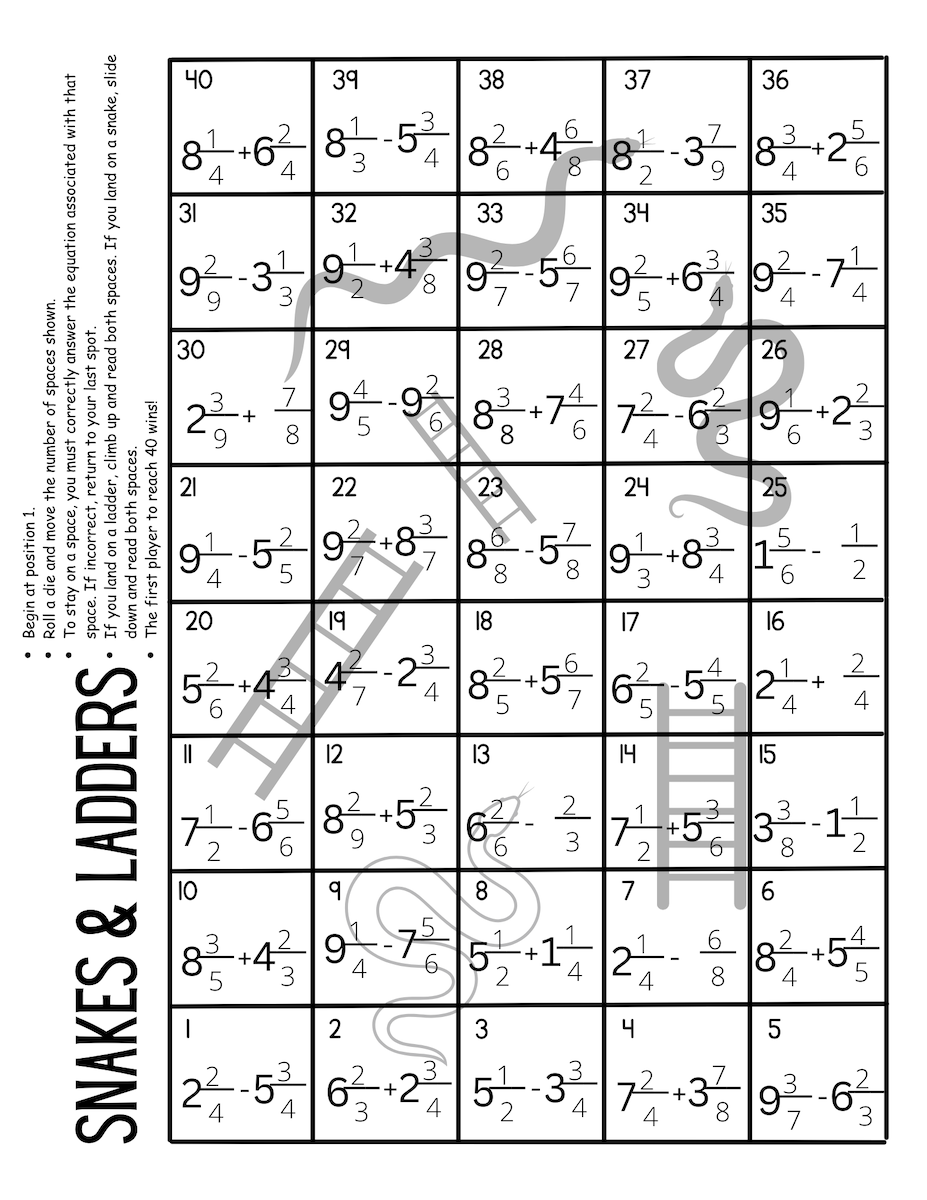
- Board Game Path: Design a board game where players move along a path by solving mixed-number problems correctly.
- Fraction Strips or Circles: Represent each mixed number with fraction strips or circles (e.g., 1 ½ = one whole strip + half strip). Line them up physically to combine or remove fractions when adding or subtracting. Regroup fractions that add up to a whole if necessary.
- Number Line: Draw a number line and mark the first mixed number. Move forward (for addition) or backward (for subtraction) by the fractional and whole parts of the next number. Record the final position as the answer.
- Converting to Improper Fractions: Convert each mixed number into an improper fraction. Add or subtract the fractions as usual, using a common denominator. Convert the result back to a mixed number if needed.
- Decomposing Mixed Numbers: Separate the whole number and the fractional part for each mixed number. Add or subtract the whole numbers first, then the fractions. Adjust the answer if the fraction is improper or requires borrowing.
- Using Visual Models (Drawings): Draw shapes (like rectangles or circles) to represent whole numbers and their fractional parts. Shade the parts for the first mixed number and then add or remove shaded parts for the second number. Count and label the total shaded parts.
- With Real-Life Measurements: Use a ruler, measuring tape, or cups to model adding or subtracting measurements (e.g., 2 ¼ cups + 1 ½ cups). Combine the measurements physically or visually. Write down the sum or difference as a mixed number.
- Using Base-10 or LEGO Models: Assign LEGO blocks or base-10 rods to represent wholes and smaller blocks to represent fractions. Physically join blocks for addition or remove for subtraction. Regroup the blocks to make new wholes if necessary.
- Utilize Magna- Tiles to construct improper fractions and mixed numbers.
- Line Them Up and Solve! Write your mixed numbers in columns. Solve Down. Background knowledge: you start with the ones column, followed by the tens, carrying over any tens. When working with fractions, carry over any fraction that includes a 1 + ___, carrying over the 1.
- Using Pattern Blocks to Conceptually Understand Adding and Subtracting Mixed Numbers: Set Up Your Pattern Blocks Assign each shape a fractional value based on a whole hexagon representing 1 whole. For example: (Hexagon = 1 whole, Trapezoid = 1/2, Rhombus = 1/3, Triangle = 1/6) Model the First Mixed Number : To represent a mixed number like 1 2/3, place: 1 hexagon for the whole number 1 2 rhombuses for 2/Model the Second Mixed Number : For 2 1/3, place: 2 hexagons 1 rhombus for 1/3. Add Mixed Numbers Conceptually: Combine all the blocks from both mixed numbers. Group fractions of the same kind to see if they create a new whole. For example: 3 rhombuses (1/3 each) = 1 whole. Count the total number of whole shapes and any remaining fractional shapes for your final sum. Subtract Mixed Numbers Conceptually: Lay out the blocks for the larger mixed number first. Remove the blocks representing the smaller mixed number. If you need to subtract a fractional piece you don’t have, “decompose” a whole hexagon into fractional pieces (e.g., 1 hexagon = 3 rhombuses) to borrow. Record Your Answer as a Mixed Number. Count how many whole hexagons remain. Combine any fraction blocks into simplified fractions. Write the result as a mixed number. Check Your Work Visually Confirm that the sum or difference matches the model. Look for opportunities to regroup fractional pieces into a whole to simplify your answer.
- Grouping Like Terms: Identify the Like Terms: FIRST: Look for numbers with the same variable or part (whole numbers with whole numbers, fractions with fractions). For mixed numbers, separate the whole number part and the fractional part. SECOND: Convert Mixed Numbers if Needed. If the fractions have unlike denominators, find a common denominator before adding or subtracting. THIRD: Group the Like Terms. Combine all the whole numbers together. Combine all the fractions together. Add or Subtract the Fractions Perform addition or subtraction on the fractional parts first. Simplify the fraction if possible. Add or Subtract the Whole Numbers. Combine the whole numbers after the fractions are simplified. Combine Results into a Mixed Number. If the fraction from step 4 is improper, convert it to a mixed number and add it to the total whole number part.
Manipulatives:
- Duplo/Lego Base ten blocks (tangible, picture, or draw square, line, dots..)
- Number Bond
- Number Line
- Cards – playing cards or uno
- Dominoes
- Number tiles (like scrabble tiles)
- Beads (like Montessori but make your own)
- Ruler / Measuring Tape
- Beads/Beans … etc
- Magnatiles
- Pattern Blocks
- Shapes
- Grid Paper
- Pentominoes
- Geoboard
- Measuring Cups
- Fraction Strips
- Fraction Circles
- Fraction Puzzles
- Food
Bodily-Kinesthetic Intelligence:
- Human Number Line: Students physically stand on a number line and move forward or backward to show the result of adding or subtracting mixed numbers.
- Math Hopscotch: A hopscotch board with fractions and mixed numbers where solving problems determines where students can jump.
- Create a Life-Size Number Line Utilize tape or chalk to mark numbers on the ground and illustrate how mixed numbers correspond to improper fractions.Students can mark the mixed numbers on the number line and see the jumps they make when adding or subtracting.
Musical Intelligence:
- Math Song Challenge: Students create short jingles or raps explaining the steps of adding and subtracting mixed numbers.
- Youtube – Math Antics & Doodles & Digits, Numberock -Adding mixed Numbers Song, Numberock – mixed Numbers Song, Learning Upgrade App – Fractions Basics Proper Improper Mixed Song, Lets do math – Change an Improper Fraction, Let’s Do Math – Change a Mixed Number to an Improper Fraction, Shmoop – Improper Fractions and Mixed Numbers
Interpersonal Intelligence:
- Peer Tutoring Circles: Students work in pairs or small groups to teach each other strategies using interactive flashcards.
- Team Problem Solving: Groups solve a series of mixed-number problems collaboratively to complete a class challenge.
- Interactive Games (Board or Cards): Create a game where each correct mixed number addition/subtraction lets you move forward or solve a puzzle. Encourage players to explain how they got each answer while playing. Use manipulatives or drawings to verify answers.
- LEGOS OR MEGA- BLOKS – Use dominoes to create an improper fraction (with the larger number on top). Construct that fraction using Legos. For instance, if you have 4/3, find a piece that is 3 units long. Compare it to your 4/3 to determine how many whole units you have and what fraction remains. Next, work on creating a mixed number and converting it back to an improper fraction using the Legos. (Label the MEGA- BLOKS to show the fraction).
- If you prefer not to use dominoes, cards, dice, or similar items, you can opt for the fraction cards provided at the end instead.
- Mixed Number Bingo: Create bingo cards with mixed numbers on them. Call out addition or subtraction problems involving mixed numbers, and players will mark the resulting mixed number on their cards. The first to complete a row or column wins!
- Fraction War: Use a deck of cards where each card represents a fraction (e.g., 1/2, 3/4, etc.). Players draw two cards to create mixed numbers, then add or subtract them. The player with the highest (or lowest) result wins the round.
- Math Relay Race: Set up a relay race where teams have to solve a series of mixed number addition or subtraction problems at different stations. Once they solve a problem correctly, they can move to the next station.
- Interactive Whiteboard Challenge: Use an interactive whiteboard to display mixed number problems. Students can come up one at a time to solve a problem, using virtual manipulatives or drawing to represent the mixed numbers.
- Mixed Number Memory Match: Create cards with mixed number problems and their corresponding answers. Players take turns flipping over two cards to find matching pairs, reinforcing their skills in a fun way.
- Math Board Game: Design a board game where players move forward by correctly answering mixed number addition and subtraction questions. Include obstacles or challenges to make the game more exciting.
- Set up a relay race where teams have to solve a series of mixed number addition or subtraction problems at different stations. Once they solve a problem correctly, they can move to the next station.
- Play BUMP, card games, Snakes and Ladders, spin the wheels, etc.
Intrapersonal Intelligence:
- Reflection Journals: Students write about their strategies and track personal progress with mixed-number addition and subtraction.
- Self-Paced Fraction Challenges: Provide a menu of problems at different difficulty levels for students to choose based on their comfort.
- Online Games: IXL, Khan Academy
- NCTM APPS: Pattern Shapes, Partial Product Finder, Number Pieces, Fractions, Number Line
- Online Games: Wordwall – mixed numbers to improper fractions, Wordwall – adding mixed numbers, Math-Play – fractions board game
Naturalistic Intelligence:
- Fraction Nature Hunt: Use objects from nature (leaves, rocks, petals) to create and solve mixed-number problems.
- Garden Measurements: Have students measure plant beds or water amounts in mixed numbers, then add or subtract them for real-world applications.
- Double your favorite cookie recipe and get baking (cookies)!
- Explore real-life scenarios where they might need to add or subtract mixed numbers, such as cooking (measuring ingredients), building projects (measuring lengths), or budgeting (adding expenses).
By exploring mixed number addition and subtraction through diverse approaches, teachers can create an inclusive and dynamic math environment. Students gain confidence as they see, touch, discuss, perform, and reflect on fractions in real-world contexts. From building with Legos to hopping on life-size number lines or creating fraction-themed art, each method reinforces conceptual understanding while keeping learning active and enjoyable. Embracing multiple intelligences not only strengthens fraction skills but also ignites curiosity, creativity, and collaboration in the math classroom.
Get Your Adding & Subtracting Mixed Numbers Packet!
Adding & Subtracting Mixed Numbers
Over 80 Pages!

@engagethestages
Leave a Reply