
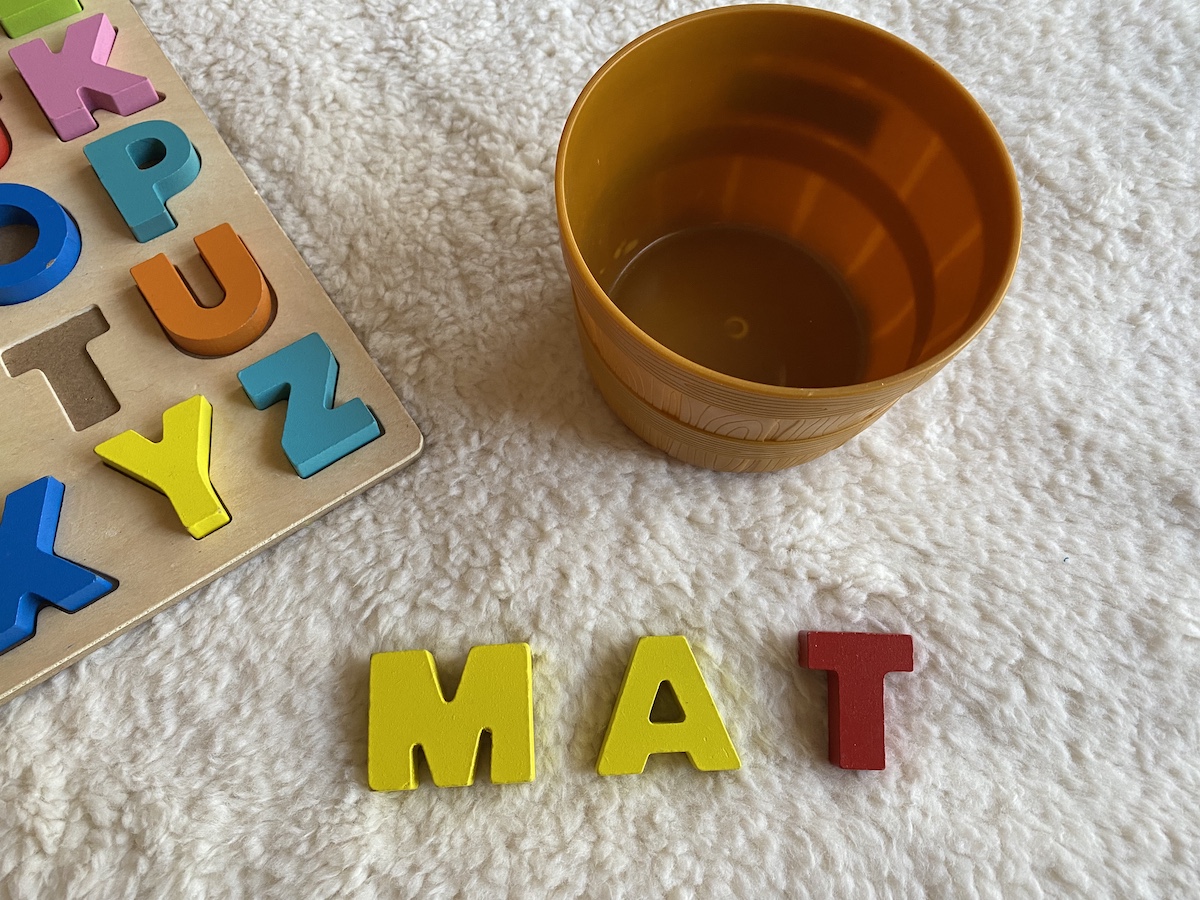


I introduced my daughters to the alphabet letters at the age of two in a quick and engaging way. Each night before bedtime, we would review the letters, using pieces from an ABC puzzle. Any type of card containing uppercase and lowercase letters would also be effective for learning. By teaching the letters and sounds this way she learned them FAST.
3 Letters At a Time
To aid in memorization, we focused on three letters at a time before progressing to the next set of three. I found it helpful to choose letters associated with people or objects they loved, as this accelerated their learning process.
- I initiated the learning process by showing them the letter “M” and saying, “mmm M for mama.” After introducing all three letters, we reviewed them together before practicing identifying and naming them. I encouraged them to find specific letters and repeat their sounds. For example, First, I show it to them “M” and say “mmmmmmm M … for mmmm mama.” , “This is mmmm M for mmmm mommy, what is this letter?” then have them repeat.
- Do all three letters, then put them all down on the table and go through them another time.
- Then ask them to find the “mmmm M.” They have to point and repeat.
- Then have all three letters down “can you find mmmm M??” etc. “Now what letter is this? What sound does it make?” etc. to all letters.
Adding More Letters
To make learning more interactive, I placed the letters in a bowl for them to select and work on. I gradually introduced three new letters once they had mastered the initial set. For example, after mastering the first three letters, we would add three more the following night while reviewing the previous ones. I continued to reinforce their knowledge by reviewing past letters alongside the new ones while still saying the sounds and names of each letter. When introducing a new letter, I associated it with a word they were familiar with, such as “M for Mom,” “D for Dad,” or “T is for Teeth (and we point to our teeth)”. Connecting letters to things they love facilitated easier learning.
While some suggest teaching only sounds initially, I opted to teach both the letter and its sound simultaneously, like “A is for aaa aaa aaaapple.”
Progression
We then progressed to sounding out words, guiding them to blend the individual letter sounds. Point to each letter to make a sound then blend. We expanded the learning by creating new words to spell and matching words with pictures.
When sounding out words later on, I focused on the sound, and when introducing concepts like the “magic e” and hard vowel sounds, I had them say the letter’s name for clarity (the e would make the a say A instead of aaaah.)


I also included a book series that covers the three letters to focus on each time, provides reinforcing activities, and offers books for them to practice reading that correlate to each new set of letters they are learning at the time.
VIDEO:
Circle Map Book:
Circle Map Book
Paste the image that starts with the same letter inside the circle

@engagethestages
Anchor Chart Block Letters:
Anchor Chart Block Letters
Paste the image that starts with the same letter inside the letter

@engagethestages
Anchor Chart Artistic Letters:
Anchor Chart Artistic Letters
Paste the image that starts with the same letter inside the letter

@engagethestages
Beginner Books:
Beginner Books
Choose which 3 letters to start learning with corresponding books to read

@engagethestages
Beginner Book Activities:
Beginner Book Activities
Activities to play and do with each corresponding books and letters being introduced

@engagethestages
Circle Map Notebook:
Circle Map Notebook
Paste the image that starts with the same letter inside the circle and engage in more activities related to that letter

@engagethestages