

7 Ways to Teach Your Child Mandarin Chinese or Another Language Without Speaking It Yourself
Introducing a second language to your child at a young age offers numerous cognitive benefits. Research shows that early exposure to a second language contributes to positive developmental outcomes. Personally, I found learning a new language challenging during my high school and college years. I believe that starting earlier might have made the process smoother – or maybe not. Early exposure could improve pronunciation, comprehension, and make it easier to learn. While exploring preschool options for my oldest child, I considered various language programs in our area. Mandarin Chinese stood out as the ideal choice for our family, even though I initially thought of teaching them Spanish. Given my husband’s work-related travels to Mandarin-speaking countries, Mandarin felt like the right path for us. Although I struggled with Mandarin during our time there, I was committed to helping my children grasp some aspects of the language. Surprisingly, teaching them Mandarin has enhanced my own language skills more than my time in the country did. I believe that I could have learned even more if I had utilized these resources while living there, rather than solely relying on language apps like Duolingo.
Top 7 Resources (Tools) for Teaching Your Child Mandarin:
In Person Mandarin Immersion School
- Initially, my eldest attended a Mandarin immersion preschool without any prior knowledge. She was just thrown in with 100% Mandarin and was one of the only kids with no background knowledge. She spent a year in this, and hardly learned any Mandarin other than hello – she didn’t have one-on-one and the kids spoke to each other in English. Then COVID happened and everything shut down. I didn’t want to stop the little bit of Mandarin she had learned so I signed her up for an online course, which proved to be the most beneficial. After everything opened back up again we signed her up for a weekend school for 3 hours each weekend. Her language skills and confidence notably improved through this experience. Many suggest full-day, everyday language immersion schools for optimal results. Whether daily immersion or weekend programs, these options boost speaking confidence. My kids understand more than they are able to output, and the Saturday schools are helping them become more confident in speaking. While we are only doing weekend school, full immersion schools are considered the most effective route.
Enhancing Speaking Skills with Online Platforms

Online One-On-One
- Enhancing Speaking Skills with Online Platforms: We use Lingobus. There aren’t many levels and you can become leveled out (which one of my kids has become). We like that there are videos (related to each lesson to watch beforehand), books, flashcards, and a quiz at the end. Then you have individual 25 minutes of speaking with a teacher. They also record these sessions so the child can go back and watch if they want to. We have done it for 4 years and my kids enjoy it. We find it’s best to do it 2 times a week, but with them in Saturday school we have gone down to once a week for now. I have heard LingoAce and Wukong are good. I have heard Preply is good and Duolingo for on the go (but Duolingo did not work for my kids at all). We tried Wukong but it was all in Mandarin and I had trouble navigating the site.
Shows and Movies in Mandarin Chinese

Changing the Language on a Show
- Shows in Mandarin. Disney+ change the language and subtitles. This is the best. The kids are able to change the language to Mandarin and able to watch their favorite shows in the other language. They have come up to me and are so excited to tell me the new word they learned in Mandarin. We don’t watch a lot of TV, but when they do it’s only allowed to be in Mandarin. Disney+ makes it easy to do this and safer than other alternatives. You can also look up things on YouTube like Peppa Pig in Chinese, but the ads and navigation risks make it not as safe as just sticking to Disney+. This goes for any language, they have variety of languages to change it to. From birth, they’ve only watched their shows in Mandarin, and this way they are exposed to it and with the correct pronunciation. One day, one of my daughters came home saying she knew a word in her Mandarin class and no one knew it, and I asked how she knew (thinking she was going to say Lingobus because I remember her learning that in one of her lessons) and she said it was on one of her shows on Disney+. Also, their weekend language teacher told me how they knew the words before going over them in class, thanks to these shows. Netflix allows you to change the language but there doesn’t seem to be as many options as Disney+. On YouTube they liked to watch the following shows: Babybus Chinese, Peppa Pig Chinese, Little Fox Chinese, and Kondosan.
Music in Mandarin Chinese

Music on YouTube
- Music in Mandarin Chinese: Our Top Picks for YouTube Listening. Whenever I’m in the car we listen to music in Mandarin (or math and ABC). Here are some of our favorites on YouTube: A Little Mandarin, BabyBus Chinese, Kim Hsieh, Little Fox Chinese, Little Dragon Tales, Disney Music in Chinese, Ezy Mandarin, and Mibao Star (for example: https://www.youtube.com/@MibaoStar). They would also listen to counting 1-100 in Chinese (Math Songs by Numberock).
Online Books

Online Books
- Online iChineseReader and LingoBus books. They find iChineseReader a bit frustrating as it lacks an automatic page turn, requiring manual flipping after reading each page. However, I appreciate the wide range of books available at various reading levels. On the other hand, LingoBus books offer automatic page flips, making it enjoyable for them to listen to the stories being read aloud. By listening to these books, they are improving their pronunciation skills.
Books

Paper Books
- Books. Mina Chinese books are a favorite due to their traditional characters, pinyin for pronunciation, translations, and interactive reading options. They also have a website or YouTube channel where you can go to have them read the book to you (with the ding to change the page). So the child is able to hear the correct pronunciation while reading it. My children love these books and have read them often. I like that they have everything to help a parent who doesn’t know the language teach their child. We have Mina Goes to the Beach, Mina’s Scavenger Hunt, Mina’s First Day of School, Mina’s Ups & Downs, and Let’s Go to the Farmers’ Market.
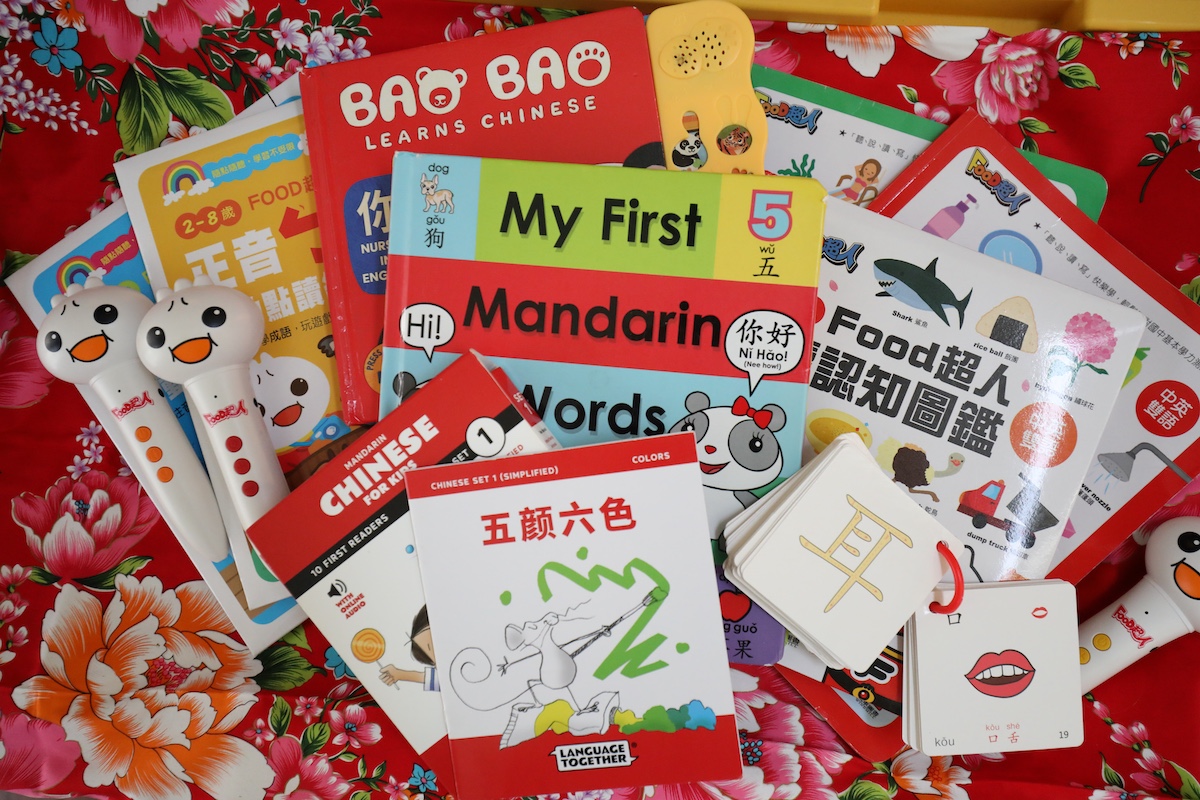
- We also have Bao Bao Learns Chinese. It’s a sing-along of 6 Nursery Rhymes with traditional characters, pinyin (so you can see the English characters to pronounce them), and the translation. You press the button to hear them sing the songs for you. The kids liked these, and if not playing YouTube for them at all, this is good. But you can find the same thing on YouTube to listen to. It is limited to 6 songs per book.
- Food Superman books are books where you can go through and learn many different types of words that are themed per page. They come with a wand that you can push on the page, and it will say the word for you either in Mandarin or English. They have traditional characters under them but not pinyin with English characters for pronunciation. They have quizzes on each page where you press it, and it will ask you to find a certain word, and you have to press it and see if you are correct or not. They have some songs, but they aren’t in Chinese. They also have sounds that the kids like, but they can be distracting, and they only press the sounds. I like the number of words and that you can hear how to say them, but I am not sure my kids learned any words from here. Sometimes we still just go to Google to translate a word to hear it over going to these books.
- Mandarin Chinese for Kids: Language Together: 10 First Readers. Set 1 and 2. They have a QR code to go to the website to listen to the 10 books. Each page shows the traditional characters and pinyin (so you can see the English characters to pronounce them). If you want to see what it means, you have to go to the last page of the book for translation. These weren’t a favorite. But it’s nice to see the target words in statement form.
Chinese Flashcards

Flashcards
- 7. Chinese Flashcards. I like these flashcards because they show you the word visually kind of shaped like the character. They also have the pinyin – how to pronounce it with English characters. However, these do not have translation and not all the pictures are exactly clear on the literal meaning of the word.


