
LEARNING TO COUNT
Numbers and counting
At first, I found it easier to learn start by mastering counting from 1 to 5 before progressing to 1 to 10, then 1 to 20, and eventually up to 1 to 100. Learning to count in Mandarin alongside English can provide a clearer understanding due to the logical sequence in Mandarin numbers.
LEARNING TO COUNT Based on each Multiple Intelligence:
Linguistic:

- Books – Interactive Reading: While reading any book, we like to count how many balls, birds, any object in the picture on the page. (This can start out as young as when they are a baby.) There are counting books that are just for certain numbers, or have a rhyme/song to the numbers, or just any book with pictures and you can count the objects.
- While reading their 1-2-3 books we point to the number, say the name of the number, trace the number, and count the objects on the page. Foster number recognition by quizzing children on numbers in books like Maisy’s Bus Book and correcting or confirming their responses. For example, in Maisy’s Bus Book, when they would get more advanced, I would ask what number it is (quiz) then correct or repeat what they said. This helped with their number recognition, especially because this book only had the numbers 1-5 in it. Starting off learning #1-5 before learning #1-10 helped in the beginning.
- Advanced Counting: Encourage children to independently count objects in books by prompting them to say the number first and then confirming or correcting their count. When they start to get more advanced, while reading, ask what number and have them count the objects by having them say the number first then mimicking them after to make sure they get it correct (just be a little bit slower than them counting with them, so if they make a mistake you can fix them and if they are correct they get validation afterwards). For example, if the number is 4 they would say “1” then right after you would say “1” then they would say “2” and you would say “2” etc. Go through and count and say each number in the book.
- Explore counting-themed books to enhance counting skills. Some books based on counting are: AlphaPrints 123, Ten Little Ladybugs, DK Numbers, Quack & Count (Keith Baker), One is a Snail Ten is a Crab (April Sayre), Rooster’s Off to See the World (Eric Carle), Equal Shmequal, Ten Apples Up On Top (Dr. Seuss), Every Buddy Counts (Stuart Murphy), One..Two..Three..Sassafras (Stuart Murphy), Tally O’Malley (Stuart J. Murphy), and Ten Black Dots (Donald Crews).
- Introducing Measurement: Another way to introduce measurement through books is by talking about the pictures. Compare sizes of objects in books by discussing the largest to the smallest or longest to shortest objects.
- Practice addition through counting objects on consecutive pages or focusing on specific objects like stars or buckets. While reading a book, add the side-by-side pages. For example, if reading a numbers book, add the page 3 and 4. 3+4 = count all the objects. Or count all the objects on the page. Or only count one object on the page. For example, count all the stars. Or count all the buckets and pails.
- Create Your Own Number Books: If they are more advanced in their fine motor skills, they can cut out objects and paste on a paper with a number book. Write the number and either draw or cut out objects and paste on the paper. Or make a circle chart, matching book, or anchor chart.
- NUMBER. Practice numbers actively by saying, writing, collecting objects, and using them in sentences.
Bodily-Kinesthetic:

- Writing: Trace the letters in the books with their fingers. Writing the letters on whiteboards. Trace numbers on lines on lined paper. Trace shapes. Trace cookie cutters of shapes. Khan Academy Kids has a spot where you use your finger to trace the numbers in the correct order (you can’t start tracing where you want to trace it and you have to stay in the thick lines). Write the numbers in the sand, foam, rice, dirt, a squirt bottle to spray water on the ground, chalk outside, etc.
- Playtime: While playing, count all their toys. Add their toys together. Build towers and count them, then knock them down.
- Play-doh: cut play-doh into pieces and count them. Use the play-doh and shape it into numbers like creating a number 2 using the Play-Doh.
- Number Jumping Game: Draw with chalk or place number pieces on the floor. Have the child run to a number, and when they get to the number, they have to jump that many times on it. Either have them run to a different number each time and they say the number out loud and jump, or you say a number and they have to run to it and then jump that many times.
- Skillz Ladder Activity: Use a Skillz ladder and write with chalk numbers inside each square. Call out numbers for the child to stand on. Variation: use it as a number line for hopping like a frog or to practice number Variation: call out a random number and they have to go to that number. (You can use the Skillz ladder as a number line or draw a number line instead.)
- Hide numbers taped around the room for them to find. When they locate a number, they tap it and announce it, followed by clapping that many times. They can also record the numbers on paper to see if they found all of them. Or when they find it, put that many objects with it.
- Attach numbers to cones and call out a number for them to run to.
- Call out a number, and then have them jump that many times or shoot that many hoops.
- Musical numbers: Print off numbers and tape them to chairs. Have them go around until the music stops, they sit on a number, say it, and then jump that many times.
- LADDER: Transform a ladder into a learning tool by writing numbers on it with chalk and calling out a number for children to find.
- LADDER: Fill each ladder spot with numbers or objects. Start at one side of the ladder. Progress to the next spot only after correctly identifying the number.
- CONES: Place numbers on cones, call out a number, and have children run to the corresponding cone.
- TREASURE HUNT: Conceal items like bottle caps or beads in sand. Reveal a number, have participants read it, find that many objects, and place them in their treasure chest.
- KNOCK DOWN: Build towers of varying numbers. Show a card, have them identify the number, find the corresponding tower, and knock it down. Knock down all the towers!
- STOMP: Scatter numbers on the floor. Participants must count objects or state the number before stomping on it.
- EGGS: Fill Easter eggs with Cheerios and hide them. Upon finding an egg, count the objects inside and write down the number.
- BOWLING: Knock down bowling pins with a ball. Count the number of pins knocked down and keep score.
- PLAY DOUGH: Shape the play dough into the number and create that many play dough balls.
- STACKING CUPS: Write numbers on the bottom of disposable stacking cups. Read the number, then stack them. Test how high they can stack before they fall and count the total number of cups.
- SHAKE SHAKE: Shake number cards in a bowl, dump them out, and read only the face-up numbers. Then twirl that many times. Repeat the process by putting the cards back in and shaking again.
- BALL TOSS: Match the number of objects to the correct number by tossing a ball into the corresponding bin. For example, the number of objects is 8; have to throw the ball into the number 8 bin.
- POPPING: Assign numbers to air bubbles from packages. Participants must correctly identify and say the number on each air pocket before popping it.
- PAPER AIRPLANE: Scatter numbers across the floor. Throw a paper airplane and read the number it lands on; then perform that many jumps.
- HOPSCOTCH: Incorporate numbers into each square of the hopscotch game. They say the number as they hop on it.
- SCAVENGER HUNT: Organize a scavenger hunt where kids find hidden cards to match the number of objects on paper. Put 1-5 paper on the floor of the number of objects (drawn on or printed off). They then have to find four cards hidden around the room for each number of objects and match.
- NUMBER SPLAT: Say a number, and children must SPLAT the correct card on the floor. Cover the floor with a deck of cards of numbers that you’re working on. 3-5-10 different numbers. Say the number, and with a fly swatter or hand they have to SPLAT the card then keep it if correct. Most cards, wins!
- TWISTER: Put numbers scattered on different circles. Say a number and they have to go stand on it.
- JENGA: Write numbers on JENGA tiles with post-it note or KERPLUNK sticks. Have to say the number before they can grab the piece.
- POM-POM-TOSS: Toss a pom-pom into a muffin tin with numbers in each cup and say the number it lands on.
- Shopping Numbers: Place or write different number on the outside of multiple bowls/bags. The child then has to put the right amount of play food in each bowl/bag.
Musical:
- Music: Also, while driving or when playing music, I would play Jack Hartmann counting 1-20 or counting 1-100. You can even explore songs in different languages if you are teaching your baby multiple languages. YouTube offers a variety of excellent counting songs in English and other languages.
- Practice: Utilize car rides, bedtime, or any free moment to practice counting to any number or challenge yourself to count as high as you can.
- Sign Language: Incorporate signing numbers with your child for a multi-sensory learning experience.
- Rhymes: Engage in singing or reading the rhyme “1,2, buckle my shoe, 3,4, shut the door, 5,6 pick up sticks, 7,8, lay them straight, 9,10 then you start all over again.” Personalize the rhyme by inserting family members’ names, such as “1,2, say hi to mom and dad… etc.”
- NURSERY RHYME: Instead of the classic “This little monkey went to the market” nursery rhyme, try a twist: “ONE little monkey went to the market, TWO little monkeys stayed home, THREE little monkeys had roast beef, FOUR little monkeys had none, and FIVE little monkeys said YAY!”
Mathematical:

- Puzzles: Chunky number puzzles: Melissa & Doug offers puzzles where you match numbers and count corresponding objects. One has a puzzle that has the number, and after you pick the number up, you can count the number of objects that the puzzle piece number represents. Another puzzles features hands with finger numbers that reveal picture objects underneath.
- Number Puzzles: I created some number puzzles, and you have to put them in order of the numbers on the bottom 1-5, 1-10, or 1-20. They loved this, and this was one of their favorite activities and helped with counting. They can color the pictures before cutting out the numbers.
- Dot to Dot: Purchase or create dot to dot activities with numbers 1-10, 1-20, or 1-30 for counting practice. You can create your own, or use mine, or Melissa & Doug has some. I think Duck Duck Moose: Moose Math and Khan Academy Kids have some dot to dot (and they do skip counting for later on). Or most of the time, I just made my own. I got out a whiteboard, picked a target number (30), and drew 30 dots in a swirl, shape, or anything, then numbered the dots, and they connected them.
- Ordering numbers: Use number tiles, chunky puzzle pieces, cards, etc., and order the numbers from smallest 1-10.
- ORDER: Arrange 4 random cards in ascending order from least to greatest.
- BOTLEY: Engage in a coding activity with BOTLEY the robot to reach specific numbers. Scatter these numbers, call one out, and have the child program the robot to go to it.
Naturalistic:
- Outside: Go on a walk and count all the trees, flowers, cars, buildings, etc. You can do this while driving as well. Make piles of leaves and compare to a pile of flowers to see which has more and which has less. Use twigs to show <, >, and = comparisons. Encourage counting everywhere. Engage in a leaf-stick activity where kids collect a specified number of leaves or sticks based on a called-out number. Draw the numbers in the dirt.
- Tally: Construct tally marks using sticks, draw in the dirt, or use pretzel rods or popsicle sticks for hands-on counting practice.
Visual-Spatial:

- Counting / Manipulatives / Visual: Manipulatives: Teach counting methods such as using fingers, number lines, tens frames, objects/toys, matching numbers to objects, 100’s chart, cards, dice, base ten blocks/rods, or Duplo/Legos (use the base ten blocks or Duplo to make a tower of ten then continue counting making a new tower of ten), 100, 10’s, 1’s coins, Monopoly money/Fake money, dominoes, number tiles, beads (make your own Montessori beads), make your own scale, number puzzles, and graphing the amount you’ve counted of each color or object.
- Matching game: Engage in number-object matching activities using games or creating your own matching game by associating numbers with objects. They sell lots of games like this. You can flip them upside down and play like a game of matching where you have to match the correct number to the number of objects. Or you can just use a number from number tiles, cards, puzzle pieces, etc., and get a random number then get that many objects (use toys, dolls, Legos, beads, etc.).
- Comparing: Build towers using blocks, Duplo, Legos, etc. Compare which one is greater and which one is less than… which one is taller/shorter, bigger, smaller. Use random numbers to build towers, write comparison symbols (<, >, =) between them, or select random cards from a deck to determine tower heights and compare them. Put that down and create a tower. Pull out a new card and create a new tower next to that new card number then put the appropriate sign <,>,= between them. Talk about their size.
- Graph: Get a group of Duplo/Legos. Sort them into colors. Count all the colors. Then on graph paper (thicker), color in how many of that color you have. Repeat for each color. Then talk about which color is the most, least, any equal, etc. Color in on the graph the color that you’re graphing. For example, if you’re graphing the greens, color in with a green.
- Drawing Activity: Draw flowers and roll a die. Color in as many flower petals as shown on the die and write the number beneath each flower.
- Next: Identify the number that comes before or after a given number.
- Ordering: Sequence events in numerical order from 1 to 4. Label the stages of a butterfly’s lifecycle from 1 to 4.
- TOWER: Build a tower by rolling dice or flipping a card, then add that many blocks to your tower or create separate towers for each number.
- COLOR: Engage in a colorful activity: Draw a flower, roll dice or flip a card, and color in that many petals.
- MEASUREMENT: Explore concepts of greater than, less than, and equal by comparing tower sizes.
Intrapersonal:

- Recommended Apps: Khan Academy Kids, Duck Duck Moose: Park Math App they have a part where you can count while they swing, OSMO Numbers has apps for counting – Fish & Silicone Sticks/Rings, Mathseeds (on Reading Eggs), IXL, Duck Duck Moose: Moose Math, Arcademics – Koala Karts, Arcademics – Jumping Chicks, Number Lines App, NCTM APPS: (Number Chart, Number Frames, Number Line, Number Pieces)
Interpersonal:

- Board Games From the Store:
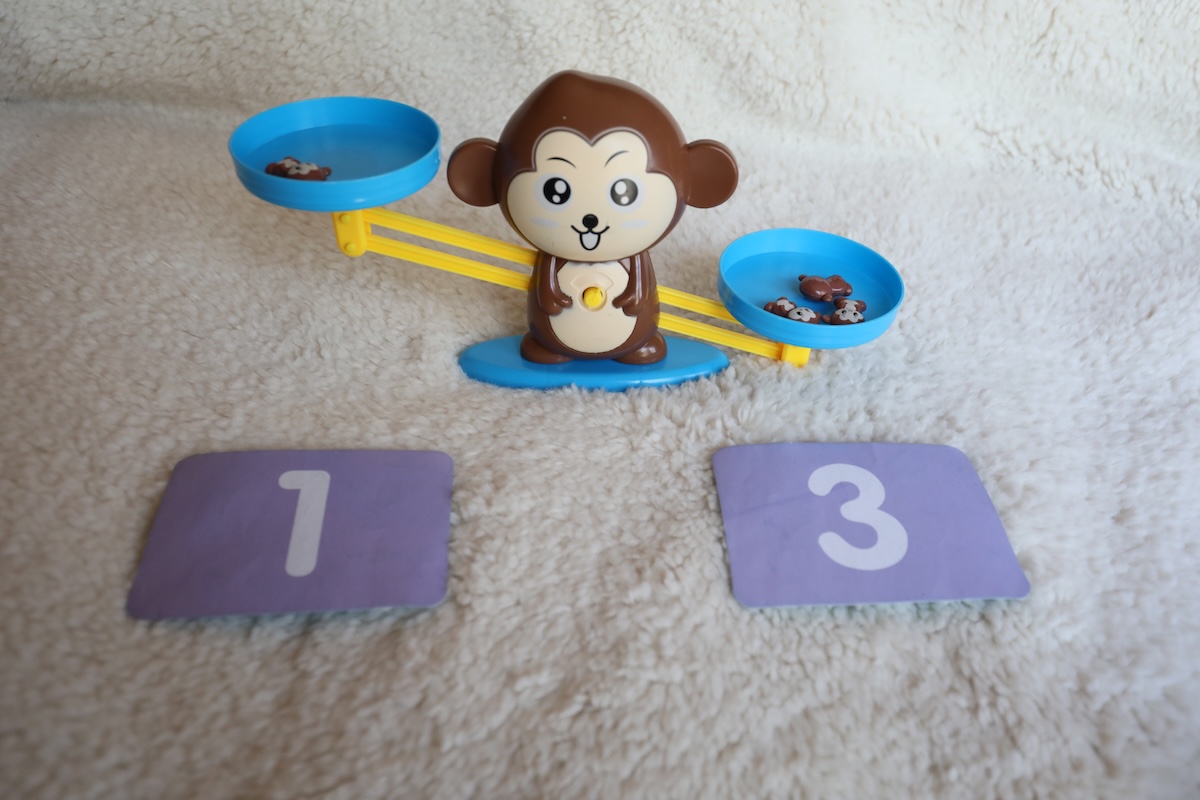
Monkey Number Scale: This game features a monkey scale with monkeys and numbers. Players place a number on one side of the scale and balance it by adding the correct number of monkeys to the other side. The game comes with flashcards, some with just the number on it, and you can use that to pick the number to put on the scale, say the number, then count out the monkeys to make sure you counted correctly and your scale is even across.
Pretty Pretty Princess: My girls LOVED this game, and it reinforces counting skills. Rolling dice and counting spots in various games can aid in developing counting abilities.
Monopoly Junior: Encourages counting through money management, dice rolling, and interacting with partners. A great introductory board game that is enjoyed by many. I have them count out their money. Then they have to roll the dice to go around the board, give money to their partners.
Shut the Box: Players either use one or two dice to roll, count the dots, and then put that number down.
Rummikub, Uno, Skip-Bo, Dominoes, and Go Fish are all entertaining games that offer opportunities for learning and fun.
My favorite and their favorite was: Ten Green Bottles by Orchard Toys. But if they aren’t ready yet these ones are good too: Orchard Toys – Spotty Dogs. Orchard Toys – The Game of Ladybirds.
- I designed a Monkey Game where players can practice numbers 1-20 (or adjust the range based on their skill level). Additionally, they can use a ten frame to match it with the corresponding number. Begin by playing with a partner, where one person rolls the dice and the other writes numbers from 0-10, 0-20, or 0-100. Switch roles when a double is rolled (e.g., 6 & 6), with the other player now rolling two dice and the first player starting to write numbers. when roles switch, continue writing from where they left off. The person who reaches 100 first wins.
- UNO Card Game: Arrange UNO cards 1-12 in order. Each person picks a card and keeps it hidden. The dealer selects a card from the deck and announces the number; the other player places an object like a doll/car/bead, etc., on that number. Continue calling out cards and putting objects on the number until you say their secret number and they call out “That’s my card!” and then start over.
- Dominoes: match number to # on dominoes. Lay out playing cards in ascending order (from smallest to largest) on a surface and sort the dominoes under the cards based on the number of dots.
- Order family members in sequence from youngest to oldest for a fun and engaging activity.
- “BEEP” Game: Choose a target number, like 20. Then one person starts counting—they can choose any number to start with. Go around the circle and count on. When you get to your target number, that person will say “BEEP” and they’re out. The next person picks a new starting number. Continue until one person is left as the winner.
- Counting Challenge: Take turns counting to a chosen number, like 10, 20, or 100.
- Take turns counting. For example, I start off and say “1,” then they say “2,” then I say “3,” etc., until you get to your target number. Start over and switch who starts first.
- “Race to ___(pick a target number)___” Take turns counting to a chosen number, like 10, 20, or 100. Players can only say 1-2 numbers at a time. The winner is the one who reaches the target number first.
- Utilize a 100’s chart by randomly dropping a bead on it, then announce the number it lands on. Alternatively, use a Concentration Chart to count from 1 to 20 and locate all the numbers on it.
- MUSICAL NUMBERS: Move around number squares on the floor until the music stops, then say the number and jump that many times.
- SEARCH: Say a number, see if you can find that many objects.
- CAR: Count and add numbers together while in the car.
- Tic-Tac-Toe: Make a tic-tac-toe board with numbers on it. Make it DON’T EAT PETE style and put chocolate chips/goldfish/M&M’s on each number and can eat it after they say the number.
- MEMORY/MATCHING: Lay multiple pairs of different number cards upside down. Flip two cards at a time to see if you can find two numbers that are the same and keep that pair. Have to say the correct number to keep the cards.
- 4 in a ROW: Two people can play on the same board. Lay out cards on the floor 6×7 or use a board that’s already made up. Take turns reading a number. Have to say the number correctly before they can cross out or put a colored paper over the number they said. (Each player gets a different color). First person to get four in a row, wins!
- PARKING LOT: Create a parking lot of numbers. Place cars on numbers when they are correctly identified and fill the parking lot to completion.
- TIME IT: Challenge participants to read numbers as quickly as possible.
- COOTIE CATCHER: Design a cootie catcher with written numbers or drawings of objects to say the number.
- Write: Create a challenging activity with numbers repeated on paper where children cross them off after counting objects or naming numbers quickly and accurately.
- HIDDEN OBJECT: put three bowls upside down with a hidden object under it. Put one random number on top of each one, they have to read the number (or put quantities of items instead of numbers) on top of a bowl they choose . If they are correct, they can look under the bowl to see if they found the missing object.
- HIDDEN OBJECT BEHIND CARD: have cards laid out. Hide something under one of them (like a printout of a happy face etc). They have to say the number correctly or count the object correctly before they can see if they found the missing object behind the card.
- GO FISH: Play a fun card game like “GO FISH” with numbered cards, encouraging matching pairs and number recognition. Sort through the deck and only have cards numbered 1-5 or all of them depending on skill level. Shuffle cards, deal each person five cards. Place remaining cards spread out in the middle of the table. One person asks the other player “_____ do you have the number _____” (insert a name and a number they want to make a pair). If they have it, then they give it to the player, if they don’t then they say, “GO FISH!” and the person asking then takes a card from the center pile. All pairs should be placed numbers up in front of each player as they are collected.
Introduction to Numbers Pack
High-Quality Games and worksheets
Introduction to Numbers Pack
Pack of over 100 pages of games and worksheets to practice number recognition and counting

@engagethestages
Monkey Game
High-Quality Game
Monkey Game
Master those numbers 1-20 with this fun Monkey Game

@engagethestages
1-10 Number Sense Matching Game
High-Quality Game
1-10 Number Sense Matching Game
Match all things related to that number

@engagethestages
1-10 Number Sense Matching Game
High-Quality Game
1-10 Number Sense Matching Game
Master those numbers 1-10 with this fun number sense game

@engagethestages