
Transform learning addition from a daunting task into an exciting adventure with these creative and interactive methods that make numbers come alive for young children

Understanding the concept of addition is a fundamental skill in mathematics. To make this learning process engaging and interactive, we can explore various math investigations and activities. These activities not only help in grasping the basics of addition but also encourage creativity and problem-solving skills. Here are some fun and effective ways to explore addition through different methods. I also have them included below in a packet with directions and worksheets on how to do them available for purchase.
9 Math Investigations for Understanding Addition
- Reading Equations and Associating Numbers with Objects
- Begin by teaching children how to read equations and understand their meanings. Present an equation, clarify the plus and equal signs, and associate numbers with objects. Encourage them to read the equation before solving the problem. Use everyday tangible objects like cars, chocolate chips, beads, and blocks. Once they are comfortable with tangible objects, use fingers as a tool, similar to counting on fingers in a car.
- Exploring Number Lines
- Introduce the concept of a number line using blocks and adding them on the line. Have children jump along the line or use a life-size number line to physically move to each number. Alternatively, use a pipe cleaner with a bead on it to practice on the number line. If a number line is not available, use a ruler or a tape measure.
- Introducing Number Bonds
- Demonstrate how two number bonds combine to form the sum. Use part-part-whole relationships to show how two parts of the sum are equal.
- Variation 1: Create a life-sized number bond using chalk on the ground or large bowls. Use two different colored objects to place in cups or to dump.
- Variation 2: Use cups or plates as circles connected by sticks. Select two cards and place different colored objects representing the numbers at the top. Combine the correct sum in the middle. For example, if you draw a two and a three, use yellow and blue colored objects to represent them, then combine them in the middle to understand that 2 + 3 = 5.
- Number Bond Variations Games (If playing against a partner, the first person to calculate the missing number wins)
- Variation 1: Flip one or two cards and place them at the top of the number bond (to create a single or double digit number). Determine which two numbers add up to the top number.
- Variation 2: Flip two cards and assign each to the bottom of the number bond. Calculate their total and place the answer at the top.
- Variation 3: Flip one or two cards for the top and one card for the bottom. Place the larger number on top. Find the missing number by subtracting the bottom number from the top or by figuring out what needs to be added to the bottom number to find the missing number.
- Variation 4: Flip one or two cards. Use that quantity of objects (like beans) at the top. Then, get the same number of objects, split them between the two bottom parts, create different equations, and keep a record. (You can use tangible objects for any of the above exercises.)
- Demonstrate how two number bonds combine to form the sum. Use part-part-whole relationships to show how two parts of the sum are equal.
- Using a Tens Frame for Addition
- Employ tangible objects or dot markers in a tens frame.
- Utilize two distinct colored counters, heads/tails coins, red/black cards, beads, or objects to place within the ten frame. Flip two cards to generate two different numbers for addition and work it out in the tens frame (a distinct color for each number), and then record your solution.
- Create a life-size tens frame and use chalk or tape to draw it out. Use balls or paper plates for the dot inside the frame.
- Employ tangible objects or dot markers in a tens frame.
- Duplo Blocks
- Use two distinct colors of Duplo blocks for each number. Add them (combine them) and stack them together.
- Tangible Objects
- Use toys, food, or play-doh to count objects. Choose two cards randomly from a deck. Place them in the “Random Card 1” and “Random Card 2” slots, with the larger number displayed first. Gather small items like Legos or Cheerios and place the number from the card above the objects in that section. Locate a card that matches the total and place it in the “Equal Card” pile, then place the corresponding number of objects under it. For a twist, draw the representation with dots or tally marks.
- Hide and Seek
- Select a target number like 5. Put that many objects in a bowl. Have the child pull out a few. Or select a random card from a deck and pull out the corresponding objects from the bowl to the number you picked. The child then has to say how many objects are left in the bowl. They can check their answer by looking in the bowl.
- Part&Part=Whole (Playing against a partner, the first to find the missing number wins. Use a chart, Duplo blocks, or base ten blocks.)
- Variation 1: Flip one or two cards and place them at the top in “whole.” Determine which two numbers add up to the top number.
- Variation 2: Flip two cards and assign each to the bottom in “part.” Calculate their total and place the answer at the top.
- Variation 3: Flip one or two cards for the top and one card for the bottom. Place the larger number on top in “whole.” Find the missing number by subtracting the bottom number from the top or by figuring out what needs to be added to the bottom number to find the missing number.
- Variation 4: Flip one or two cards. Use that quantity of objects (like beans) at the top. Then, get the same number of objects (like Duplo or Legos), split them between the two bottom parts, create different equations, and keep a record.
- Monkey Scale or Design Your Own Scale
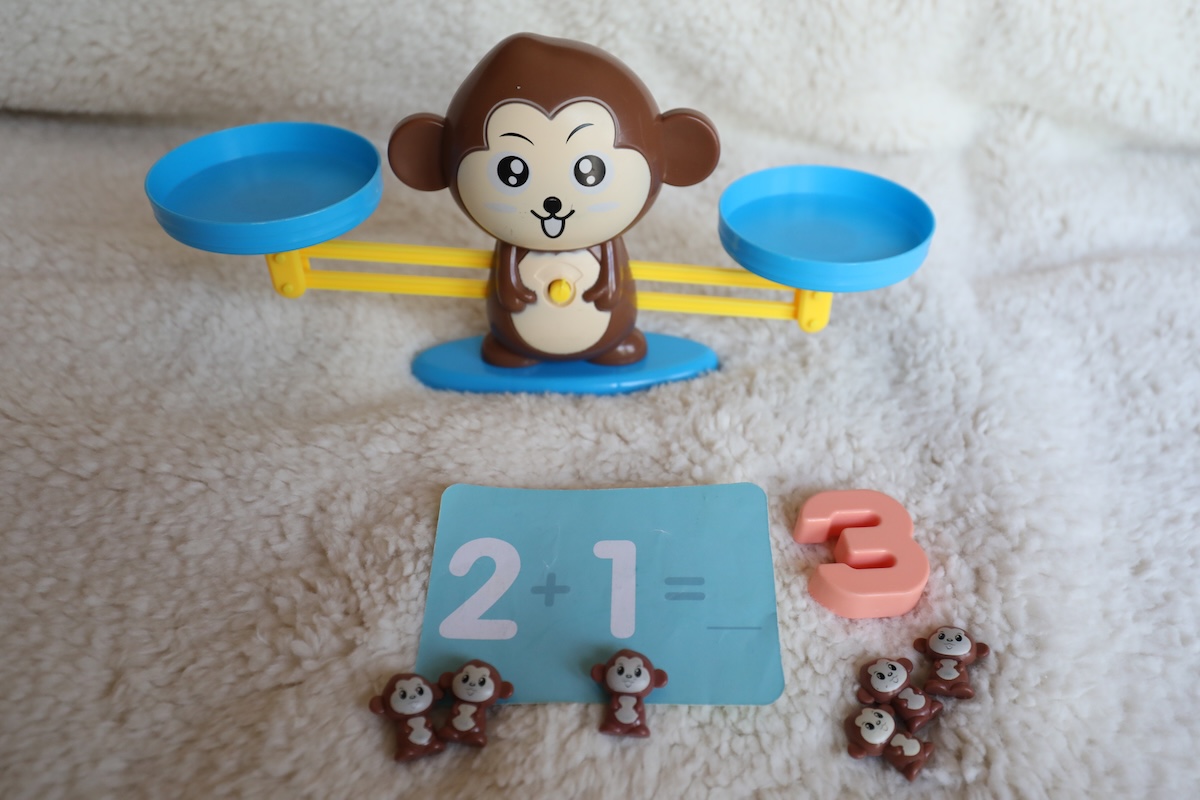
- Begin with the MONKEY SCALE or design your own scale. I prefer the monkey scale because the numbers are as heavy as the little monkeys, allowing them to verify their work. I like to lay out the equation, place the monkeys under each number, count up the monkeys, and find the corresponding number. Alternatively, you can add the monkeys on one side and place them on that side, then get the corresponding number and place it on the opposite side.
Conclusion
These math investigations offer a variety of ways to explore and understand the concept of addition. By engaging in these activities, children can develop a strong foundation in mathematics while having fun. Encourage them to explore different variations and use tangible objects to make learning addition an enjoyable experience. All of these are available in the following packet I have developed:
Introduction to Adding Packet:
High-Quality Introduction to Adding Packet
Introduction to Adding
Over 100 pages of games and activities to practice adding and understanding the concept of adding

@engagethestages