
Long division doesn’t have to be a headache—especially when remainders are involved! By tapping into the power of multiple intelligences, students can explore divisionin ways that are engaging, creative, and hands-on. From story-driven word problems and energetic relay games to musical claps and nature scavenger hunts, there’s an approach here for every type of learner.
By the end of these activities, learners will not only master how to divide with remainders but also understand how math shows up in everyday life, from sharing snacks to planning a garden. When division is experienced through stories, movement, music, and discovery, students develop confidence and excitement for problem-solving.
Hands-On Math Investigations and Games for Long Division with Remainders Using Multiple Intelligences
Verbal-Linguistic Intelligence (Word Lovers)
- Story Problems with Remainders: Students read or write division stories (e.g., “29 cookies shared among 4 friends”). They narrate the quotient and leftover cookies as the remainder.
- Division as Fair Sharing (Story Problems): (Paper, markers, and manipulatives like mini erasers.) Create a story: “29 cookies need to be shared among 4 friends.” Students physically share the cookies, one at a time, until they can’t share equally. Discuss the number each friend gets and the leftover cookies as the remainder.
- Math Poetry: Students can write poems or rhymes that explain the steps of long division. This could be in the form of acrostic poems, where each line starts with a letter from “DIVIDE,” or simply a fun rap that covers the process and mentions the concept of remainders.
- Role-Playing Division: Organize a role-playing game where students take on different roles in a division problem (dividend, divisor, quotient, and remainder). They can physically act out the division process, using props like counters or blocks to represent numbers, which will help reinforce their understanding verbally.
- Division Debate: Host a debate where students argue different methods for solving long division problems. They can research and present their arguments on why one method might be better than another, incorporating examples of problems with remainders in their discussions.
- Division News Report: Have students act as news reporters who have to explain a long division problem to their audience. They can create a news segment that covers a scenario involving division (like distributing supplies or prizes) and must clearly communicate how the division process works, including the remainder.
- Give out task cards with different word problems. Solve each word problem by using manipulatives to solve the problem.
Books:
- 17 Kings and 42 Elephants – Margaret Mahy -Figure out how many elephants each king get.
- A Remainder Of One – Elinor Pinczes
- Bean Thirteen – Matthew McElligott
- Divide and Ride – Stuart Murphy
Logical-Mathematical Intelligence (Problem Solvers)
- Division with Counters: Students divide counters into cups and observe leftovers (e.g., 23 ÷ 5 = 4 R3). Record the quotient and remainder.
- Remainder Puzzles: Create puzzles where students must piece together parts of a division problem to find the quotient and remainder. Each piece will have a part of the problem or a hint. This encourages critical thinking and reinforces the steps in long division.
- Use Number Tiles by writing +, -, x, /, and = on the reverse side. Select seven tiles to create number sentences. (Use the signs from the other tiles that are not being used.) Take turns with a partner, linking your equations together like you would connect words in Scrabble.
Visual-Spatial Intelligence (Picture Thinkers)
- While performing long division, use number blocks or monopoly money on the side. Use a whiteboard to draw the groups (the number on the outside of the box), and money or blocks to divide (the number on the inside of the box) equally between the groups.
- Division with Counters (Remainder as Leftover): (Counters, small cups or bowls.) Give students a set of counters (e.g., 23). Ask them to divide the counters equally into a set number of cups (e.g., 5 cups). They will see some counters remaining after equal sharing—this is the remainder. Have students record it as 23 ÷ 5 = 4 R3.
- Array Building with Blocks: (Interlocking blocks, magnatiles, or tiles.) Present a division problem (e.g., 28 ÷ 6). Students build arrays (rows of 6) to visualize equal groups. Count how many full rows they can make and how many blocks are left—the leftover is the remainder.
- Long Division with Arrays: (Graph paper, colored pencils.) Students can create an array to represent the division problem (e.g., 36 ÷ 4). They can draw a rectangle on graph paper and fill it with squares to represent the total (36). Then, they divide the squares into 4 equal rows to see how many squares fit in each row. This visual method helps them understand the concept of dividing and grouping.
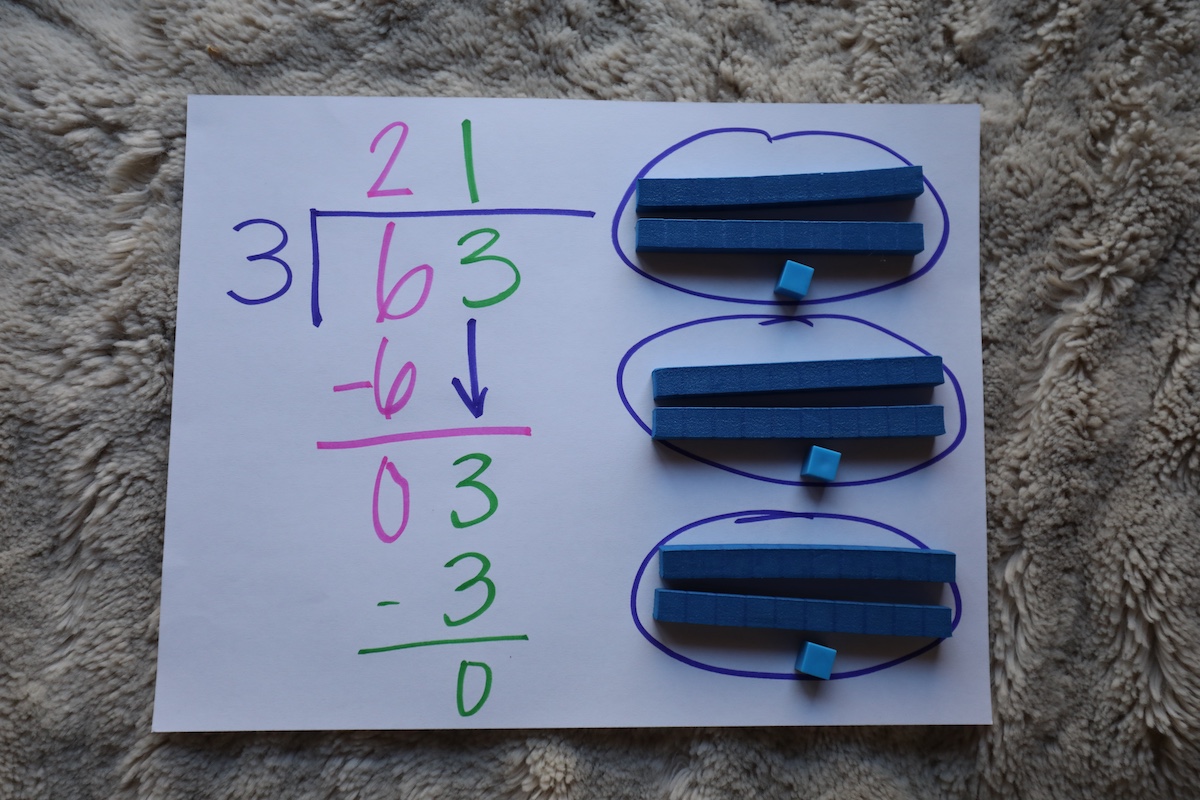
- Division with Base Ten Blocks: (Base ten blocks (units, rods, and flats).) Provide students with a division problem (e.g., 144 ÷ 12). Have them use the blocks to model the dividend (144) and physically group the blocks into sets (draw circles or have bowls) to represent the divisor (12). They can visually see how many groups of 12 fit into 144, allowing them to calculate and understand the process of long division.
- Skip Counting and Subtraction Race: (Whiteboard or math journals.) Give a division problem (e.g., 47 ÷ 8). Students repeatedly subtract 8 or skip count by 8 until they can’t go further. The number of subtractions is the quotient, and the leftover is the remainder.
- Remainder Walk (Number Line Activity): (Floor number line, measuring tape, whiteboard, or paper number line.) Draw a number line and have students jump in intervals of the divisor (e.g., for 48 ÷ 6, students would jump in increments of 6). They can count how many jumps it takes to reach 48. This helps them visualize the concept of division as repeated subtraction. Or for remainders, give an example like 35 ÷ 6. Have students “jump” by 6 along the number line until they cannot land exactly on 35. The number of jumps is the quotient, and the distance to 35 from the last jump mark is the remainder.
- Lego Towers Remainder Challenge: (Legos or snap cubes.) Give students a number (e.g., 31) and ask them to build towers of a fixed size (divisor, e.g., 7). See how many full towers can be built. The leftover blocks are the remainder.
- Division Sorting with Envelopes: (Envelopes and small objects (beans, stickers, paperclips).) Label envelopes with the divisor (e.g., 1–5). Give students a set number of objects (e.g., 22) to sort equally into the envelopes. See how many full sets each envelope gets and how many are leftover. Record the division equation with remainder.
- Real-Life Division Scenarios*: (Fake money or counters.) Set up a “store” where students can use fake money to buy items priced with whole numbers. For example, if a student has $50 and wants to buy items that cost $8 each, they can use long division to determine how many items they can purchase. This not only teaches long division but also reinforces practical math skills.
- Remainders in Real Life: (Snack items (e.g., candies, cookies).) Give students a certain number of snack items (e.g., 29 candies) and ask them to divide them among a group (e.g., 4 friends). Students can perform the long division and then physically distribute the candies, observing how many each friend gets and what remains. This makes the concept of remainders tangible and relatable.
- Long Division Art: Have students create a visual representation of a long division problem. They can draw pictures to show the dividend, the divisor, the quotient, and the remainder. This artistic approach reinforces their understanding of the process.
- Long Division Art: Have students create an artistic representation of a long division problem on large paper. They can use colors, shapes, and drawings to illustrate each step of the division process, including the quotient and remainder. This activity allows them to visualize the division process and express their understanding creatively.
- Fill a jar with a specific amount of beans, balls, Cheerios, or similar items. Ask participants to estimate how many scoops it took to fill the jar. After they make their guesses, reveal the actual number of items inside the jar. Challenge them to calculate how many scoops that would be. Finally, test their calculations by determining approximately how many items are in each scoop.
Manipulatives:
- Duplo/ Lego/ Base ten blocks (tangible, picture, or draw square, line, dots…)
- 100, 10’s, 1’s coins
- Number Line
- Monopoly money/Fake Money / Coins
- Cards – playing cards, Uno, or Skipbo
- Dominoes
- Number tiles (like Scrabble tiles)
- Beads (like Montessori but make your own)
- Tens Frame
- Number Bond
- Part-Part-Whole
- Hundreds Chart
- Beads, Beans, play-doh, etc.
- Magna-Tiles
- Ruler/ Measuring Tape
Bodily-Kinesthetic Intelligence (Hands-On Learners)
- Remainder Walk on a Number Line: Students physically “jump” along a floor number line in steps of the divisor. The last incomplete jump shows the remainder.
- Remainder Hunt: Set up a scavenger hunt where students solve long division problems to find clues. Each clue leads to the next division problem, and the answers will either guide them to the next location or reveal a final prize. This activity allows students to physically move while practicing their division skills.
- Long Division Relay: Organize a relay race where teams of students solve long division problems on a whiteboard. Each team member must correctly complete one problem before the next can start. This encourages teamwork and quick thinking while practicing long division.
- Division Relay Race: Set up a relay race where students work in teams. Each team member must solve a long division problem before passing the baton to the next teammate. Use a large board or paper to write out the problems, and include problems with remainders. This encourages movement and teamwork.
- Division Hopscotch: Create a hopscotch grid with different long division problems in each square. Students must solve the problem in the square they land on before they can proceed. This allows for physical activity while reinforcing division concepts.
- Long Division Board Game: Design a board game where players move around the board by solving long division problems with remainders. Include spaces that allow players to move forward or backward based on their answers. Incorporate physical challenges (like jumping jacks) for incorrect answers to keep everyone active.
- Hands-On Division with Manipulatives: Use physical objects like blocks or counters. Use hula hoops for groups or draw with chalk on the ground.Have students group the objects to visualize the division process. For example, if dividing 28 by 6, they can create groups of 6 and see how many groups they can make, identifying the remainder by counting the leftover blocks.
- Role-Play Division: Assign students roles where they can act out the division process. One student can represent the dividend, others can represent the divisor, and they can physically divide a set of items (like colored balls or beanbags) among themselves to understand how remainders work.
- Fraction Division Activity: Use a pizza or pie model to illustrate long division. Students can physically cut the pizza into slices (representing the divisor) and see how many full slices can be served (the quotient) and what remains (the remainder).
- Obstacle Course Division: Set up an obstacle course where each station has a long division question. Students must solve the problem to proceed to the next station. This incorporates physical movement, problem-solving, and excitement.
Interpersonal Intelligence (Team Players)
- Division with Dice (Game): (2 dice, whiteboard or notebook.) Roll two dice to make a dividend (e.g., dice show 3 and 5 →35). Choose a divisor (like 4 or 6 based on skill level). Students divide, use manipulatives or draw models, and record quotient and remainder. Turn it into a competition or puzzle-solving game.
- Remainder Hunt with Cards: (Number cards 1–9, small objects.) Pick a card as the divisor. Choose a dividend (number of objects) and distribute them into equal groups. Students hunt for the remainder by seeing what cannot be grouped. Rotate and repeat with different dividends and divisors.
- Division Relay: (Chalkboard/whiteboard, problem cards, counters.) Split the class into teams. Show a division problem with a remainder (e.g., 50 ÷ 7). Teams use counters to model and find the quotient and remainder. First team to model correctly wins a point; rotate problems.
- Long Division Relay: (Whiteboards and markers.) Set up a relay race where students are divided into teams. Each team member must complete one step of the long division process before passing the marker to the next teammate. This encourages teamwork and reinforces the steps involved in long division.
- Interactive Division Wheels: (Paper plates, markers.) Create division wheels where students write a division problem on one side and the answer on the other. Students can spin the wheel, solve the division problem using long division, and then check their answers. This activity adds a game-like element to practicing division.
- Division Races: Create a large grid on a whiteboard or chart paper. Write different division problems (with remainders) in each square. Students race to solve the problems using long division on their individual whiteboards. They can use colored markers to show their work and highlight the remainder.
- Long Division Bingo: Create bingo cards with answers to long division problems (e.g., 63 ÷ 5 = 12 R3). Call out division problems, and students must solve them and cover the correct answer if it’s on their card. This reinforces the concept of remainders and helps with quick recall.
- Group Investigations: Divide students into small groups and give each group a different long division problem to investigate. They must work together to solve it and prepare a short presentation to explain their method and the remainder.
- Division Jeopardy: Set up a Jeopardy game with categories related to long division. Include questions that require calculating long division problems with remainders. Students can work in teams to answer and earn points.
- Long Division Board Game: Create a board game where players move around the board by solving long division problems. Each correct answer allows them to advance, while incorrect answers send them back.
- Flashcard Challenge: Make flashcards with long division problems on one side and answers with remainders on the other. Students can quiz each other in pairs or small groups, racing to see who can answer the most correctly in a set time.
- Math Escape Room: Design an escape room challenge where students must solve long division problems with remainders to unlock clues or codes that lead to their escape. Each challenge could be solving with different manipulatives, word problems, or game style.
- Division Board Games: Design board games where players move spaces by correctly solving long division problems. Incorporate “challenge” spaces that require players to solve a problem to advance. This creates a playful environment for practicing division.
- Division Race: Set up a large grid on the floor using tape. Label the grid with numbers that represent dividends. Provide students with a set of cards that represent different divisors. Students can take turns racing to the grid, picking a dividend, and then working out the long division with their divisor. They can visually represent their work on the grid by marking where they find the quotient and remainder.
- Long Division Relay Race: (Whiteboards, markers, and a timer.) Divide students into teams. Each team races to correctly solve long division problems on their whiteboards. Once a problem is solved, they pass the board to the next teammate. This can also allow for personal reflection on strategies used.
- Division Relay Race: (Whiteboard, markers, division flashcards.) Divide students into teams. Each team gets a set of long division problems on flashcards. One at a time, a member from each team runs to the board to solve a problem. If they get it right, they earn a point; if not, they return to their team for help. This encourages teamwork and communication.
- Interactive Division Stations: (Different stations with varying division challenges (worksheets, manipulatives, digital tools).) Create multiple stations where students can rotate in pairs or small groups. Each station has a unique long division challenge, including games, puzzles, or hands-on activities. Students must collaborate and discuss their approaches at each station.
- Play War with cards. Flip two cards to make a double digit (or more) number and another card (or die) to divide.
- Find my Factors: Use a hundreds chart. The first player selects a number from the chart and circles it in their chosen color. The second player then circles all the factors of the first player ‘s number (excluding the original number). Player one adds their selected number, while player two sums up all the factors they’ve circled. Next, it’s player two’s turn to choose a number, and player one will circle all its factors. Continue alternating turns, adding your scores along the way. The player with the highest lowest points at the end wins!
- Make a board game of random numbers. Roll a die or flip a card to move around. The space you land on divide it by the number you rolled. If correct you can stay on your spot. If incorrect, go back to the previous spot.
- Clear the board/Shut the box: Use flashcards with remainders. Only put down the remainder number after dividing.
- Games: Prime Climb & Shut the Box
Intrapersonal Intelligence (Independent Learners)
- Skip Counting and Subtraction Race: Students independently subtract or skip-count by the divisor to reach the dividend. The last number they can’t subtract past represents the remainder.
- Creative Division Journals: Encourage students to keep a journal where they document their understanding of long division with remainders. They can write about their experiences solving problems, reflect on their learning process, and use illustrations or diagrams to complement their writing.
- APPS: IXL, Khan Academy Kids, Khan Academy, Duck Duck Moose Bingo
- NCTM APP: Partial Product Finder, Number Pieces, Number Line
- Online Games: MathPlayground – Brain Workout Missing Digit, Snorks – Free training tutorial, MathPlayground – Treasure Quest Mult, Funbrain – Math Baseball
Musical-Rhythmic Intelligence (Pattern Lovers)
- Division Song and Clap: Chant the division steps to a rhythm (divide, multiply, subtract, bring down), clapping to represent each step, and “tap” the remainder.
- Long Division Gameshow: Create a game show format where students answer long division questions for points. Incorporate sound effects and music for correct answers or fun challenges for incorrect ones.
- Musical Chairs with Division: (Chairs, music, and division problems.) Modify the classic game of musical chairs by placing division problems on each chair. When the music stops, students must solve the problem on the chair they sit on.
- Instrumental Division: (Various instruments or household items that can produce sound.) Assign different instruments to different parts of the long division process (e.g., drum for dividing, tambourine for multiplying). As students work through problems, they use instruments to represent each step.
- YouTube: Kevin Barnhart – Prime Numbers Rap, Songs for School – Prime Song, Numberock – Division Song, Numberock – Division with 2 digit, Mr Napoles – Long Division Math Rap Song
Here are several ways and sayings to help remember which number in a fraction goes into long division:
- “Sunny and Windy”: The top number (numerator) blows down into the box to divide a fraction and determine the decimal value.
- *Dividend Goes Inside: Remember that the numerator (the top number of the fraction) is the dividend, and it goes inside the long division bracket.
- *Denominator on the Outside: The denominator (the bottom number) is the divisor, which goes outside the long division bracket.
- *Top Goes In, Bottom Stays Out: This catchy saying emphasizes that the top number (numerator) goes inside the division symbol, while the bottom number (denominator) remains outside.
- Numerator Nestles In: Visualize the numerator as a cozy bird that nests inside the long division bracket, while the denominator stands guard outside.
- N for Nesting, D for Dividing: Associate the letter “N” with numerator (nesting inside) and “D” with denominator (dividing outside).
Naturalistic Intelligence (Nature-Oriented Learners)
- Nature Sorting Challenge: Use leaves, rocks, or shells as counters. Students divide the items into equal groups on the ground, identifying leftover objects as the remainder.
- Garden Plot Division: (A garden plot (real or a drawn grid), seeds or small stones representing plants.) Create a garden plot divided into sections (e.g., a 5×5 grid).
- Ask students to “plant” seeds (or stones) in the grid, representing a total number of plants (e.g., 18). Students must figure out how to distribute the plants evenly across the sections, noting any leftover plants (remainders). Discuss how this relates to real-life gardening and resource distribution.
- Nature Scavenger Hunt Division: (Scavenger hunt list, bags for collecting items.) Create a list of natural items for students to find (e.g., 30 pinecones). Once collected, students must work in pairs or small groups to divide the items evenly among themselves. They will calculate how many items each person gets and how many are left over. This can be followed by a discussion on the importance of sharing resources in nature.
- Divide and Conquer Nature Walk: (Clipboards, paper, and pencils.) Take students on a nature walk to observe different plants or animals in groups (e.g., 20 birds in a tree). After the walk, students choose a total number of observed items and divide them into groups based on certain characteristics (e.g., 5 groups of birds). They will calculate how many items are in each group and any remainders. Encourage discussion about biodiversity and how nature organizes itself.
- Long Division with Rocks: (Various sizes of rocks, chalk, and a large outdoor space.) Use rocks of different sizes to represent numbers. Set up a long division problem using the rocks (e.g., 56 divided by 4). Students will physically group the rocks and find out how many rocks each group would get and how many remain.
- Nature’s Division Relay: (Natural objects (sticks, stones, leaves), paper, and markers.) Divide students into small groups and provide each group with a set of natural objects. Assign a total number of objects (e.g., 24 sticks) and ask groups to divide them among themselves (e.g., 4 students). Each group calculates how many objects each student would get and what would be left over (the remainder). Groups can then present their findings using the objects to demonstrate their division and remainders.
- Real-Life Scenarios: Present students with real-life scenarios involving division, like sharing snacks. For example, if there are 25 cookies and 4 friends, how many cookies does each friend get, and how many are left? Students can use drawings or physical items to demonstrate their understanding.
- Math Investigation Projects: (Research materials, poster boards.) Assign groups to investigate different topics related to division with remainders, such as how remainders play a role in sports scoring, cooking measurements, or budgeting. Students present their findings to the class, encouraging peer learning and collaboration.
——
Real World Math Investigation Project: Long Division with a Reminder
Project Title: Dividing Up a Community Garden (Objective: To understand the concept of long division through a real-world application by dividing resources for a community garden.)
Scenario: Imagine your community has decided to set up a community garden to grow vegetables for local families. The garden committee has collected a total of 125 pounds of seeds to distribute among different sections of the garden.
Task: You will use long division to determine how many pounds of seeds can be distributed evenly to each of the 8 sections of the garden, and calculate the remainder.
Steps to Follow:
Set Up the Problem: You have 125 pounds of seeds. You need to divide this amount by 8 sections.
Perform Long Division: Use long division to divide 125 by 8. Show each step of your long division, including: How many times 8 goes into the first digit (1) and then into the first two digits (12). Subtracting and bringing down the next digit. How many times 8 goes into 45 and finding the remainder.
Calculate and Record: Document your calculations step-by-step. Write down the quotient and the remainder.
Interpret the Results: Explain what the quotient represents (the number of pounds of seeds each section will receive). Discuss the significance of the remainder (how many pounds of seeds will be left over).
Real-World Application: Research what could be done with the leftover seeds. Could they be saved for next season, given to another community garden, or used for another purpose?
Write a brief paragraph about how your community could use the remainder effectively.
Reflection: At the end of your project, write a short reflection on what you learned about long division and how it relates to real-life situations. How does mathematics help in planning and distributing resources in your community?
Presentation:
Create a poster or a digital presentation that includes:
Your long division steps.
The final quotient and remainder.
Your explanation of how the community can use the seeds.
Any visuals related to gardening or community involvement.
Additional Tips: Make sure to show your work clearly. Use colored markers or digital graphics to make your presentation eye-catching. Feel free to include photos or drawings of community gardens.
—-
Long division with remainders doesn’t have to live in a workbook—it can come alive in the classroom, playground, and even outdoors. By weaving together storytelling, hands-on manipulatives, team games, music, and nature-based activities, students experience division as a fun and meaningful journey. Empower your learners to see math as more than numbers on a page—it’s a skill that connects to their world, their creativity, and their curiosity. With these strategies, remainders become a moment of discovery, not confusion, and long division becomes a challenge they’re excited to tackle!
Long Division Concepts and Games Packet:
Long Division
Over 60 Pages of Concepts & Games Already Made Up

@engagethestages
