
Multiplying fractions can feel abstract and intimidating for many students, but with the right approach, it can become a hands-on, visual, and even fun experience. By tapping into multiple intelligences—linguistic, logical-mathematical, visual-spatial, kinesthetic, musical, interpersonal, intrapersonal, and naturalistic—teachers or parents can transform fraction lessons or practice into dynamic learning adventures and fun activities. From storytelling and art projects to life-sized grids and cooking activities, these strategies make fraction multiplication both meaningful and memorable.
Linguistic Intelligence:
- Fraction Story Builders: Students create stories or word problems involving multiplying fractions. Give each group a set of fractions (e.g., ½, ⅓, ¾). Have them write a short story problem (e.g., “Sally ate ½ of a pizza, then shared ⅔ of her piece with a friend…”). Present the story and solve the multiplication problem together.
- Story Problem Modeling: Present word problems like “You ate 2/3 of a chocolate bar, and then 1/4 of that was shared with a friend. How much of the whole bar did they get?” Have students draw or model the solution.
- Books: Multiplying Menace, The Multiplying Menace Divides
Logical-Mathematical Intelligence:
- Fraction Puzzle Race: Students solve a series of multiplication fraction puzzles to reach the finish line. Provide a game board with 10 spaces and fraction multiplication problems on cards. Students draw a card, solve the problem, and move forward if correct. First to the end wins.
- Begin by reviewing multiplication and division concepts. For multiplication, consider 2 x 3, which means 2 groups of 3, resulting in 6. For division, take 27 ÷ 9, which asks how many 9s fit into 27, and the answer is 3.
- 2×5 means the sum of fives written two times. 2/3 x 4/5 means 4/5 written only a fraction of a time. We need a unit area that can be divided among five people and three people . 2 OF 5 = 10.
- When multiplying with mixed numbers, first convert them all to irregular fractions then multiply numerators and denominators.
Visual-Spatial Intelligence:
- Fraction Art Multiplication: Students color diagrams to visualize multiplying fractions. Provide rectangles divided into grids. First fraction = shade rows; second fraction = shade columns. The overlapping area represents the product fraction. Students create a colorful “Fraction Art Book.”
- Grid paper or Transparency paper: Area Model Multiplication: Provide graph paper and ask students to shade a rectangle to represent the first fraction (e.g., 2/3 of the width). Then, shade in the second fraction (e.g., 1/4 of the height) in a different color. The overlapping area represents the product.
- Fraction Strips Overlap: Give students fraction strips of various denominators. Have them overlap strips to visually see what part of a whole is represented when multiplying two fractions.
- Real-Life Recipe Scaling: Provide a recipe and ask students to scale it down or up using fractional amounts (e.g., “Half of 2/3 cup of sugar”). Show how multiplication of fractions adjusts the quantities.
- Number Line Jumps: Use a number line to show repeated fractional jumps. For example, “Take 1/2 of 3/4” by dividing the 3/4 segment into two equal parts and identifying the product.
- Paper Folding: Ask students to fold a rectangular piece of paper into fractional parts for the first fraction, then fold again for the second fraction perpendicular to the first. The overlapping rectangles show the product.
- Tile or Grid Activity: Provide a 12×12 grid. Have students color 3/4 of the grid in one direction, then 2/3 in the other. Count the overlapping squares to visualize the product.
- Interactive Fraction Cards: Prepare two sets of fraction cards. Students pick two fractions, multiply them, and then demonstrate the problem using a diagram on whiteboards or paper.
- Digital Simulation with Virtual Manipulatives
- Fraction Tiles: Use fraction tiles to visually represent the fractions being multiplied. Have students physically manipulate the tiles, laying them out to see how one fraction takes a portion of another. This helps them visualize the concept of multiplying fractions as finding a part of a part.
- Fraction Circles: Use fraction circles or paper plates cut into fractional parts. Students can overlap different fractions to see how they combine and understand the concept of multiplication as finding a part of a part.
- Building Models: Use building blocks or LEGO bricks to create models that represent fractions. Students can stack or combine blocks to demonstrate how multiplying fractions can be seen as finding parts of a whole.
- Each of the following concepts—fraction strips, number lines, grids, pattern blocks, and play-doh—can be utilized with both proper fractions and mixed number fractions for multiplication and division.
- Pattern Blocks: Begin by showing students the pattern blocks (hexagons, trapezoids, rhombuses, and triangles). Explain that these shapes can represent fractional parts of a whole. Decide which block represents “1 whole.” Commonly, the hexagon is used as the whole. Demonstrate how other blocks relate to the whole: (Trapezoid = 1/2 of the hexagon, Rhombus = 1/3 of the hexagon, Triangle = 1/6 of the hexagon). Use pattern blocks to show the first fraction in the multiplication problem. For instance, 2/3 × 1/2: first, display 1/2 of the hexagon with a trapezoid. Apply the Second Fraction Take the identified section and show the second fraction of that part. For 2/3 × 1/2, divide the trapezoid into 3 equal sections (using triangles or drawing lines) and select 2 of those parts. Compare the resulting piece to the original whole hexagon to determine the final fraction. This shows that multiplying fractions can mean “taking a part of a part.”
- Using Groups of Tangible Items: Collect small tangible items such as beads, buttons, or goldfish crackers. You will need enough to create multiple sets. Represent the first fraction as a group of items. For example, if the fraction is 2/3, divide your items into 3 equal groups and select 2 of those groups. Use the second fraction to take a portion of the first fraction. For example, to multiply 2/3 × 1/2, take half of the items from the 2 groups you selected. Count how many items are in the part that represents the product of the two fractions. Show that the number of items you ended up with represents the numerator of the new fraction. The total starting items represent the denominator, reinforcing the concept visually.
- How to Multiply Fractions: Look at the top numbers (numerators) of the two fractions and multiply them together. Look at the bottom numbers (denominators) of the two fractions and multiply them together. Write the New Fraction. Simplify the Fraction.
Manipulatives:
- Duplo/Lego Base ten blocks (tangible, picture, or draw square, line, dots…)
- Number Line
- Number Bond
- Cards – playing cards or Uno
- Dominoes
- Number tiles (like Scrabble tiles)
- Beads (like Montessori but make your own)
- Ruler / Measuring Tape
- Beads/Beans … etc.
- Magna-Tiles
- Pattern Blocks
- Shapes
- Grid Paper
- Pentominoes
- Geoboard
- Measuring Cups
- Fraction Strips
- Fraction Circles
- Fraction Puzzles
- Food – crackers, cookies, etc. Oreos and the frosting
- Playdough
- Mega-Bloks (write on them which fraction they are in proportion to each other)
Bodily-Kinesthetic Intelligence:
- Human Fraction Grid: Students act out fraction multiplication on a life-sized grid. Tape a 4×4 grid on the floor. Assign rows to represent one fraction and columns another fraction. Students “stand” on the overlapping squares to physically show the product. ½ × ⅓ = 1/6 of the grid filled.
- Utilize Magna-Tiles in place of grid paper. Opt for LEGO or MEGA BLOKS instead of fraction strips, and implement a life-sized number line for your number line activities.
- Have fractions written all over the ground with chalk. Play some music for everyone to dance to. When the music stops, quickly rush to a fraction. Then, draw either a domino or a fraction card and either multiply or divide your fraction. If you answer correctly, you earn a point.
- Create large fractions on the ground using chalk to represent multiplication. Illustrate the groups and add shade in.
- Use dominoes, cards, or dice. Perform addition, subtraction, multiplication, and division as quickly as possible.
- Triple a food recipe and cook it. (Variation: half the recipe/ divide it in half.) Copy your favorite recipe and then triple it. Show the measurements and then make it.
- Set up cups or bowls, each labeled with a fraction either on the outside or placed inside. Use a ball marked with a value or draw a random fraction card. Toss the ball into a cup or bowl and multiply the two fractions. If the answer is correct, earn a point. Variation: throw a ball into two cups or bowls and multiply the fractions from both.
- Paste equations around the room and then walk around to solve them.
Musical Intelligence:
- Fraction Rhythm Multiplication: Use rhythmic clapping or drumming to model fractional parts. Pick a 4-beat measure. First fraction = number of beats. Combine rhythms to show how fractions multiply (e.g., ½ of ½ = ¼ of the total beats).
- YouTube: Nlvm – multiplying fractions, Simpson_Math – Physically Multiplying Fractions, Numberock – Multiplying Mixed Numbers Song, phi – Dividing Fractions rap, Murf Math – Multiplyin’ Fractions, Murf Math – Dividin’ Fractions, Numberock – Multiplying Fractions Song, Numberock – Dividing Fractions by whole numbers, Numberock – Dividing fractions Keep Change Flip
Interpersonal Intelligence:
- Fraction Team Relay: Teams solve and share fraction problems cooperatively. Set up problem stations with fraction multiplication tasks. Teams rotate through stations, solving and checking each other’s work. Team with the most correct solutions wins.
- Fraction Card Match: Prepare cards with fractions on them and cards with their products. Students flip two fraction cards, multiply them, and find the corresponding product card.
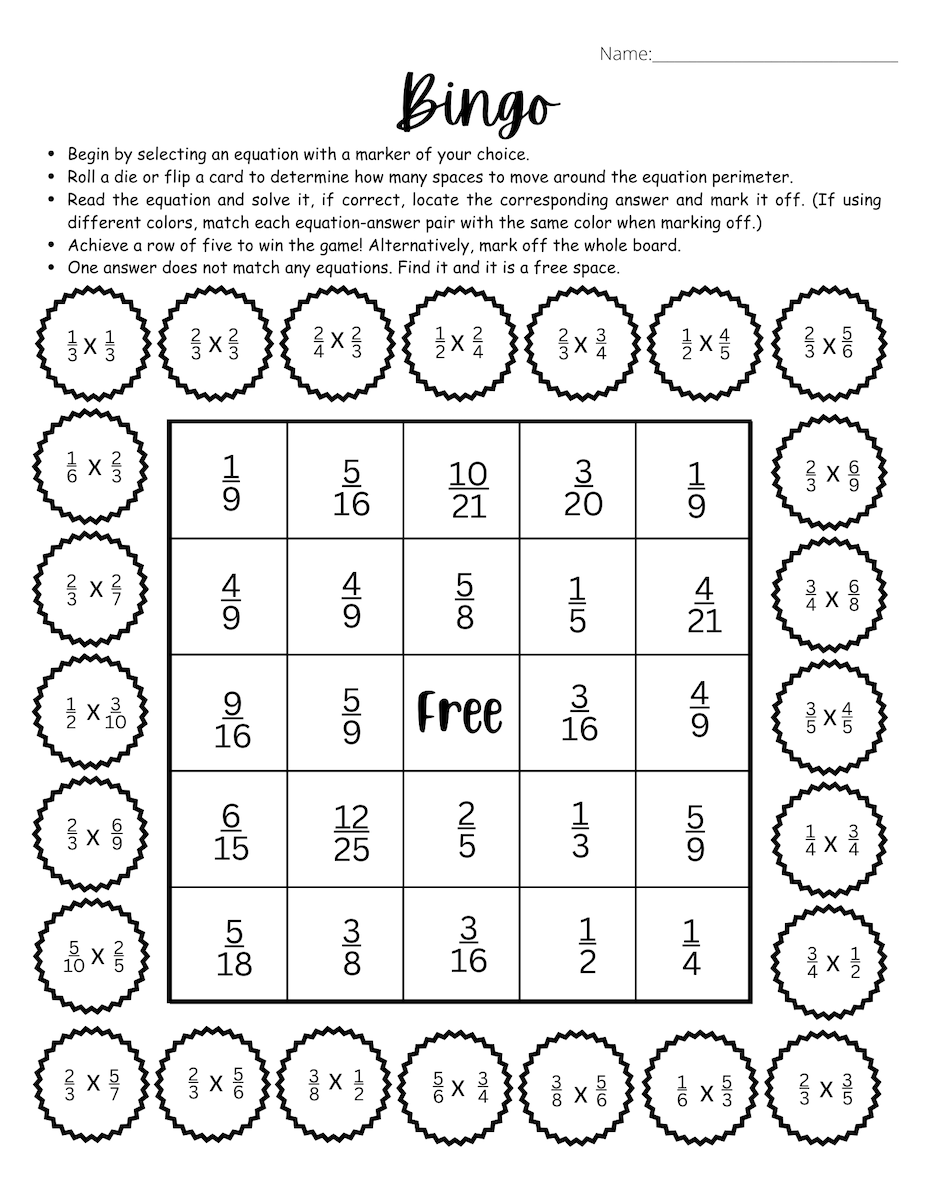
- Fraction Bingo: Give each student a bingo sheet with fraction products. Call out multiplication problems (e.g., ½ × ⅓), and students mark the product on their sheet. First to get five in a row wins! Or just to get all the spaces.
- Dice Fraction Multiplication: Use two dice to generate numerators and two dice to generate denominators. Roll, create two fractions, and multiply them. Students can compete for correct answers or lowest/simplest fraction.
- Fraction War (Card Game): Each player flips two cards to form a fraction. Multiply both fractions, and the one with the larger product wins that round.
- Interactive Board Game: Create a board with spaces that require solving fraction multiplication to move forward. Bonus spaces can encourage simplifying fractions for extra points.
- Fraction Relay Race: Teams solve fraction multiplication problems in sequence. Each correct answer lets the next teammate continue, keeping the race active and competitive.
- Fraction Spinner Game: Create a spinner with fractions. Students spin twice and multiply the fractions. They can represent the product using an area model or fraction strip to confirm their answer.
- Fraction War: Use a deck of cards where each card represents a fraction (e.g., 1/2, 1/3, 3/4). Players draw two cards, multiply the fractions, and the player with the highest product wins the round. You can also include a rule that players must simplify their answers.
- Fraction Jeopardy: Set up a Jeopardy-style game with categories related to fractions, including one specifically for multiplying fractions. Players choose questions of varying point values and must solve multiplication problems to earn points.
- Fraction Puzzles: Create puzzle pieces that fit together based on multiplication of fractions. Each puzzle piece could have a fraction on one side and its product with another fraction on the other. Players must match pieces correctly.
- Make your own board game, snakes and ladders, Around and Around, BUMP, Pyramid with fraction cards, spinners, dominoes, boggle, battleship, etc.
- Play Connect 4. Before making your move, draw a domino or fraction card to either multiply or divide. If you arrive at the correct answer, you can place your piece; if not, you ‘ll need to skip your turn. Alternatively, write fractions on each piece, in order to play and keep a piece in a spot the player must multiply the two fractions that will touch (if more than one, multiply all pairs) in order to play that spot.
Intrapersonal Intelligence:
- Fraction Reflection Journal: Students record personal strategies and insights. After practicing fraction multiplication, have students write about what steps make sense to them. Encourage them to keep track of mistakes and self-correct. Share a favorite example at the end of the lesson.
- Online Games: Wordwall – dividing fractions, Wordwall – multiplying fractions, iknowit – muliplying fractions by whole numbers, Arcademics – Snow Sprint – Multiplying, Arcademics – Puppy Chase (Fraction to Decimal)
- IXL, Khan Academy, NCTM APPS: Pattern Shapes, Partial Product Finder, Number Pieces, Fractions, Number Line, nlvm.usu.edu National Library of Virtual
Naturalistic Intelligence:
- Garden Fraction Multiplication: Students calculate fractional areas in a garden plot. Draw a garden rectangle on paper, divided into equal parts. Assign fractions for planting two crops (e.g., ⅔ of the garden for flowers, ½ of that for tulips). Multiply fractions to find the portion for each crop and color the sections.
- Cooking with Fractions: Use real or pretend cooking measurements (½ cup, ⅓ cup). Ask students to find how much is needed if you double or triple a recipe, reinforcing fraction multiplication in a hands-on way.
When students explore fraction multiplication through diverse activities, they move beyond rote memorization into true conceptual understanding. Whether they are using pattern blocks, shading colorful grids, solving puzzles, or planting fraction gardens, learners discover that fractions are everywhere—and mastering them can be fun. By incorporating a variety of approaches into your lessons, you’ll not only reach every type of learner but also spark a lifelong curiosity for math in the real world.
Get Your Multiplying Fractions Packet!
Multiplying Fractions
Over 100 Pages!

@engagethestages
Leave a Reply