
Understanding how to convert improper fractions to mixed numbers and vice versa can be challenging for students. By incorporating activities tailored to Howard Gardner’s Multiple Intelligences, educators can create dynamic learning experiences that cater to diverse strengths. Here are targeted activities and games for each intelligence:
Linguistic Intelligence (Word Smart):
- Fraction Story Creation: Students write short stories where characters face real-life fraction dilemmas that require conversions.
- Math Pictionary: Use fraction-related terms in a drawing and guessing game, reinforcing vocabulary like “improper fraction” and “mixed number.”
- Story Problems: Create story problems that involve mixed numbers and improper fractions. Have students illustrate their problems or act them out, reinforcing the concepts through narrative and drama.
Books:
- Peg + Cat The Pizza Problem – Jennifer Oxley
- Inchworm and a Half – Elinor Pinczes
- Fraction Fun by David A. Adler,
- The Hershey’s Milk Chocolate Bar Fraction Book by Jerry Pallotta
- Sir Cumference and the Dragon of Pi by Cindy Neuschwander
- Math Curse by Jon Scieszka
- Fraction Action by Loreen Leedy
- Give Me Half! by Stuart J. Murphy
Logical-Mathematical Intelligence (Number/Reasoning Smart):
- Background knowledge: Review fractions like 1/2, 1/3, 3/4 etc.
- Fraction Puzzles: Create puzzles where students must match improper fractions to their mixed number equivalents. This can be done using card games or digital platforms that support interactive learning.
- Conversion Relay Races: Set up stations where students solve different conversion problems quickly and accurately.
Visual – Spatial Intelligence (Picture Smart):
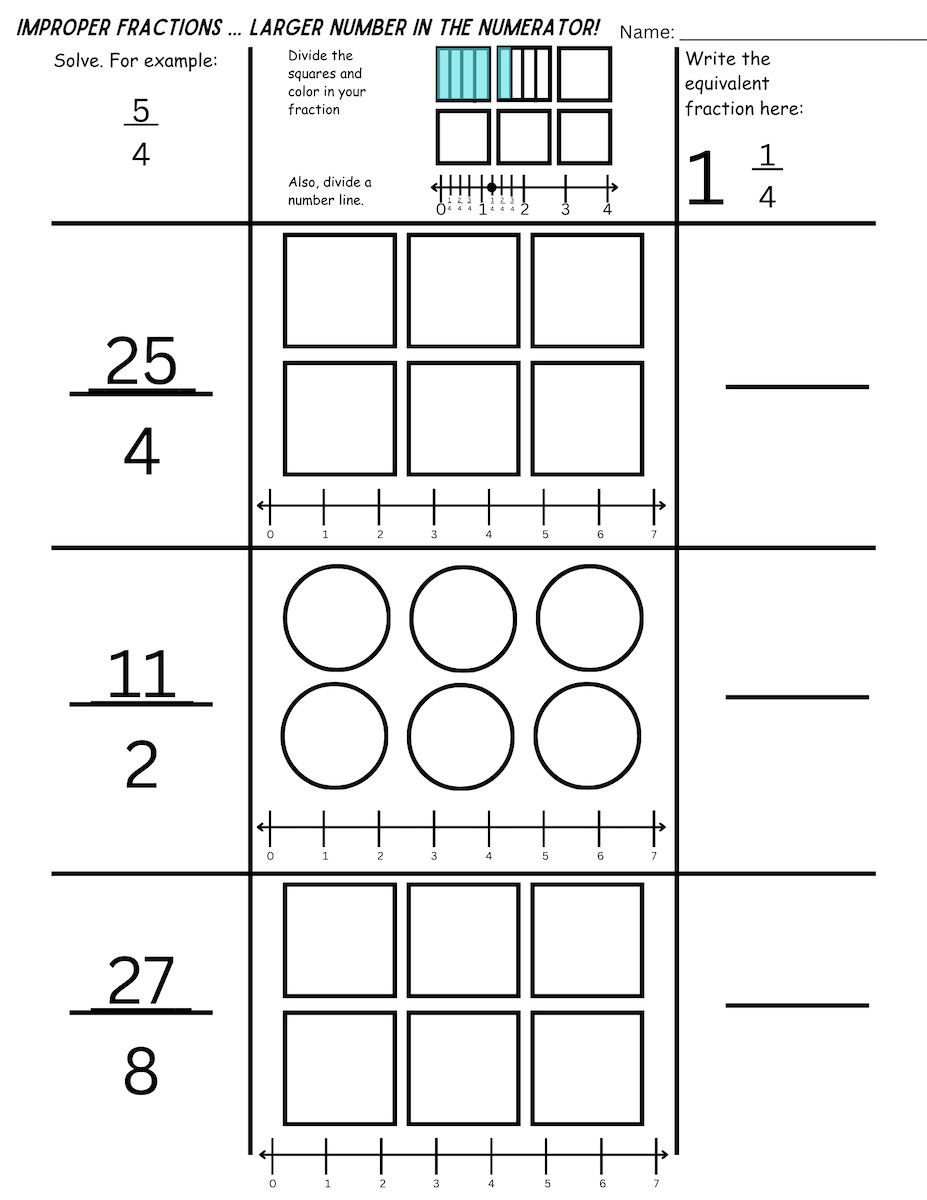
- Fraction Art Designs: Have students create geometric art where they color sections to represent improper fractions and then label the equivalent mixed numbers.
- Art Project: Have students create a piece of artwork that incorporates improper fractions and mixed numbers. For instance, they can design a pie chart or a mosaic where each section represents a fraction.
- Pizza art and label what mixed numbers each topping represents
- Fraction Strips: Create strips of paper that represent different fractions. Have students cut and label strips for whole numbers, proper fractions, and improper fractions. They can physically manipulate these strips to see how improper fractions can be converted to mixed numbers by combining strips.
- Fraction Strips: Select strips representing the denominator of the improper fraction. Lay out enough strips to match the numerator. Group whole numbers by matching full-length strips. Count the full groups (whole number) and any leftover strips (remainder as a fraction).
- Pie Charts: Use paper plates or circular cut-outs to represent whole numbers. Students can color sections of the plates to show improper fractions (e.g., 7/4) and then convert them into mixed numbers (1 3/4) by showing the whole and the remaining fraction visually.
- Circles: Draw or use circular models divided into equal sections. Color sections to represent the numerator. Group full circles and count leftover sections.
- Building Blocks: Use blocks or LEGO pieces to represent whole numbers and fractions. For instance, one block can represent a whole, and smaller pieces can represent fractional parts. Students can build structures to represent mixed numbers and express them as improper fractions.
- Cooking with Fractions: In a cooking activity, use recipes that require measurements in fractions. Have students convert mixed numbers to improper fractions and vice versa while measuring ingredients. This real-life application reinforces their understanding.
- Number Line Activity: Create a large number line on the floor using tape. Have students place cards with improper fractions and mixed numbers on the number line, helping them visualize their positions and how they are related.
- Number Line: Draw a number line marked with whole numbers. Start at zero and make jumps equal to the fraction’s denominator. Count complete jumps (whole number) and the remaining distance (fraction).
- Fraction War: In pairs, students can play a card game where they draw cards with mixed numbers and improper fractions. They need to convert the numbers to determine which is larger, helping them practice conversions in a fun, competitive way.
Step-by-Step Instructions for Converting Improper Fractions to Mixed Numbers Using Various Manipulatives
- Food (e.g., pizza slices, chocolate bars): Use food items divided into equal parts. Combine pieces to form whole items. Count whole items and leftover parts.
- Pattern Blocks: Choose shapes where multiple pieces form a whole. Combine pieces to create whole shapes. Count complete shapes and remaining pieces.
- Playdoh: Roll Playdoh into equal-sized pieces. Group pieces to form whole sets. Count whole sets and leftover pieces.
- Squares: Divide squares into equal parts. Color or shade parts to represent the numerator. Group shaded parts into whole squares. Count whole squares and leftover parts.
- Grid: Use a grid to represent the fraction. Shade squares representing the numerator. Identify groups of shaded squares that form whole units. Count whole units and remaining shaded squares.
- Number Bonds: Break down the numerator into parts showing whole groups and a remainder. Show how many times the denominator fits into the numerator (whole number). The leftover part becomes the fraction.
- Measuring Cups: Use cups marked with the fraction. Pour or fill repeatedly to represent the numerator. Count full cups (whole numbers) and any remaining portion (fraction).
- Fraction War: In pairs, students can play a card game where they draw cards with mixed numbers and improper fractions. They need to convert the numbers to determine which is larger, helping them practice conversions in a fun, competitive way.
Step-by-Step Instructions for Converting Mixed Numbers to Improper Fractions Using Manipulatives
- Fraction Strips: Select strips representing the whole number part of the mixed number. Add strips representing the fractional part. Count all equal parts to determine the improper fraction.
- Legos: Use same-sized Lego blocks to represent whole numbers. Smaller bricks represent fractional parts. Stack and count total units, converting to an improper fraction.
- Food: Use items like pizza slices or chocolate bars. Show whole items and the fractional part separately. Combine and count all parts to form the improper fraction.
- Pattern Blocks: Use whole pattern blocks (e.g., hexagons) for the whole number. Use fraction pieces (triangles, trapezoids) for the fractional part. Count total pieces of the same type to form the improper fraction.
- Playdoh: Shape Playdoh into whole units. Divide another piece into equal parts for the fraction. Count all parts to determine the improper fraction.
- Number Line: Mark whole numbers on the number line. Add fractional segments beyond the whole number. Count equal divisions passed to find the improper fraction.
- Squares: Draw or use paper squares to represent whole numbers. Divide another square into equal parts for the fraction. Count all parts to convert to an improper fraction.
- Grid: Shade full grids for whole numbers. Shade parts of a grid to represent the fraction. Count total shaded sections to form the improper fraction.
- Circles: Use whole circles for the whole number. Divide another circle into equal segments for the fraction. Count all segments together to get the improper fraction.
- Number Bonds: Create a number bond with one part as the whole number and one as the fraction. Break the whole into equal parts matching the fraction’s denominator. Add all parts to form the improper fraction.
- Measuring Cups: Use full cups to represent the whole number. Measure out the fractional part. Count all the fraction-sized measures to convert to an improper fraction.
Manipulatives:
- Duplo/Lego Base ten blocks (tangible, picture, or draw square, line, dots…)
- Number Line
- Number Bond Cards – playing cards or Uno
- Dominoes
- Number tiles (like Scrabble tiles)
- Beads (like Montessori but make your own)
- Ruler / Measuring Tape
- Beads/Beans … etc.
- Magna-Tiles
- Pattern Blocks
- Shapes
- Grid Paper
- Pentominoes
- Geoboard
- Measuring Cups
- Fraction Strips
- Fraction Circles
- Fraction Puzzles
- Food – crackers, cookies, etc. Oreos and the frosting
- Playdough
- Mega-Bloks (write on them which fraction they are in proportion to each other)
Bodily-Kinesthetic Intelligence (Body Smart):
- Create a Life-Size Number Line. Utilize tape or chalk to display numbers, illustrating the relationship between mixed numbers and improper fractions. Variation: Print out a set of fraction cards, shuffle them, and then sort them either from smallest to largest or arrange them along the number line.
- Utilize magna-tiles to construct improper fractions and mixed numbers. LEGOS OR MEGA- BLOKS – Use dominoes to create an improper fraction (with the larger number on top). Construct that fraction using Legos. For instance, if you have 4/3, find a piece that is 3 units long. Then, compare it to your 4/3 Lego creation to determine how many whole units you possess and what fraction remains. Next, practice creating a mixed number and converting it back to an improper fraction using the Legos. (Label the MEGA-BLOKS to illustrate the fraction.)
- Fraction Hopscotch: Design a giant hopscotch board with improper fractions and mixed numbers, requiring students to jump between equivalent fractions.
- Physical Manipulatives: Use fraction tiles or pie models for hands-on conversion activities.
- Fraction Relay Race: Set up a relay race where students must solve improper fraction problems or convert them to mixed numbers at different stations before racing to the next station.
Musical Intelligence (Music Smart):
- Fraction Conversion Songs: Create catchy tunes or raps that explain the steps of converting fractions.
- Rhythm Fractions: Use clapping or percussion instruments to represent fractions, demonstrating how beats can be grouped as improper fractions or mixed numbers.
- Youtube:
- Math Antics & Doodles & Digits
- Numberock – mixed Numbers Song
- Learning Upgrade App – Fractions Basics Proper Improper Mixed Song
- Lets do math – Change an Improper Fraction
- Let’s Do Math – Change a Mixed Number to an Improper Fraction
- Shmoop – Improper Fractions and Mixed Numbers
Interpersonal Intelligence (People Smart):
- Peer Teaching: Students pair up to teach each other conversion techniques, fostering collaboration.
- Fraction Debate: Organize a debate where students discuss the advantages of using improper fractions vs. mixed numbers in real-life scenarios. This encourages collaboration and critical thinking.
- Fraction War: Use a deck of cards where each card represents a fraction. Students draw two cards to form an improper fraction and must convert it to a mixed number. The student with the largest mixed number wins the round.
- Fraction Matching: Prepare cards with improper fractions and their equivalent mixed numbers. Students must match the cards within a time limit. This game promotes quick thinking and reinforces conversion skills.
- Spin the Wheel: Create a spinner divided into sections with different improper fractions. Students spin the wheel, land on a fraction, and then must convert it to a mixed number. They can earn points for correct conversions.
- Fraction Pictionary: Students draw improper fractions or mixed numbers on the board while their teammates guess the fraction. This encourages visual representation and understanding of the concepts.
- Scavenger Hunt: Set up a scavenger hunt where students find real-life examples of improper fractions and mixed numbers (like measuring cups or food portions) and convert them during the hunt.
- Fraction Bingo: Design a bingo game where students have cards with mixed numbers and call out improper fractions. This will help them recognize the relationship between the two forms while making it a fun competition.
- Games with Dice: Use dice to generate random numbers. Students can roll two dice to create an improper fraction and then convert it into a mixed number. This can be turned into a competitive game to reinforce their understanding.
- Pizza Fraction Fun Game: This game uses pizza slices to teach fractions. Players work with different fractions to create whole pizzas, which can include improper fractions and mixed numbers in the process.
- Fraction Dominoes: Use dominoes with fractions on them. Players can match dominoes based on equivalent improper fractions or mixed numbers, which encourages recognition and understanding of these concepts.
- Fraction Board Games: Look for commercially available board games designed specifically for teaching fractions, such as “Fraction Action” or “Fraction Frenzy.” These games often incorporate various aspects of fractions, including improper fractions and mixed numbers.
- Create Your Own Board Game: Encourage students to design their own board game that focuses on improper fractions and mixed numbers. This can include challenges, trivia questions, or problem-solving tasks related to fractions.
- Domino war to see which improper fraction is larger or mix it up.
- Snakes and ladders, make your own board game with around and around, matching mixed numbers to improper fractions, and converting them both at random.
- If you prefer not to use dominoes, cards, dice, or similar items, you can opt for the fraction cards provided at the end instead or make your own.
- Utilize the fraction flashcards. You can either work with improper fractions and convert them into mixed numbers, or start with mixed numbers and change them to improper fractions.
- Game 1: Cut out all the cards and crumple them into balls. Scatter them around the room while playing music. When the music stops, grab a “snowball” and convert the fraction.
- Game 2: Select a card at random; if you answer correctly, crumple it up and shoot it into hoops or buckets, each marked with different point values. Scoring a bucket earns you that amount (similar to basketball, where making a shot gives you a point).
Intrapersonal Intelligence (Self Smart):
- Reflection Journals: Students keep math journals to reflect on their understanding and strategies for conversion.
- Personal Goal Setting: Encourage learners to set personal goals related to mastering fractions and track their progress.
- Games: IXL, Khan Academy
- NCTM APPS: Pattern Shapes, Partial Product Finder, Number Pieces, Fractions, Number Line
- Online Games: Wordwall – mixed numbers to improper fractions, Wordwall – mixed numbers to improper fractions, Math-Play – fractions board game
Naturalistic Intelligence (Nature Smart):
- Outdoor Fraction Hunt: Create a scavenger hunt where students find natural objects grouped in ways that represent improper fractions, then convert them to mixed numbers.
- Eco-Fraction Projects: Analyze data related to nature, like plant growth stages, using improper fractions and mixed numbers.
- Fraction Scavenger Hunt: Create a scavenger hunt where students find real-life examples of improper fractions and mixed numbers in nature or everyday objects, such as measuring ingredients for a recipe.
- Double your favorite cookie recipe and bake a larger batch (cookies).
By integrating these activities, you can address the diverse learning styles, making fraction conversions both effective and enjoyable. Try out these ideas and watch your students’ understanding flourish!
Get Your Improper Fractions and Mixed Numbers Packet!
Improper Fractions and Mixed Numbers
Over 100 Pages!

@engagethestages
Leave a Reply