
Mastering double-digit multiplication doesn’t have to be a daunting task filled with repetitive drills and worksheets. By tapping into the diverse learning styles outlined in Howard Gardner’s theory of multiple intelligences, educators can create dynamic, engaging experiences that make math meaningful—and fun! This guide is packed with creative investigations, hands-on activities, and interactive games designed to meet learners where they thrive, whether through storytelling, physical movement, music, logical problem-solving, or natural exploration. Get ready to transform your math lessons into exciting journeys of discovery and skill-building.
Linguistic
- Math Story Problems: Create short stories where characters solve double-digit multiplication problems to progress in the story.
- Multiplication Journals: Students write explanations of different strategies for solving double-digit multiplication.
- Math Debates: Have students explain and defend their preferred method for solving problems.
- Multiplication Story Creation: Have students create a story or scenario involving multiplication. They can write out the scenario where they need to use multiplication to solve a problem, helping them connect math to real-life situations.
- Story Problems and Role Play: Create story problems that involve multiplying double-digit numbers. Students can act out scenarios, using props to reinforce the multiplication concept. This helps them see real-world applications of their calculations.
- Multiplication Storytelling: Have students create stories or poems where characters multiply items in various scenarios. This activity allows linguistic learners to engage with multiplication through narrative creation.
- Word Problem Relay: Set up a relay race where students solve multiplication word problems as they progress. Each team member must solve a problem and explain their reasoning before the next person begins, encouraging verbal articulation of mathematical concepts.
- Role-Playing Scenarios: Create scenarios where students take on roles such as shopkeepers or chefs who need to use double-digit multiplication in their jobs. They can act out these roles, communicating their mathematical reasoning.
- Crossword and Crossword Puzzle Creation: Students can solve and create crosswords where the clues and answers involve multiplication terms and concepts, enhancing their vocabulary and understanding.
- Interactive Math Storybooks: Use or create interactive storybooks where the plot revolves around solving multiplication problems. Students can read and interact with the story while practicing multiplication.
Books:
- Each Orange Had 8 Slices – Paul Giganti, Jr.
- 365 Penguins – Jean-Luc Fromental
- Anno’s Mysterious Multiplying Jar – Masaichiro Anno
Logical-Mathematical
- Multiplication Chart Challenges: Give students partially filled-in multiplication charts and challenge them to complete the missing sections.
- Step-by-Step Puzzles: Solve multi-step problems that require double-digit multiplication to unlock the next step.
- Math Investigations: Compare different algorithms like lattice method vs. traditional long multiplication.
- Multiplication Dice Game: Use two sets of 10-sided dice. Each player rolls the dice to form two two-digit numbers, then multiplies them. The player with the correct answer earns points.
- Interactive Multiplication Grid: Create a large grid with double-digit numbers along the top and side. Learners can fill in the grid by multiplying the intersecting numbers.
- Math Puzzles: Design puzzles where learners solve multiplication problems to unlock clues. Each correct answer helps reveal more of the puzzle.
- Real-World Problem Solving: Present scenarios where learners must use double-digit multiplication to solve realistic problems, like budgeting for a party or planning a trip.
- Technology-Based Simulations: Use educational software or apps that simulate real-world situations requiring double-digit multiplication. These simulations often include challenges and rewards, keeping learners engaged and motivated.
- Collaborative Projects: Have students work in groups to create a story or presentation involving scenarios that require using double-digit multiplication.
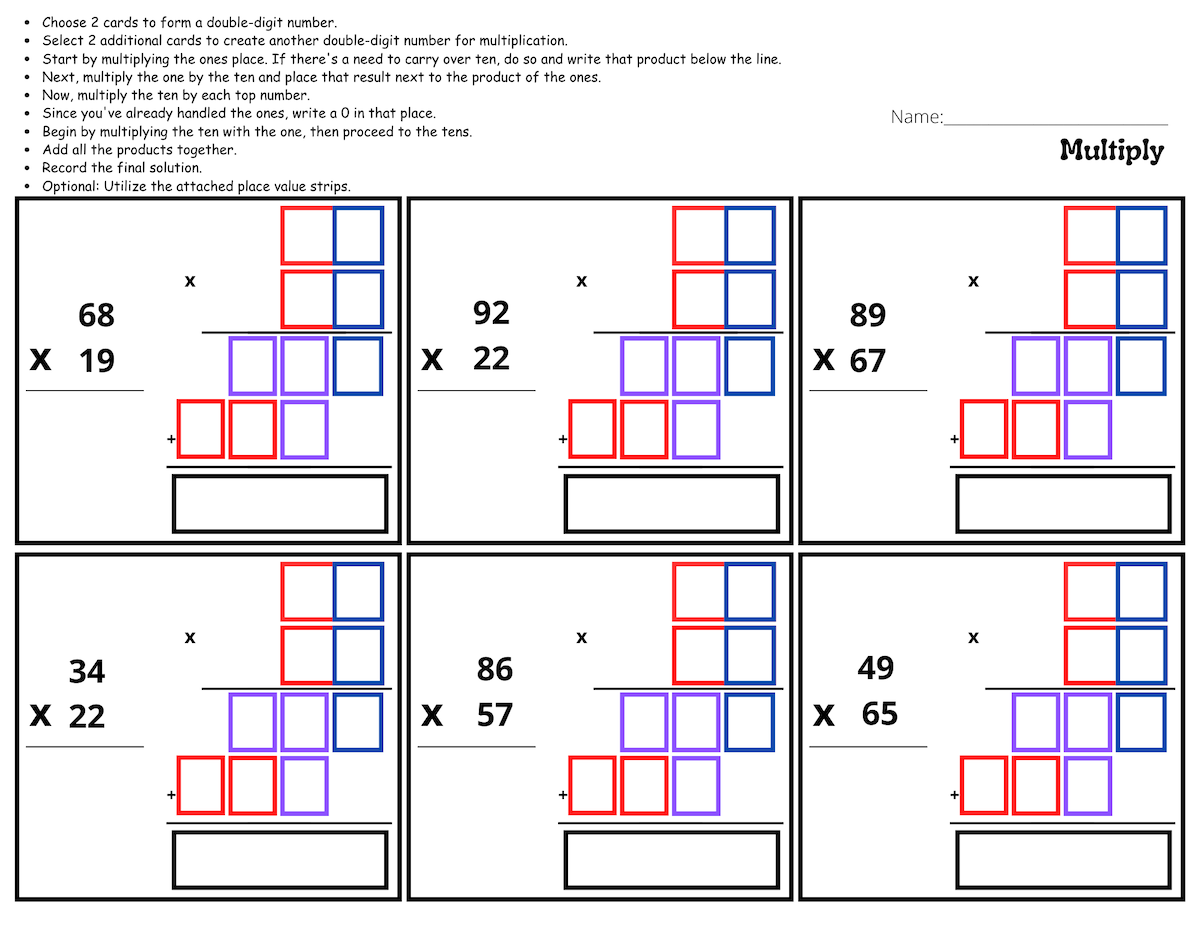
- When performing double-digit multiplication, start by multiplying the ones place with all the digits. After this step, place a 0 in the ones place to indicate that you have completed the multiplication for that position and are now moving on to the tens to multiply to all the digits. Finally, add all the results together.
Visual-Spatial
- Area Model Exploration: Use grid paper to break down multiplication into smaller parts. For example, multiply 23 by 45 by splitting them into (20 + 3) and (40 + 5) and calculating each part separately before combining the results.
- Array Building with Blocks: Use small blocks or tiles to create arrays representing two double-digit numbers. For instance, to multiply 23 by 15, build a rectangle with 23 rows and 15 columns. This visual representation helps students understand the concept of area and multiplication.
- Grid Paper Exploration: Provide students with grid paper to draw rectangles that illustrate the multiplication process. They can shade in sections to represent tens and ones, helping them break down multiplication into manageable parts.
- Use Grid paper to solve problems. It will help keep numbers organized.
- Box out with different colors when multiplying each place value.
- Interactive Number Lines: Use a large number line and markers to represent increments of one of the numbers. For example, to multiply 34 by 12, make 12 jumps of 34 on the number line. This activity shows repeated addition, a fundamental multiplication concept.
- Distributive Property Investigation: Experiment with the distributive property by rewriting multiplication problems. For example, 34 x 56 can be broken into (30 + 4) x (50 + 6) and solved using smaller, more manageable computations.
- Number Line Method: Visualize multiplication on a number line. Investigate how repeatedly adding one number to itself, a specific number of times, aligns with double-digit multiplication.
- Lattice Multiplication: Explore the lattice method, drawing a grid and multiplying each digit separately, then adding diagonally to find the final product.
- Estimating and Rounding: Practice rounding numbers to the nearest ten before multiplying to estimate products. Compare these estimates to actual products to understand the impact of rounding.
- Pattern Discovery: Look for patterns when multiplying numbers with similar digits, such as 11 x 22, 12 x 21, etc. Discuss how these patterns can simplify calculations.
- Technology and Tools: Use calculators or online tools to verify results and explore how digital methods can assist in understanding multiplication concepts.
- Array Building: Use graph paper or digital apps to represent double-digit multiplication as arrays.
- Building Block Challenges: Use building blocks or LEGO to represent multiplication problems visually. Each block can represent a number, and students can build models to see the multiplication process.
- Math Art Projects: Encourage students to create artwork that represents multiplication problems. They can use grids or patterns to visualize how multiplication works.
Manipulatives:
- Duplo/Lego
- Magna-Tiles
- Base ten blocks (tangible, picture, or draw square, line, dots..)
- 100, 10’ s, 1’s coins
- Number Line
- Monopoly money/ Fake Money
- Number Bond
- Cards – playing cards or uno
- Dominoes
- Number tiles (like scrabble tiles)
- Beads (like Montessori but make your own)
- Grid Paper
- Ruler / Measuring Tape
- Beads/Beans
Bodily-Kinesthetic
- Math Relay Races: Teams solve double-digit multiplication problems as they race to complete each step.
- Floor Arrays: Use tiles or mats to physically build arrays representing multiplication problems.
- Multiplication Relay Races: Set up stations with different multiplication problems. Students race between stations, solving each one to move forward. This adds a physical and visual component to learning.
- Math Scavenger Hunt: Create a scavenger hunt with clues that are double-digit multiplication problems. Students work in pairs or small groups to solve each problem to find the next clue, promoting collaboration and discussion.
- Multiplication Hopscotch: Draw a large hopscotch grid on the playground. Each square contains a multiplication problem. Students must solve the problem before advancing to the next square. This combines movement with problem-solving.
- Interactive Math Stations: Set up stations around the classroom with different double-digit multiplication activities. Include puzzles, flashcards, and interactive whiteboards. Students rotate between stations, engaging in various kinesthetic tasks.
- Group Problem-Solving with Giant Dice: Use oversized dice to generate numbers for multiplication problems. Students work in groups to roll the dice, calculate the product, and discuss strategies. This promotes collaboration and movement.
Musical
- Multiplication Songs: Create jingles or raps to remember steps in double-digit multiplication.
- Pattern Beats: Assign beats to each digit and product when performing multiplication.
- Beat the Clock: Play upbeat music and challenge students to solve as many double-digit multiplication problems as they can before the song ends, maintaining a focus on accuracy and speed.
- YouTube: Sharon Rutter – Elementary, My Dear Schoolhouse Rock, Numberock – Multi Digit Multiplication Song, Numberock – Area Model Multiplication, Math Antics – Multi- Digit Multiplication, Leo Ramos – Multiplication Song, MashupMath – Area Model Multiplication
Interpersonal
- Peer Teaching: Students teach each other a double-digit multiplication method.
- Math Buddy Games: Solve partner-based games where two players must collaborate to find the answer.
- Group Challenges: Small groups compete to solve and explain problems effectively.
- Multiplication Bingo: Create bingo cards with products of double-digit multiplication problems. Call out equations, and players mark the correct answers on their cards. The first to complete a line wins.
- Flashcard Race: Use flashcards with double-digit multiplication problems. Players race against the clock to solve them. The fastest solver wins the round.
- Multiplication Board Game: Design a board game where moving forward requires correctly answering multiplication questions. Each correct answer advances the player, while incorrect answers may send them back.
- Math Jeopardy: Create a Jeopardy-style game with different categories for varying levels of difficulty in double-digit multiplication. Teams compete to answer correctly and earn points.
- Matching Game: Use cards with multiplication problems and their answers. Players must match the correct equation to its product. This can be done in a memory game style.
- Multiplication Relay: In teams, players solve problems one by one. Each correct answer allows the next team member to take their turn. The first team to finish all problems wins.
- Multiplication Board Games: Develop a board game where students advance by solving double-digit multiplication problems. Incorporate elements that require players to collaborate, such as teaming up to solve challenges or trading tips.
- Multiplication Grid Game: Create a large grid on the floor using tape. Each square contains a number. Students roll two dice to get a double-digit number and find the product on the grid. This encourages spatial reasoning and number sense.
- Card Multiplication: Use a deck of cards where each card represents a number. Draw two cards to form a double-digit number and multiply. This game enhances mental calculation and logical thinking.
- Wheel of products: Spin two wheels and multiply the numbers.
- War with cards: Flip multiple cards to great multiple digit numbers and multiply.
- Start with a deck of cards. Keep flipping cards and multiplying on until you get through the deck of cards or get over a certain target number.
- Make your own deck of cards of double digit or multiple digit number cards. Use this to play games.
- Pyramid of numbers: make a pyramid of numbers and multiply numbers adjacent or diagonal and once you find the correct product you can take the numbers off the board. (Alternatively use a whiteboard and erase the numbers going up.)
- Make a spiral game board and multiply the number to the number on the card or dice as you go around. Goal is to reach the opposite end.
- Make snakes and ladders, dice games, spiral games, etc.
Intrapersonal
- Self-Paced Puzzles: Provide choice boards with problems and allow students to select their own pace.
- Reflection Journals: Write reflections about which multiplication strategies felt easiest.
- Dice Roll Multiplication: Have students roll two 10-sided dice to generate double-digit numbers, then use counters or chips to create arrays for the resulting multiplication problem. This adds an element of chance and excitement to the learning process.
- Personalized Math Puzzles: Create puzzles that require solving double-digit multiplication problems. Allow learners to work on these puzzles individually, encouraging them to find patterns and connections.
- APPS: IXL, Khan Academy Kids, Khan Academy, Duck Duck Moose Bingo
- Online: Arcademics – Canoe Penguins 2×1 digit, MathPlayground – Brain Workout Missing Digit, Funbrain – Math Baseball, word wall, ToyTheater – Combo Multiplication Game
Naturalistic
- Outdoor Arrays: Create multiplication arrays using natural objects like stones, leaves, or sticks.
- Nature Product Sorting: Solve real-world problems like calculating totals of seeds or plants in rows.
- Interactive Technology Tools: Use educational software or apps that simulate hands-on multiplication activities. These tools often include interactive features that allow students to manipulate numbers and visualize the multiplication process dynamically.
- Leaf Pile Multiplication: Collect leaves and use them to form piles that represent multiplication problems. For instance, make two piles of 15 leaves to show 15×2.
- Math Nature Trail: Design a nature trail with multiplication challenges posted along the way. Use natural elements to illustrate different problems and encourage students to solve them as they walk.
- Garden Plot Problems: If you have access to a garden or plant area, use plots to illustrate multiplication. Plant seeds in rows and columns, discussing how the arrangement represents double-digit multiplication.
Double-digit multiplication is more than just numbers—it’s an opportunity to inspire curiosity, critical thinking, and confidence in young learners. By incorporating activities tailored to various intelligences, educators can foster a love for math through collaboration, creativity, and real-world connections. This collection of games, investigations, and interactive tasks not only strengthens multiplication skills but also encourages students to see math as an integral part of their world. Dive in, explore, and watch your students multiply their knowledge—and their enthusiasm—for math!
Get Your Multiple-Digit Multiplication Concepts and Games Packet:
Multiple-Digit Multiplication
Over 70 Pages of Concepts & Games Already Made Up

@engagethestages