
Rounding numbers is more than just a foundational math skill—it’s a practical tool used in everyday life, from estimating grocery bills to managing time effectively. However, teaching this concept in a way that resonates with diverse learners can be challenging. To bridge this gap, educators can harness the power of multiple intelligences, incorporating activities that cater to logical thinkers, budding artists, kinesthetic movers, and musical minds alike. By infusing creativity, movement, and real-world applications into rounding lessons, students not only grasp the concept but also enjoy the learning process.
Logical-Mathematical Intelligence
- Rounding Relay: Give teams a series of numbers to round to the nearest 10, 100, or 1,000. Teams race to correctly solve the list.
- Number Line Challenge: Place large number lines on the floor. Call out a number and the place to round. Students must stand on the correct rounded number.
- Interactive Rounding Chart: Have students create an interactive rounding chart using sticky notes. They can write numbers on sticky notes and place them on a large poster. As they round each number, they can move the sticky notes to their rounded position, creating a visual and tactile learning experience.
- Interactive Rounding Puzzles: (Pre-cut puzzle pieces with numbers and their rounded counterparts.) Create puzzles where students match a number to its rounded form. They can work in pairs or small groups, discussing the reasoning behind their answers as they piece the puzzle together.
Linguistic Intelligence
- Rounding Riddles: Create riddles like, “I am closer to 30 than 20, and I round to 30. What number am I?” Students solve or write their own.
- Story of a Number: Students write a short story about a number traveling to its nearest 10, 100, or 1,000.
- “If it’s 5 or more, let it soar; if it’s 4 or less, let it rest”
- Rounding Riddles: Create a set of riddles or clues that lead to specific rounded numbers. For example, “When rounded, I become 50. What number am I?” Students can work in pairs to solve these riddles and write their own to share with classmates.
- Rounding Storybook: Have students write a short story or a poem that incorporates rounding numbers into the narrative. For example, they could write about a character who needs to round numbers to complete a task, like sharing candies among friends. This encourages creativity while practicing rounding.
- Number Line Poetry: Create a large number line in the classroom and have students write poems or sentences about numbers that need rounding. They can place their writing at the corresponding point on the number line.
- Rounding News Report: Assign students to be news reporters who must report on “breaking news” involving rounding numbers. They can create a skit where they round numbers related to fictional stories, such as populations, distances, or scores, turning math into a storytelling experience.
- Create a Rounding Dictionary: Students can create a “rounding dictionary” where they define rounding terms and provide examples. They can include illustrations, synonyms, and sentences using rounded numbers, which reinforces both language and math skills.
Books:
- Let’s Estimate – David A. Adler
- Sir Cumference and the Roundabout Battle
- Betcha! – Stuart J. Murphy
- Coyotes All Around – Stuart Murphy
Bodily-Kinesthetic Intelligence
- Rounding Hopscotch: Draw a hopscotch grid with rounded numbers. Read a number aloud, and the student jumps to the correct rounded square.
- Human Number Line: Students hold number cards and arrange themselves in a line. One student is the “rounder” who moves to the closest multiple.
- Create a large number line on the floor using tape. Give students various numbers to round, and have them physically place markers (like small cones or colored paper) at the correct rounded locations on the number line. For example, if rounding 23 to the nearest ten, they would place a marker at 20.
- Fill a jar with a certain number of small objects (like marbles or counters). Have students estimate how many objects are in the jar and round their estimates to the nearest ten or hundred. Afterward, they can count the actual number of objects and discuss how close their estimations were.
- Set up a relay race where students are divided into teams. Place a list of numbers at one end of the room. One at a time, students will run to the list, pick a number, round it, and run back to their team to share the rounded number. The team that correctly rounds the most numbers in a set time wins.
- Rounding Relay Race: (Large number cards (1-100), cones or markers for a relay course.) Set up a relay course with cones. Place number cards at different stations. In teams, students race to a station, pick a number card, and round it to the nearest ten or hundred before running back to tag the next teammate. The team that correctly rounds the most numbers in a set time wins.
- Rounding Bingo: (Chalk (for outdoor play) or tape (for indoor play) to create a number line, number cards.) Draw a large number line on the ground. Scatter number cards around. Students hop to a number on the line, pick a card, and round it to the nearest ten or hundred before hopping back to the start. They can also discuss why the rounding is correct.
- Rounding Around the Room: Create a scavenger hunt with cards hidden around the room, each containing a number to round. Students work in pairs to find the cards, round the numbers, and write down the answers. After finding all cards, they share their answers with another pair for peer review. Discuss as a class to reinforce concepts.
Visual-Spatial Intelligence
- Rounding Art: Have students create a color-coded chart or poster showing numbers and their rounded values.
- Rounding Diagram Puzzle: Give puzzle pieces with numbers and their rounded forms for students to match visually.
- Number Line with Clothespins: (String, clothespins, number cards.) Hang a string across the board and clip number cards at equal intervals (e.g., 0, 10, 20). Give students numbers on smaller cards and have them clip them in the correct position to decide if they round up or down.
- Rounding Roller Coaster: (Paper template of a hill (roller coaster), marbles.) Place a marble at the number in question. If it is below 5, it “rolls back down” (rounds down). If 5 or above, it “rolls forward” to the next ten.
- Place Value Blocks: (Base-ten blocks.) Build the number with blocks. Ask students to see if the ones (or tens) are closer to rolling up or down to the nearest ten or hundred.
- Rounding Cups Toss: (10 labeled cups (0-9), small beanbags.) Students toss a beanbag into a cup. That digit determines whether you round the number up or down based on the rounding rule (0-4 down, 5-9 up).
- Rounding Dice Game: (Number cubes (0-9), rounding chart.) Roll dice to make a number. Students round it to the nearest ten, hundred, or thousand using the dice result as the deciding digit.
- Interactive Rounding Wheel: (Spinner or wheel divided into sections 0-9.) Spin the wheel to determine the rounding digit. Students place a marker on the nearest ten or hundred based on the result.
- Stacking Cups Tower: (Plastic cups labeled with numbers.) Stack cups to form a tower for the number. If the last digit is 0-4, remove cups to round down; if 5-9, add cups to reach the next round number.
- Rounding Hopscotch: (Hopscotch grid with numbers.) Students jump to the nearest ten or hundred based on the number they are given, physically embodying the rounding decision.
- Sticky Note Number Line: (Sticky notes, floor space.) Place sticky notes on the floor to form a number line. Students stand on a number and move to the nearest ten/hundred based on the rounding rules.
- Rounding Bingo: (Bingo cards with rounded numbers, calling cards with original numbers.) Call out a number. Students round it correctly and mark the rounded number on their Bingo card.
- To round a number, first underline or highlight the digit you are rounding to (for example, underline the hundreds place). Then, draw an arrow pointing from that digit to the number immediately to its right.
- Rounding Number Line: Create a number line on a large piece of paper or a whiteboard. Mark whole numbers and demonstrate how to round a number by showing where it falls on the line. For example, if rounding 34, show that it is closer to 30 than 40.
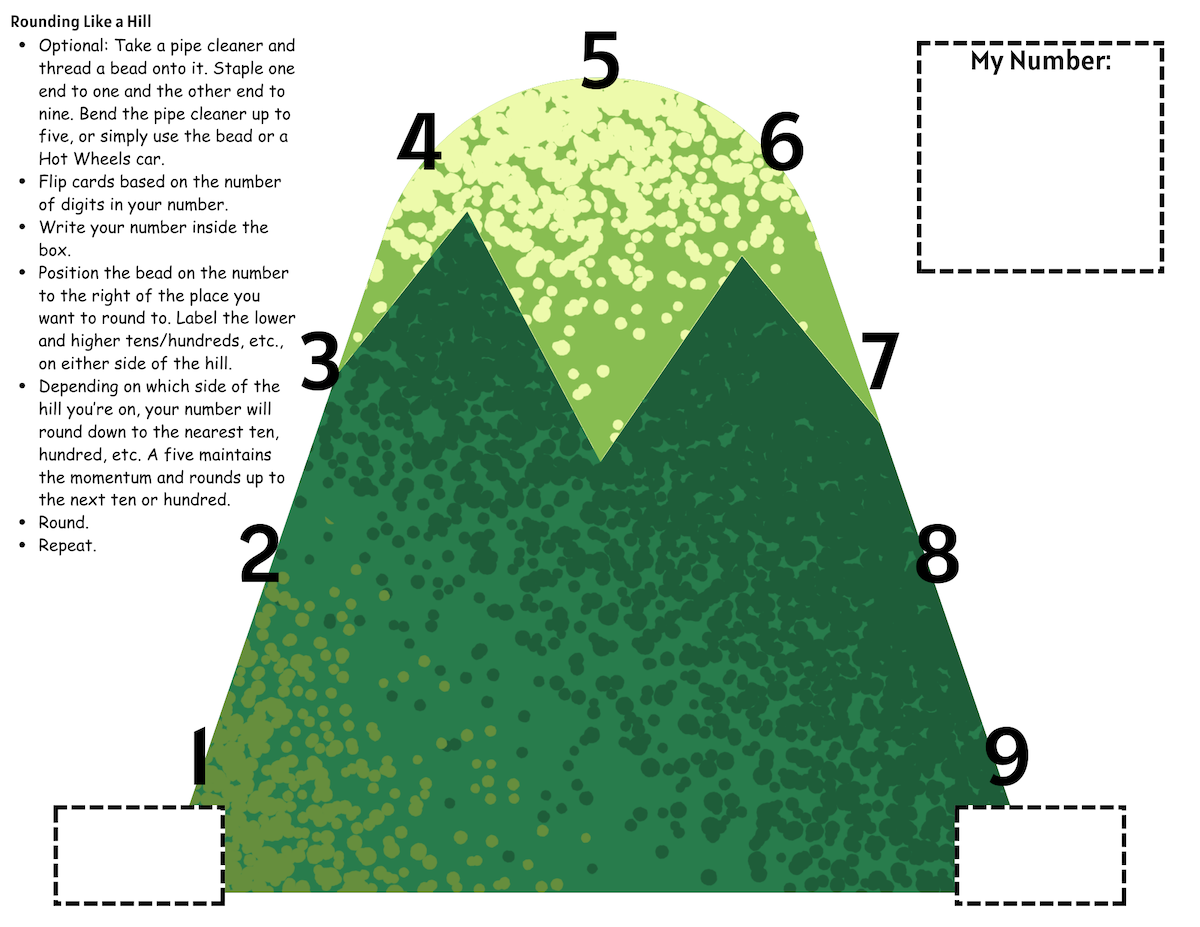
- Rounding Like a Hill: Take a pipe cleaner and thread a bead onto it. Staple one end to one and the other end to nine. Bend the pipe cleaner up to five, or simply use the bead or a Hot Wheels car. Flip cards based on the number of digits in your number. Position the bead on the number to the right of the place you want to round to. Label the lower and higher tens/hundreds, etc., on either side of the hill. Depending on which side of the hill you’re on, your number will round down to the nearest ten, hundred, etc. A five maintains the momentum and rounds up to the next ten or hundred. Round.
- Rounding Number Line: Create a number line on a large piece of paper or a whiteboard. Mark whole numbers and demonstrate how to round a number by showing where it falls on the line. For example, if rounding 34, show that it is closer to 30 than 40.
Manipulatives:
- Duplo/Lego
- Base ten blocks (tangible, picture, or draw square, line, dots..)
- 100, 10’s, 1’s coins
- Number Line
- Monopoly money/ Fake Money / coins
- Cards – playing cards or uno
- Dominoes
- Number tiles (like scrabble tiles)
- Beads (like Montessori but make your own)
- Tens Frame
- Hundreds Chart
- Ruler / Measuring Tape
- Beads/Beans … etc
Musical Intelligence
- Rounding Chant: Teach a chant or song about rounding rules (e.g., “5 or more, raise the score; 4 or less, let it rest”).
- Beat the Round: Clap or tap rhythmically as students call out the correct rounded number in time with the beat.
- Musical Number Line: (A large number line drawn on the ground or wall, music player.)
- Play music and have students dance around the number line. When the music stops, call out a number, and students must move to the nearest rounded number on the line. Discuss why they chose that rounded number.
- Rounding Songs: (Instruments, lyrics paper.) Have students create their own songs about rounding numbers. They can use familiar tunes and change the lyrics to include rounding rules and examples. Perform these songs for the class.
- Dance of the Rounding Numbers: Teach students a simple dance that incorporates movements representing rounding up and rounding down. For example, jumping up for rounding up and squatting down for rounding down. This kinesthetic activity will help reinforce the concept through movement.
- YouTube: Numberock – Rounding Numbers Song, The Singing History Teachers – Rounding, Patricia Enriquez – We will round you!, MrAguilarTX – Rounding Rap, Mr. DeMaio – How to Round to Tens & Hundreds
Interpersonal Intelligence
- Pair and Share Rounding: Students work in pairs. One gives a number, the other rounds it, and they switch.
- Team Rounding Race: Teams solve rounding problems collaboratively on the board or with cards.
- Rounding Hopscotch: Draw a hopscotch board with numbers. Call out a number, and students hop to the nearest 10 or 100 based on rounding rules.
- Number Line Walk: Create a large number line on the floor. Call out a number, and students walk to the closest tens or hundreds position.
- Rounding Compass: Place arrows on the floor labeled with directions like “Round Up” and “Round Down.” Students move to the correct direction depending on rounding.
- Rounding Corners: Place numbers in each corner of the room. Call out a number, and students run to the corner that represents the number it rounds to.
- Four Corners Rounding Challenge: Each corner is labeled with a rounded value (e.g., 10, 20, 30, 40). Say a number, and students move to the correct corner.
- Rounding Relay Race: Teams receive numbers on cards. They run to post their card under the correct rounding station (nearest 10, 100, etc.).
- Rounding Scavenger Hunt: Hide numbers around the room. Students find a number and move to the spot showing its rounded value.
- Direction Dice Rounding: Roll a number cube and a direction cube (Up, Down, Left, Right). Students move in that direction if they round up or down.
- Human Number Line: Students hold number cards and stand in a line. A caller says a number, and the “human number line” shifts or points to where it should round.
- Simon Says Rounding: Use a “Simon Says” format: “Simon says step forward if 46 rounds up” or “Simon says step right if 82 rounds down.”
- Roll a die to determine how many digits your number will have. Place the corresponding number of cards or roll the same number of dice. Read your number out loud. Document your answer on the chart. Use a paper clip to spin the wheel; round your number to the nearest place value that you land on. Write down the rounded number.
- Rounding Dice Game: Provide students with a set of dice. Have them roll two dice to create a two-digit number. Students will then round the number to the nearest ten or hundred, depending on the focus of the lesson.
- Clear the board with rounding numbers. Instead of 1-10, have 10-100 by tens or by 100-1000 by thousands.
- WAR – flip 2-3 cards to make multiple digits and round to the nearest ten, hundred, etc.
- Rounding Jeopardy: Create a Jeopardy-style game with categories for different rounding rules (e.g., nearest ten, nearest hundred). Players take turns choosing a category and answering questions based on rounding numbers.
- Rounding Pictionary: Write different numbers on slips of paper. One player draws a slip and rounds the number out loud while others guess the original number based on its rounded form.
- Rounding Relay Race (Number cards, a timer, and markers for scores.): Create a set of cards with various numbers (e.g., 23, 47, 89.5, etc.). Divide the class into teams and place the number cards at one end of the room. On “Go!”, one player from each team races to pick a card, rounds the number (to the nearest whole number or tenth), and writes down the answer on a scoreboard. After writing the answer, they return to tag the next player. The team with the most correct answers at the end of the race wins.
- Rounding Bingo: (Bingo cards with rounded numbers, markers, and a list of numbers to call out.): Create Bingo cards with rounded numbers (e.g., 30, 50, 100). Call out various numbers (e.g., 28, 52, 99) and ask students to round them to the nearest ten or hundred. Students place a marker on the corresponding rounded number on their Bingo card.
- The first to complete a row or column shouts “Bingo!” and must explain their rounding choices to win.
- Rounding Number Line Walk: (A large number line drawn on the floor with tape and number cards.) Tape a large number line on the floor ranging from, for example, 0 to 100. Give students number cards randomly. Students must walk to the correct place on the number line where their number would round to the nearest ten or hundred. Discuss as a group why each number falls where it does on the number line.
- Rounding Scavenger Hunt: (Clue cards with numbers, rounding worksheets, and a prize.) Hide clue cards around the classroom or playground, each containing a number. As students find each clue, they must round the number and complete a worksheet that connects to that number (e.g., rounding and then using it in a word problem). Once they complete the worksheet, they can move on to find the next clue. The first group to finish all clues and worksheets wins a prize.
- Rounding Dice Game: (Dice or number cubes, paper, and pencils.) Students roll two dice: one for the tens place and one for the ones place (or use a decimal die for rounding to the nearest tenth). They create a number from the dice roll and round it to the nearest ten or hundred.
- Each student or team keeps track of how many correct rounds they achieve over several rounds of play. Add a twist by having students explain their reasoning after each roll.
- Rounding Cooking Challenge: (Recipe cards with various measurements, measuring cups, and ingredients.) Provide students with recipes that require rounding measurements (e.g., 1.7 cups of sugar rounded to 2 cups). Divide them into small groups and have them prepare a simple dish while rounding the ingredients needed. After cooking, students must present their dish and explain their rounding process.
- Rounding Board Game: Design a board game where players advance by correctly rounding numbers. Players can draw cards with different numbers and must round them to the nearest ten or hundred to move forward. Create fun challenges or questions related to rounding to keep the game exciting.
Intrapersonal Intelligence
- Rounding Reflection Journal: Students write about how they know which way to round and any strategies that help them.
- Rounding Flashcards: Create flashcards with different numbers on one side and their rounded counterparts on the other. Use these cards for group games, where participants have to quickly show the rounded version of a number.
- Interactive Rounding Worksheets: Design worksheets that require students to cut out numbers and glue them in the correct rounded position on a chart. This hands-on activity reinforces their understanding of rounding.
- Games: APPS: IXL, Khan Academy Kids, MathSeeds (on reading eggs)
- OSMO: Fish (number tiles), Math Wizard (Magical Workshop), Pizza
- Online: ten frame -Round 3- Digit Numbers, MathNook – Rounding Games, Arcademics – Tandem Turtles, Math Playground – Bin, Bing, Bingo, Math Playground – Space Jaunt
Naturalistic Intelligence
- Nature Number Hunt: Use real-world examples like tree counts, leaf numbers, or animal groups. Students round their findings.
- Rounding in the Wild: Show pictures of natural groups (e.g., 23 birds). Ask students to round to the nearest 10 or 100.
- Have students collect real-life data, such as prices of items in a store, distances traveled, or populations of cities. They will round these numbers and then create a poster or presentation to showcase their findings, discussing why rounding is useful in those contexts.
- Present students with story problems that involve rounding numbers in real-life situations (like shopping, travel distances, or Mountain sports statistics). Students can work in pairs or small groups to solve the problems and explain their reasoning for the rounding choices they made.
- Provide students with recipes that require rounding measurements (e.g., 1.7 cups of sugar
- rounded to 2 cups). Divide them into small groups and have them prepare a simple dish while rounding the ingredients needed. After cooking, students must present their dish and explain their rounding process.
- Rounding Rocks: Use small rocks or pebbles. Label some rocks with numbers, and when it’s time to round, ask students to physically place the rocks closer to the nearest ten or hundred on a marked line or designated area.
- Rounding Art Project: (Colored paper, scissors, glue, and markers.) Students create a collage or poster that visually represents rounding. They can cut out numbers from magazines, round them, and glue them onto their project, showing both the original and rounded numbers alongside illustrations.
- Rounding Role Play: Assign students roles in a mock store (cashier, customer, manager). Create scenarios where customers need to buy items priced with decimals (e.g., $1.49, $2.75). Students must round the prices for transactions and discuss the impact of rounding in budgeting. After role-playing, have a group discussion on their experiences and the importance of rounding.
- Have students collect data (e.g., prices of items, distances, or temperatures) and round these numbers to the nearest ten, hundred, or thousand. They can present their findings in a creative format, like a poster or a digital presentation, reflecting on their rounding process.
- Nature Number Hunt: Students will go on a nature walk to collect items. Each item will be assigned a number based on its characteristics (e.g., the number of leaves on a branch). Back in the classroom, students will round these numbers to the nearest ten or hundred and write down their findings.
- Rounding Nature Art: Have students create an art project that incorporates rounding. For example, creating a “Rounding Tree” where the trunk represents a number, and the branches represent rounded numbers. Each branch can have a different color representing different rounding rules (rounding up, rounding down). Students can explain their projects to the class, reinforcing their understanding of rounding.
- Estimation Stations: Set up several stations with different nature items for students to estimate quantities. Students will estimate how many items are in each station, then round their estimates to the nearest ten or hundred. After rounding, they can count the actual items to see how close their estimates were, discussing the importance of rounding in real-world contexts.
- Shopping and Budgeting: When calculating expenses, people often round prices to the nearest dollar to simplify budgeting. For instance, if groceries cost $47.89, someone might round it to $48 when estimating total spending.
- Time Management: When scheduling, people often round time. If a meeting is set to last 1 hour and 15 minutes, one might round it to 1.5 hours when planning.
- Distance and Travel: When calculating travel distances, individuals might round distances to the nearest mile or kilometer. For example, a trip that is 12.7 miles might be rounded to 13 miles.
- Sports Statistics: In sports, statistics such as batting averages or scoring averages are often rounded. A basketball player with a shooting percentage of 45.67% might be reported as having a 46% shooting average.
- Finance and Investments: When discussing interest rates or investment returns, people often round percentages for clarity. An interest rate of 3.75% might be rounded to 4% when comparing options.
- Weather Forecasts: Meteorologists often round temperature forecasts. If the temperature is expected to be 72.3°F, they might report it as 72°F.
Incorporating a variety of interactive rounding activities ensures that every student finds an approach that aligns with their learning style. Whether it’s hopping through a rounding relay, solving riddles, creating number art, or singing a catchy chant, these strategies make rounding both meaningful and memorable. By embracing these diverse methods, educators can foster a deeper understanding and appreciation for math, transforming rounding from a routine task into an engaging and essential life skill.
Get Your Rounding Packet!
Rounding Numbers
Over 15 Pages!

@engagethestages
Leave a Reply