

Understanding addition is fundamental in building a strong mathematical foundation for students. Different math investigations and concepts provide varied strategies to develop these essential skills. Engaging students through interactive, hands-on activities fosters not only comprehension but also enjoyment in learning. This guide explores a variety of methods to teach addition and the count on method, each designed to cater to different learning styles and preferences. Whether using physical objects, visual aids, or mental strategies, these activities help students grasp the concept of combining numbers to find a total.
9 Different Ways to Understand Addition Conceptually
- Head and Fingers: Begin by placing the larger number in your mind while using your fingers to represent the smaller number. Count up from the larger number.
- Number Line: Attach a string or pipe cleaner along a number line, threading one bead before securing it. Alternatively, use a frog, beads, Cheerios, or LEGO pieces with holes to move between numbers. Incorporate dice or playing cards (like Uno or a standard deck) for the numbers to add. Start with the first card/die number and position your bead on that number, then add the next number to find the total.
- Adding with Objects: Place a number tile or card down. Flip another card and gather that many objects to add on, placing them next to the initial number. State the number, then count the objects to arrive at the answer.
- Make Your Own Scale: Gather a hanger, two paper cups, and string to create a scale. Use the string to attach the cups to the hanger, then hang it on a bar. Position an equation next to one cup. Fill the other cup with the corresponding number of beans, Duplo blocks, etc., and cover it with a tissue to conceal the quantity. Solve the equation and add the manipulatives to the cup containing the equation. Check if the hanger balances, verifying the quantities are equal by looking under the tissue.
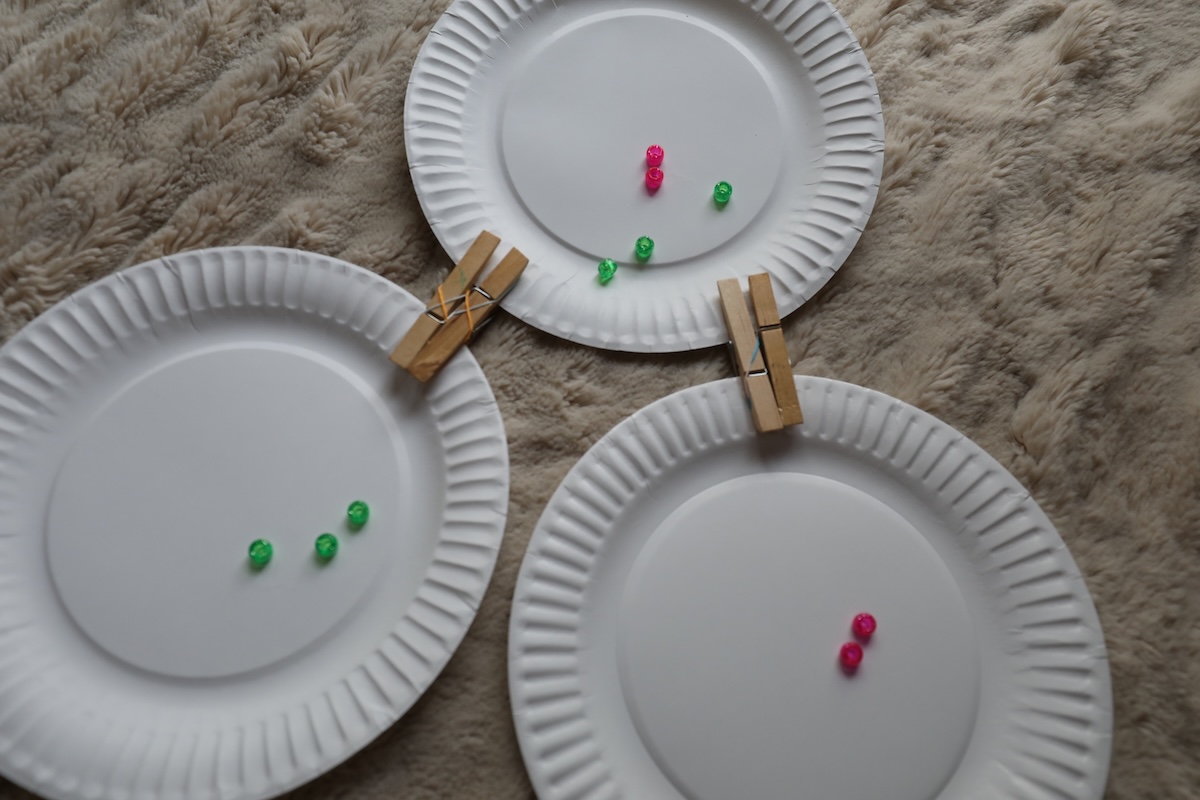
- Number Bond: Create a number bond using cups or plates as circles connected by sticks. Select two cards and place differently colored objects representing those numbers at the top. Combine the correct sum in the middle. For instance, if you draw a two and a three, use yellow and blue objects to represent them, then combine them in the middle to understand that 2 + 3 = 5.
- Math Ten Frame: Utilize two distinct colored counters, heads/tails coins, red/black cards, or beads to place within a ten frame. Use this frame to solve equations. Position the total amount of objects for one of the numbers, then add the smaller number to see how many you have in total.
- Adding with a Hundreds Chart: Use the hundreds chart to solve addition problems by starting at one number and adding the second number.
- Using Duplo: Choose two different colors for each number and stack them on top of each other. Start with one color, state the number, and then count on with the next color.
- Part & Part = Whole
- Variation 1: Flip one or two cards and place them at the top in “whole.” Determine which two numbers add up to the top number.
- Variation 2: Flip two cards and assign each to the bottom in “part.” Calculate their total and place the answer at the top.
- Variation 3: Flip one or two cards for the top and one card for the bottom. Place the larger number on top in “whole.” Find the missing number by subtracting the bottom number from the top or by figuring out what needs to be added to the bottom number to find the missing number.
- Variation 4: Flip one or two cards. Use that quantity of objects (like beans) at the top. Then, get the same number of objects (like Duplo or Legos), split them between the two bottom parts, create different equations, and keep a record.
In conclusion, these diverse math investigations and concepts not only enhance students’ addition skills but also cultivate problem-solving abilities and mathematical thinking. By incorporating a variety of strategies, educators can meet the diverse needs of their students, making learning math both effective and enjoyable. Encouraging exploration, practice, and discussion around these activities will help solidify foundational math skills and build confidence in young learners.
Get Your Adding By Counting On CONCEPTS Packet With 100 Pages:
Adding by Counting On Concepts & Investigations
100 Pages of Math Investigations and More Already Made Up

@engagethestages
Get Your Adding By Counting On Packet With Over 140 Pages:
Adding by Counting On Games
Over 140 Pages of Games Already Made Up

@engagethestages