

Introduction
Number bonds are an essential concept in early mathematics education, particularly when teaching counting on in addition. A number bond illustrates the relationship between a whole number and its component parts, helping children develop a deeper understanding of how numbers can be broken down and recombined. This visual and conceptual tool supports the development of mental math skills, number sense, and flexible thinking, all of which are foundational for more advanced mathematical concepts.
Why It’s Important
- Strengthens Number Sense: Number bonds help students understand how numbers relate to each other, forming the basis for recognizing patterns and relationships within numbers.
- Promotes Mental Math Proficiency: By internalizing number bonds, students can quickly and accurately perform addition without relying solely on counting each item individually.
- Encourages Flexible Thinking: Understanding that numbers can be decomposed and recomposed in different ways fosters adaptability in problem-solving and mathematical reasoning.
- Builds a Foundation for Advanced Concepts: Mastery of number bonds prepares students for future topics such as subtraction, multiplication, division, and algebra.
- Supports Diverse Learning Styles: The visual nature of number bonds, coupled with hands-on activities, benefits visual, auditory, and kinesthetic learners.
Steps to Incorporate Number Bonds in Learning Counting On
- Introduce the Concept with Real-Life Examples: Start with tangible objects. For example, “You have 4 blue marbles and 3 red marbles. How many marbles do you have altogether?” Show how these two parts create one whole.
- Use Visual Aids: Draw number bond diagrams with circles representing the whole and its parts. Place numbers in each section to show how parts combine to form the whole.
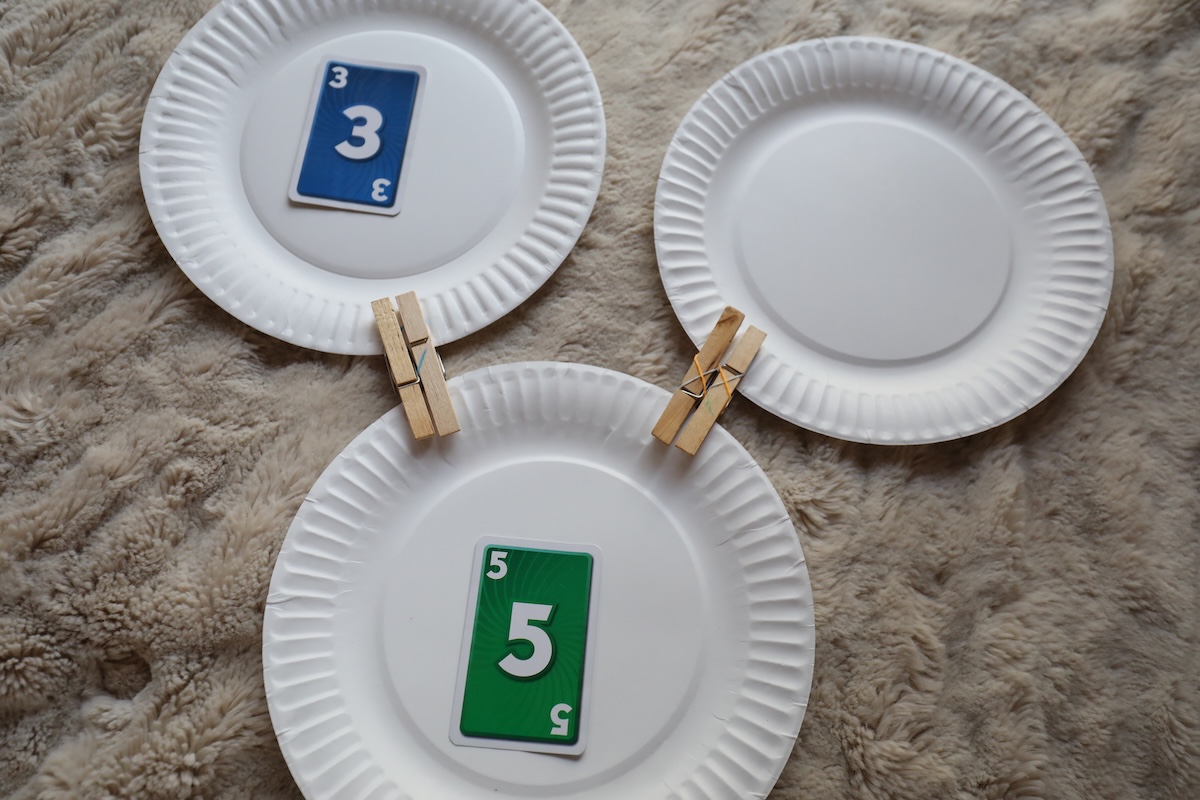
- Hands-On Manipulatives: Provide students with counters, blocks, or beads. Have them physically group objects to represent parts and combine them to find the whole. Use plates connected to sticks to have a hands on model.
- Guided Practice: Provide simple addition problems and guide students through identifying the parts and counting on to find the whole.
- Encourage Verbal Explanation: Ask students to articulate their thought process: “I know that 5 and 2 make 7 because 5 plus 2 equals 7.”
- Transition to Mental Math: Gradually shift from concrete objects to mental visualization of number bonds, encouraging students to solve problems without physical aids.
Games to Play When Learning Number Bonds in Addition
- Number Bond Match: Provide cards with different number bonds and separate cards with corresponding sums. Students match the parts with the correct whole.
- Build the Bond: Give students a whole number and have them find various combinations of parts using counters or blocks. Use plates and sticks to have a hands on model.
- Missing Part Mystery: Display a number bond diagram with one part missing. Students deduce the missing number by counting on from the known part.
- Dice Bond Challenge: Roll two dice to represent the parts and have students count on from the larger number to find the whole.
- Story Problems with Number Bonds: Create simple stories, such as “Emma has 6 stickers, and she gets 3 more. How many stickers does she have now?” Students use objects or drawings to represent the number bond and solve the problem.
- Bonds Hopscotch: Draw a large number bond diagram on the ground. Students jump into the “part” spaces, count on, and land in the “whole” space with the answer.
- Interactive Number Bond Puzzles: Provide puzzles where students fit parts into a whole, reinforcing the concept through engaging, hands-on activities.
Conclusion
Number bonds are a powerful strategy for teaching counting on in addition, helping students visualize and internalize the relationships between numbers. By using structured steps and incorporating interactive games, educators can create an engaging and supportive learning environment. Mastery of number bonds not only enhances addition skills but also lays a strong foundation for more complex mathematical concepts, fostering confidence and competence in young learners.
Get Your Adding By Counting On CONCEPTS Packet With 100 Pages:
Adding by Counting On Concepts & Investigations
100 Pages of Math Investigations and More Already Made Up

@engagethestages
Get Your Adding By Counting On Packet With Over 140 Pages:
Adding by Counting On Games
Over 140 Pages of Games Already Made Up

@engagethestages