
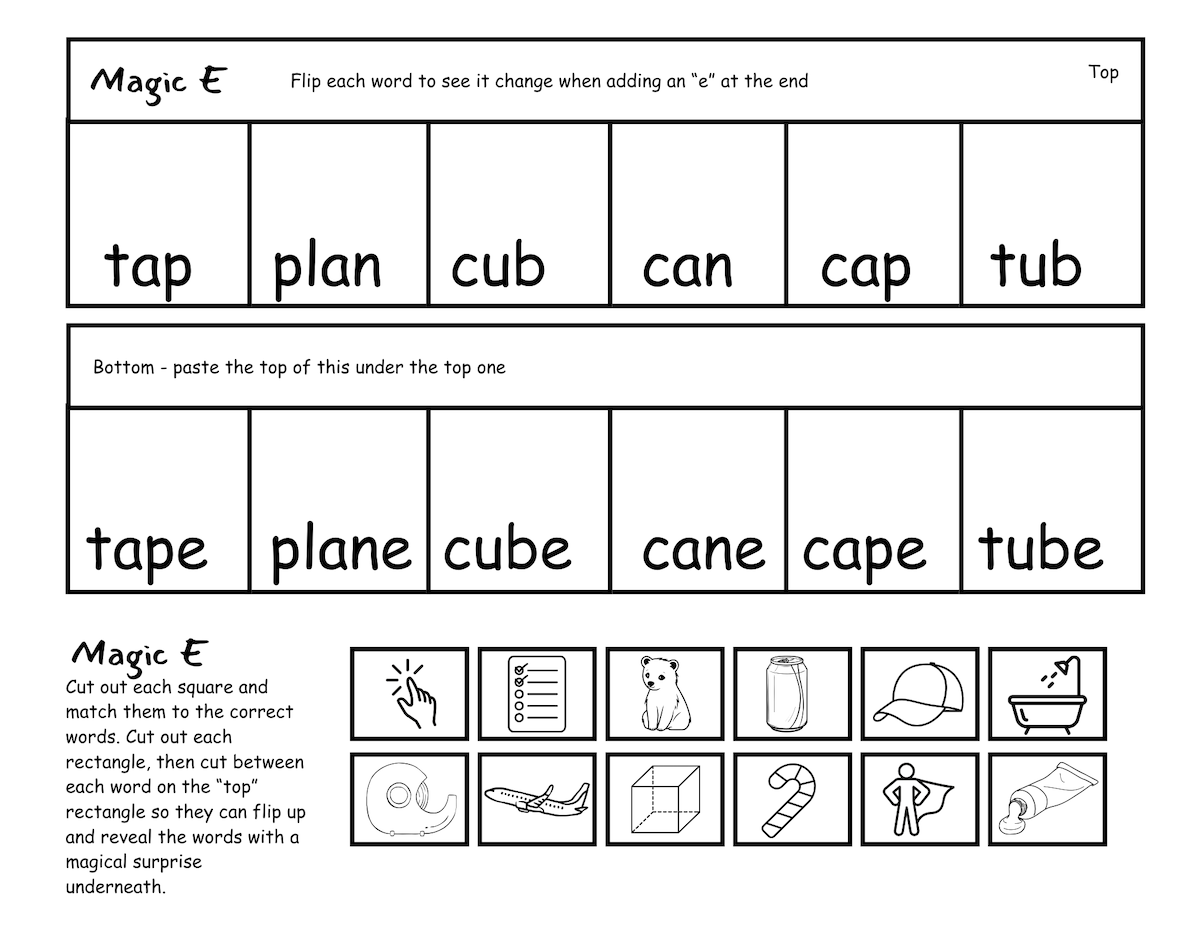
Teaching the concept of the “magic e” can be both challenging and rewarding. Many young learners struggle to grasp how this seemingly invisible letter transforms words by making vowels say their names—without ever being pronounced itself. Drawing inspiration from magical themes, like Harry Potter’s invisible cloak, educators can create captivating lessons that bring this phonics rule to life. By utilizing a variety of teaching methods aligned with Howard Gardner’s Multiple Intelligences framework, educators can cater to diverse learning styles, ensuring that every student has a chance to master the magic e.
4 Strategies for Teaching the Concept
- Explicit Instruction and Modeling
- Explain that “magic e” makes the vowel “say its name.”
- Demonstrate with side-by-side examples (kit → kite, hop → hope).
- Visual Anchors
- Use anchor charts showing word pairs with and without the magic e.
- Phonics Stories and Contextual Learning
- Read or create short stories emphasizing magic e words.
- Have students highlight or circle magic e words while reading.
- Multi-Sensory Approach
- Incorporate movement, writing, and speaking (ex. trace the e in the air while saying the new word).
Here are ways to teach magic e (silent e) using Howard Gardner’s Multiple Intelligences framework:
Linguistic Intelligence (Word Smart)
- Silly Story Writing: Have students write short stories filled with magic e words like “hope,” “cake,” and “ride.”
- Magic E Word Hunt: Search books or classroom materials for magic e words and list them.
- Decodable books
- Story Creation – Write short, silly stories using lots of magic e words and have the learner highlight or circle them.
- Read-Aloud Practice: Have students say the word before and after adding e to hear the vowel change.
- Play Wordle with CVC and CVCe words.
- Circle Maps.
- Spelling the words.
- Make your own books.
- Search and Find
Logical-Mathematical Intelligence (Logic Smart)
- Word Sorting Challenge: Sort words into CVC vs. CVCe (magic e vs no magic e: hug/huge) categories.
- Word Ladder Puzzle: Start with “cap” and transform it step by step to “cape,” “tape,” etc.
Visual-Spatial Intelligence (Picture Smart)
- Flip Cards Game: Show CVC and magic e word pairs like “hop” → “hope.” Visual learners can see the transformation.
- Color-Coded Word Sorts: Highlight the magic e in a bright color to emphasize its role.
- Word Ladder Posters: Display step-by-step changes on a chart for words like “cap → cape → tape.”
- Magic E Wand Activity – Use a small wand or pencil as the “magic e” that transforms a word. Place it at the end of a word to see how the vowel sound changes.
- Flip Cards Game: Use cards showing the transformation from CVC to magic e words. Or use a wand to put e at the end and say the new word.
- Rainbow: draw a rainbow from the e to the vowel it’s changing the sound of.
- Harry Potter’s invisible cloak: casts a spell on the vowel to say it’s name but you can’t say the e at the end
- Flip the Sound Game: Prepare cards with CVC words (cap, kit, hop). On the back, tape a small “e” card. Students read the CVC word first, then “flip the e” to see how the vowel changes (cap → cape).
- Magic E Craft: Create a paper “magic e” hat or crown. When students wear it, they “become the magic e,” making short vowels say their name.
Bodily-Kinesthetic Intelligence (Body Smart)
- Magic E Wand Activity: Move a wand or stick to the end of a word to “magically” change the vowel sound.
- Letter Tile Word Building: Physically add or remove letters to create new words.
- Whichever book number you’re on, call out a word from it. Child JUMPS says the word, then JUMPS to their side and says a rhyming word. For instance, “MATE” they could say “RATE” while jumping back and forth.
- Write with chalk on the ground (or print out the words) and say the word and have them run to it. For example: “tap” and “tape” on the floor and say “tape” and they run to that word. OR scatter printed out words around the table, have the child slap the corresponding word after you say it.
- Grab 7 letters or bananagrams letters and try to make as many words as you can in under a minute. Write to the side on a whiteboard or paper to record.
- Get some sand or play dough. Make the words with playdough or trace with your finger or a stick in the sand/dirt.
- Hide words around the room. Have the child look for the words and when they find it say the name of the word. If they can, find the tangible object. Variation 1: Scatter words around the room. When you say a word, they have to run to it. Variation 2: Say word with that sound and they have to run to that sound or word that is taped on the wall or floor. Variation 3: When they find a word – say it, write it, and draw a picture of it. 6. Get 3 bowls. Hide one object under one of the bowls or 3 different objects under each bowl. Put each new word on top of a bowl. Have the child say the word to see if they found the object they were looking for. Alternatively, hide the picture of the word under the bowl so they can check to see if they are correct.
- Play Twister. Put words on all of the colors. Call out a random color and have them pick a spot they haven’t done and say the word. If correct, then they can put their hand or foot down on that color. Or have a bowl of words and they can’t move until they say the word.
- Put pictures from *match the pictures* and put them in the correct labeled bags or bowls that are labeled with the CVC vs CVCe. Or sort words and pictures into different bags.
- Play musical chairs variation by placing words on the chairs, prompting children to say the word correctly when the music stops and repeat. If correct, take the word away. If wrong, keep the word in the circle.
- Have bags/bowls with sound focus on the front. Toss a ball/chip into a bag. Take out a word and read it. Or match pictures to the sounds and put them in the bags/bowls.
- Slap letters as sounding out a word. Or put out all sound cards and have to slap the doubles (find matching cards with the same sound) and say the sound correctly.
- Play GO FISH using sound cards or oh snap cards.
- Use the MAZE and make an accordion book and cut out all the pictures that have that sound and put in the book. All the ones that do not, put in the back.
- Utilize words for a GUESS WHO game.
- Challenge children to write as many words with a specific sound within a time limit.
- Write the digraph at the top of the paper for them to write under.
- Play Connect Four, with sounds on red/yellow chips requiring players to say the sound before placing a chip.
Musical Intelligence (Music Smart)
- Magic E Song or Chant: Create a catchy chant: “Magic e makes the vowel say its name!”
- Rhythm Reading: Clap out beats as you read CVC and CVCe pairs aloud.
- Youtube: English4abc, Little Fox, Kids vs Life, Phonics Garden, Abi online teach. Nessy Reading Strategy – Magic E, Kids vs Life – How to Read – Magic E. A_E
Interpersonal Intelligence (People Smart)
- Partner Word Games: Read CVC words, then add the silent e together and compare the sounds.
- Team Word Sort Races: Students compete to sort or build the most magic e words collaboratively.
- Flip Cards Game – Create cards with CVC (consonant-vowel-consonant) words on one side and the same word with a magic e on the other. For example, “cap” → “cape.” Flip and read both.
- Word Sorts – Sort words into two categories: with magic e and without magic e. Discuss the vowel sounds.
- Interactive Word Building – Use letter tiles or magnetic letters to build CVC words, then add an e and read the new word.
- Magic E Hunt – Go through books or magazines to find and list magic e words.
- Board Game Practice – Design a simple board game where players move forward by reading or creating magic e words correctly.
- Word Sort Races: Mix sets of CVC and CVCe word cards.
- Students race to sort them into “Short Vowel” and “Magic E (Long Vowel)” categories.
- Change the Word Relay: Teams compete to transform a list of CVC words into CVCe words that make sense (mad → made, pin → pine).
- Sound Guess!!! Cut out the sounds and place them in a bowl. One person selects a sound and puts it on their head. Their partner has to read the card and say the sound it makes. Next, the person with the card on their head tries to spell the word (letter) or write the word (letter) on their white board. Keep guessing the spelling until it is correct, taking turns. *For a variation, try playing Old Maid (print two copies of this page). Remember to say the word (sound) when putting down pairs. *Another variation involves placing a few sounds between two people. The adult or teacher says the sound or word, and the first person to grab the word or picture with the sound in it wins (you can add actions like jumping or clapping before sitting down and grabbing the answer). For example if you say MAT, they have two options and have to grab MAT not MATE. Alternatively, say a word and the first person to identify the sound in the word wins!
- Cut out the word cards and place them in a bowl. One person picks a card and holds it on their head, while their partner must say the word. The person with the card then tries to spell it out. Keep trying at the spelling until it’s correct, taking turns back and forth. (Use a whiteboard.)
- OH SNAP!! Put the words in a bowl and take turns picking one out to read aloud. If correct, keep it; if not, return it to the bowl. If you draw an “Oh SNAP” card, return all your cards. The player with the most cards at the end wins! (These words can also be used for the spin-a-sound game.)
- BINGO with words and pictures.
- Snakes and Ladders, BUMP, and Around & Around, with words in the spaces to practice reading.
Intrapersonal Intelligence (Self Smart)
- Word Journaling: Keep a personal notebook of magic e words discovered during reading.
- Khan Academy Kids, Reading Eggs, Duck Duck Moose Reading, Duck Duck Moose Word Wagon, Teach your Monster to ReadOSMO – Little Genius – ABC, OSMO – Words Classic (Junior) (ABC tiles)
Naturalistic Intelligence (Nature Smart)
- Magic E Scavenger Hunt: Hunt for magic e words in nature-themed books, magazines, or signs.
- Outdoor Word Challenge: Use sidewalk chalk to write magic e words and have students “hop” to the correct ones.
Mastering the magic e is an essential milestone in a child’s reading journey. Through explicit instruction, creative storytelling, engaging activities, and multi-sensory approaches, educators can demystify this phonics rule and make learning both effective and fun. Whether it’s waving a magic wand, singing catchy chants, or embarking on word hunts, the strategies highlighted here are designed to captivate students’ imaginations while reinforcing their literacy skills. With a little creativity and the right tools, teaching the magic e becomes an enchanting experience for both teachers and learners.
et Your Silent E Books!
Silent E Books
5 Decodable Books

@engagethestages
Get Your Silent E Activities!
Silent E Activities
Over 60 Pages!

@engagethestages